Can I Switch from a Student Visa to a Work Permit in Poland?
So, you’ve spent a good chunk of time hitting the books in Poland, maybe navigating the labyrinthine university system, exploring vibrant cities, and perhaps even falling a little bit in love with the pierogi. Now, as your studies wind down, the big question looms: "Can I just switch my student visa to a work permit here?" It's a common question, and let me tell you, it's a journey many expats embark on, often with a mix of hope and a fair bit of bureaucratic dread. This guide is here to shed light on how you can transition from student life to working life in Poland, detailing the steps, pitfalls, and practical advice you’ll need to make the leap successfully.
Understanding Your Current Status: Student Visa in Poland
Before we even think about a work permit, it’s absolutely crucial to understand the legal basis of your current stay. When you arrived in Poland to study, you likely did so on a national (Type D) visa issued for study purposes, or if you're an EU/EEA citizen, your situation is different and generally more straightforward. For non-EU/EEA citizens, this initial visa often leads to a temporary residence permit, known as a Karta Pobytu, granted specifically for educational pursuits.
What Your Student Visa Allows
A student visa and the subsequent temporary residence permit for study primarily allow you to reside in Poland for the duration of your academic program. While most student permits do allow a certain number of working hours per week (often part-time during studies and full-time during holidays), this is strictly an ancillary right tied to your student status. It's not a standalone work permit in itself.
Think of it this way: your right to work stems from your primary purpose for being in Poland, which is education. If that primary purpose ceases – i.e., you finish your studies or drop out – then the grounds for your stay, and consequently your right to work, are no longer valid. This distinction is paramount, because simply having worked part-time as a student does not automatically qualify you for a work permit or mean you can just "upgrade" your current permit. This is often a point of confusion and frustration for many international students.
The Importance of Your Residence Permit Karta Pobytu
Your Karta Pobytu (residence card) is your most important document in Poland, signifying your legal right to stay. For students, this card will explicitly state its purpose: "CEL WYDANIA: EDUKACJA" (Purpose of Issue: Education) or something similar. This is not just a formality; it dictates what you can and cannot do in Poland and what type of future permits you can apply for. If your Karta Pobytu is tied to your student status, it means that once you graduate or your enrollment ends, that specific basis for your stay expires. You don't get to keep it and magically morph it into a work permit.
It's also worth noting that the validity period of your student Karta Pobytu is usually aligned with your study program duration, or sometimes a bit shorter. Many students find themselves in a race against time, needing to secure a new legal basis for their stay before their student permit expires. Procrastination in this area can lead to serious complications, including potential overstay and even difficulties in future visa applications for Poland or other Schengen countries. Therefore, understanding the expiration date of your current permit and proactively planning your next steps is absolutely critical. For a deeper dive into this crucial document, you might want to read our guide on How to Get a Temporary Residence Permit (Karta Pobytu) in Poland (2027).
The Core Challenge: Transitioning from Student to Worker
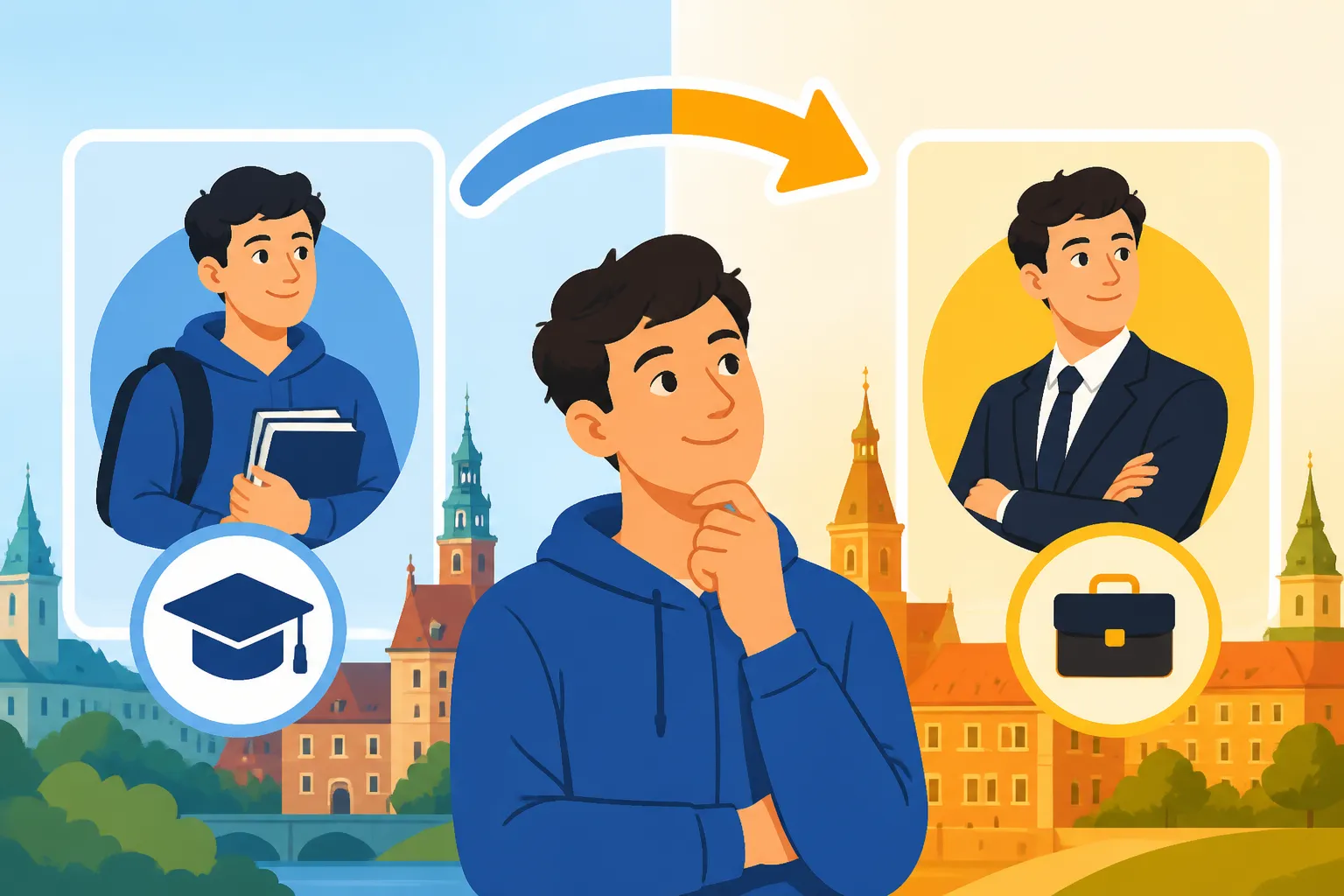
The idea of a direct "switch" from a student visa to a work permit is a common misconception, and frankly, it often leads to a lot of stress for expats. The reality in Poland, like in many countries, is that these are distinct categories of legal stay, each with its own requirements and application process. You're not typically just "updating" your existing status; you're applying for a new basis for your residency.
Why a Direct "Switch" Isn't Straightforward
When you're a student, your residence permit is granted based on your enrollment at a Polish educational institution. The moment you complete your studies, or even if your enrollment simply lapses, the underlying reason for that permit disappears. Polish immigration law does not usually allow for a seamless "conversion" from a student Karta Pobytu to a work-related Karta Pobytu without a new, comprehensive application process.
This means you can't just walk into the Urząd Wojewódzki (Voivodeship Office) with your diploma and ask them to change your permit's purpose. Instead, you'll need to gather a completely new set of documents, primarily focused on your employment rather than your education, and submit an entirely new application. It’s like starting fresh, but with the advantage that you’re already physically present in Poland, which saves you a trip back to your home country. Many an expat has been caught off guard by this, expecting a simple form to fill out, only to find themselves drowning in paperwork and Polish legal jargon.
The Need for a New Legal Basis for Stay
To transition from being a student to a worker, you need a new, valid legal basis for your stay in Poland. This almost always involves applying for a temporary residence permit for work purposes, which often comes bundled with a work permit in what's known as a "Single Permit." This permit type explicitly allows you to reside and work in Poland based on an employment contract with a specific employer.
The entire process hinges on having a concrete job offer. Without an employer willing to hire you and initiate the work permit application process, your options for staying and working legally after your studies become very limited. This is why securing a job offer before your student Karta Pobytu expires is paramount. It gives you the necessary time to prepare and submit your new application without the added pressure of an expiring permit.
It’s also important to understand that your new permit will be tied to that specific employer and position. If you change jobs later, you will likely need to go through another permit modification or even a new application process, which is another hurdle for expats to understand. This isn't a free pass to work anywhere; it's a permit specific to the role and company that sponsored it. Understanding this is key to successfully navigating the Polish employment landscape.
Pathways to a Work Permit After Studying in Poland
Alright, let's talk brass tacks. You've graduated, you're ready to put those hard-earned skills to use, and you want to stay in Poland. The good news is, it's entirely possible! But it requires foresight and a solid plan. The primary pathway involves securing employment, which then forms the basis for your new residence and work permit application.
Securing an Employment Offer
This is your absolute first step. Without a job offer from a Polish employer, the entire process grinds to a halt. Employers in Poland will often look to hire foreigners if they can't find suitable candidates within Poland or the EU/EEA, especially in sectors like IT, finance, and specialized services. Many international students successfully find roles by leveraging their Polish language skills (if they've learned any!), their international background, and their familiarity with the local market gained during their studies.
Start your job search early – ideally, six months to a year before your student permit is due to expire. Polish companies understand the visa process for international students, but it’s still your responsibility to present yourself as a valuable hire who can navigate the administrative side. Be proactive in reaching out to companies, utilizing job boards like Pracuj.pl, LinkedIn, and even local expat groups. Many companies, especially larger international corporations, are familiar with sponsoring non-EU citizens for work permits. When you're discussing potential employment, it’s absolutely essential to confirm that the employer is willing to sponsor your work permit. Don't assume anything; always ask directly. For tips on finding roles, our guide on How to Find English-Speaking Jobs in Poland could be a great resource.
Applying for a Work Permit and Temporary Residence Single Permit
Once you have that golden job offer in hand, your employer will typically initiate the process for obtaining a work permit on your behalf. In most cases, for non-EU citizens, this happens concurrently with your application for a temporary residence permit, leading to what’s called a "Single Permit" (zezwolenie na pobyt czasowy i pracę). This single document grants you both the right to reside and work in Poland.
Here's how it generally works:
- Employer's Role: Your employer will submit an application for a work permit (or a declaration of intent to employ you) to the local Urząd Wojewódzki (Voivodeship Office). They'll need to demonstrate that the position couldn't be filled by a Polish or EU citizen (this is the "labour market test," though certain professions are exempt, especially in IT).
- Your Role: Once the employer has their part of the documentation ready, you will submit your application for the Single Permit. This involves filling out extensive forms, providing copies of your passport, previous Karta Pobytu, job offer/contract, proof of sufficient financial means, and, crucially, proof of health insurance. Many expats opt for private health insurance providers like Cigna Global to ensure comprehensive coverage during this transition, as public NFZ coverage might have gaps or complexities.
- Submission: You submit your application package to the Urząd Wojewódzki in the region where you intend to live and work. Remember, booking an appointment can be a challenge – often requiring patience and quick fingers! For more details on the single permit, check out our piece on Understanding the Single Permit (Jednolite Zezwolenie) in Poland.
During the processing period, if your student permit expires and you have submitted a complete and correct application for a new permit before its expiry, your stay in Poland is generally considered legal while your new application is pending. You'll receive a stamp in your passport confirming this. However, this stamp doesn't grant you the right to work if your student permit has already expired and your new work permit hasn't been issued yet. This is a critical point of confusion: the stamp confirms legal stay, not legal work. Always consult with your employer's HR or a legal professional to understand your specific situation.
Considering Self-Employment JDG
Perhaps you’ve got an entrepreneurial spirit, or you've been freelancing during your studies and want to formalize it. Poland offers a path for self-employment through registering a Jednoosobowa Działalność Gospodarcza (JDG), which is essentially a sole proprietorship. This can also be a basis for a temporary residence permit.
However, moving from a student permit to a JDG-based residence permit is generally more complex than the employee route. You’ll need to demonstrate not only your intention to run a business but also its financial viability and that it will generate sufficient income to support yourself and, potentially, contribute to the Polish economy. You'll also need to prove you have adequate health insurance and sufficient funds to start and run the business.
This route requires a much more robust business plan and financial projections. It’s not simply a matter of registering a business; you must convince the immigration authorities that your JDG is a genuine, active enterprise. This option is often best pursued with the help of a Polish accountant or legal advisor specializing in business immigration. If this path sounds like it's for you, our guide on Self-Employment in Poland: The JDG (Sole Proprietorship) Guide for Foreigners will give you a detailed overview.
Navigating the Application Process
The Urząd Wojewódzki experience is a rite of passage for every expat in Poland. It can be a bureaucratic odyssey, filled with paperwork, long waits, and sometimes, a communication barrier that feels like an Olympic sport. But with preparation and patience, it’s manageable.
Gathering Essential Documents
The success of your application largely hinges on the completeness and accuracy of your documents. For a Single Permit application (work and residence), you'll need:
- Application Form: A thoroughly completed "Wniosek o udzielenie zezwolenia na pobyt czasowy i pracę" (Application for a Temporary Residence and Work Permit).
- Passport: Original passport and photocopies of all pages with stamps and personal data.
- Photos: Four current biometric passport-style photographs.
- Proof of Funds: Bank statements showing you have sufficient funds to cover your living expenses. This is usually determined by a certain amount per month, multiplied by the permit duration.
- Accommodation: Proof of a place to live in Poland (rental agreement, umowa najmu, or a zameldowanie confirmation).
- Health Insurance: Valid health insurance coverage for your stay in Poland. This could be from the NFZ (if your employer registers you) or a private policy. Many expats find private options like Cigna Global to be a reassuring choice, particularly during the uncertain waiting periods of permit applications.
- Employer Documents: This is where your employer's role is critical. They will provide:
- Your employment contract (umowa o pracę or umowa zlecenie).
- Information about the company and your position.
- The work permit (or a oświadczenie – declaration of intent to employ) issued by the Urząd Wojewódzki or Powiatowy Urząd Pracy.
- Proof that the labour market test was conducted (if applicable) or that the position is exempt.
- Previous Karta Pobytu: Your expiring student Karta Pobytu and the decision letter that granted it.
- Administrative Fee: Proof of payment for the application fee.
It's common for the Urząd to request additional documents or clarifications, so be prepared to respond promptly. Keep copies of everything you submit! If you want to dive deeper into the specifics, our guide How to Prepare Documents for a Karta Pobytu Application provides an excellent checklist.
The Urząd Wojewódzki Experience
Booking an appointment at the Urząd Wojewódzki can be challenging, especially in larger cities like Warsaw, Krakow, or Wroclaw. The online booking systems often require quick action the moment new slots are released. Be persistent! Some offices also allow walk-in submissions if you're prepared for a very long wait. You might even find yourself checking for appointments multiple times a day or early in the morning. Our detailed guide on How to Book an Appointment at the Urząd Wojewódzki for Immigration can help you strategize.
When you go for your appointment, ensure you have all your documents, originals, and copies. Bring extra passport photos just in case. The officials often speak some English, especially in larger cities, but it's always helpful to bring a Polish-speaking friend or an interpreter if you're not confident in your Polish. This can significantly reduce stress and miscommunication.
The waiting times for decisions can vary wildly, from a few months to over a year, depending on the Urząd and the complexity of your case. Be patient, but also don't hesitate to check the status of your application online (if available) or by sending a formal inquiry (zapytanie o status sprawy). Remember, as long as you submitted your complete application before your student permit expired, your stay is considered legal while it's pending. However, you typically cannot work legally until the new work permit is issued, unless specific exceptions apply (e.g., if you already had a work permit and are applying for its extension with a new employer). This distinction is critical and often misunderstood.
Practical Advice for a Smooth Transition
Making the move from student to professional in a foreign country is a significant life step. While the bureaucracy can be daunting, there are many things you can do to smooth the process and increase your chances of success.
Timing is Everything
I cannot stress this enough: start early. The single biggest mistake expats make is underestimating the time it takes to find a job, for an employer to process initial work permit documents, and for the Urząd Wojewódzki to make a decision.
- Job Search: Begin actively looking for jobs at least 6 months, if not 9-12 months, before your student Karta Pobytu expires. This gives you time to network, interview, and for your chosen employer to prepare their internal paperwork.
- Application Submission: Aim to submit your new Single Permit application at least 60-90 days before your current student permit expires. This is the sweet spot. If you submit it too late, you risk a gap in your legal status or having to leave the country. If you submit it too early, the Urząd might tell you to wait closer to your expiry date.
- Follow-Up: Don’t just submit and forget. Keep copies of all documents and correspondence. Politely follow up with the Urząd if you haven't heard anything within a few months. Remember the Polish saying: "Co nagle, to po diable" (What is sudden, is from the devil) – rushing things rarely works in administration.
Planning your move in advance can really save you a headache later down the line. If you're considering a move around Poland, perhaps even to a different city for work, companies like Sirelo can help with the logistics of international or domestic relocation, ensuring your belongings make it safely to your new address, removing one huge stressor from your plate.
Language and Support
While you might have found an English-speaking job, dealing with Polish bureaucracy often requires some level of Polish language understanding.
- Learn the Basics: Even a rudimentary understanding of Polish terms related to immigration, applications, and legal documents can be incredibly helpful. It shows respect and can streamline conversations at the Urząd. Knowing terms like wniosek (application), dokumenty (documents), termin (deadline), and podpis (signature) can make a world of difference.
- Seek Assistance: Don't be afraid to ask for help. Many Polish employers, especially those used to hiring foreigners, will have HR departments that can guide you through the work permit process. If not, consider hiring a legal firm specializing in immigration law. While there's a cost involved, it can save you immense stress and prevent costly errors. Expat communities online are also invaluable for sharing experiences and advice.
- Online Resources: Utilize official government websites (even if poorly translated) and reputable expat forums for information. Keep in mind that rules and procedures can change, so always double-check the latest requirements.
Successfully transitioning from a student to a working professional in Poland is a testament to your resilience and determination. While it demands a thorough understanding of the bureaucratic landscape and proactive planning, the opportunities that await can make it all worthwhile. Remember, you've already navigated the complexities of studying in a new country; this is just the next chapter in your Polish adventure.
Disclaimer
The information provided in this guide is for general informational purposes only and does not constitute legal or professional advice. Immigration laws and procedures in Poland are subject to change and vary depending on individual circumstances. It is essential to consult with the official Polish immigration authorities (Urząd Wojewódzki), a qualified immigration lawyer, or an accredited legal advisor for advice tailored to your specific situation. We do not accept responsibility for any loss which may arise from reliance on the information contained in this guide.