How Do I Get a Polish Visa as a Software Developer?
Alright, so you've set your sights on Poland, perhaps enticed by the booming tech scene, the lower cost of living, or just a new adventure in Central Europe. That's fantastic! But let's be real, the moment you decide to move, especially when it involves work and visas, a cold dread often creeps in: "How am I actually going to do this?" For my fellow software developers out there, the good news is Poland genuinely needs your skills, making the visa process more straightforward than for some other professions. However, "straightforward" in Polish administration still means wading through paperwork, understanding acronyms, and exercising the patience of a saint. This guide is here to cut through the noise, giving you a realistic roadmap for getting your Polish visa as a software developer.
Navigating the Polish Immigration Landscape for Software Developers
Poland's economy is hungry for IT talent, and the government has established several pathways to welcome skilled professionals like yourselves. It's not always a smooth, paved road, but knowing which path to take is half the battle.
The Core Options: Work Permit and Single Permit (Jednolite Zezwolenie)
As a software developer, your most common routes will be either a traditional work permit (Zezwolenie na Pracę) combined with a national D-type visa, or, more likely, a "Single Permit" (Jednolite Zezwolenie). Let's break down the two, because the Single Permit is often the preferred and more streamlined choice for many non-EU professionals already in Poland or applying from abroad.
A traditional work permit, known as Zezwolenie na Pracę, is issued to your employer. They apply for it on your behalf, specifying your position and salary. Once the employer secures this permit for you, you then take it to the Polish consulate or embassy in your home country (or country of legal residence) to apply for a national D-type visa. This visa allows you to enter Poland and, importantly, collect your residence card (Karta Pobytu) which then serves as your legal right to stay and work for the duration of the permit. The key takeaway here is that the work permit is tied to that specific job and that specific employer. If you change jobs, you'll likely need a new work permit and potentially a new residence permit. It's a bit of a two-step dance.
Now, the "Single Permit" (officially zezwolenie na pobyt czasowy i pracę – temporary residence and work permit), is usually the more convenient option. It consolidates both your right to reside and your right to work into one single document – the Karta Pobytu. Your employer still needs to initiate the process, but you, as the applicant, submit the entire package directly to the local provincial office (Urząd Wojewódzki) in Poland. This is especially beneficial if you're already in Poland on a different visa (e.g., a short-stay visa) and your employer wants to hire you long-term. The beauty of the Single Permit is that it bypasses the need for a separate work permit and then a D-type visa at an embassy abroad. It’s more efficient, but it does mean you’ll be dealing directly with the Polish administration within Poland itself, which can be… an experience. Many developers find this option preferable as it keeps everything under one roof, even if that roof can sometimes feel like it's leaking paperwork. You can dive deeper into the specifics of How to Get a Work Permit (Zezwolenie na Pracę) in Poland or get a full grasp of Understanding the Single Permit (Jednolite Zezwolenie) in Poland in our other guides.
Blue Card for Highly Skilled IT Professionals
For many software developers, the EU Blue Card (Niebieska Karta UE) might be the most attractive option. This is a special type of temporary residence and work permit designed for highly qualified non-EU professionals. The biggest perk of a Blue Card over a standard Single Permit? It offers more flexibility. After a certain period, it allows you to change jobs without needing a brand-new permit from scratch (though you still need to inform the authorities). It also offers a faster track to long-term EU resident status.
To qualify for a Blue Card, you need:
- A higher education qualification (university degree, usually at least 3 years of study). This is almost a given for most software developers.
- An employment contract for at least one year with a Polish employer.
- A gross annual salary that is at least 150% of the average national gross salary in Poland for the preceding year. For 2024, this threshold is quite significant, so your job offer needs to be competitive. For instance, in Q3 2023, the average salary was around PLN 7,670 gross. So, your salary would need to be roughly PLN 11,500 gross per month or higher. This figure is updated periodically, so always check the latest thresholds.
- Your employer must confirm your qualifications are suitable for the role.
The Blue Card is a powerful tool for skilled professionals. If your offer meets the salary criteria, it's definitely worth pursuing. It’s often seen as a golden ticket, providing more freedom within the EU in the long run. Learn more about the specific advantages and requirements in our article on Understanding the Blue Card (Niebieska Karta) for Skilled Workers in Poland.
Self-Employment (JDG) as an Alternative for Freelance Developers
Perhaps you're not looking for a traditional employer but want to continue freelancing for clients abroad or start your own IT consultancy in Poland. In this scenario, you'd be looking at registering a sole proprietorship, known as Jednoosobowa Działalność Gospodarcza (JDG). This is a popular and relatively simple business form for freelancers and independent contractors in Poland.
If you go this route, you'll need a temporary residence permit based on running a business. This path requires a solid business plan, proof of sufficient funds to sustain yourself and your business, and demonstrating that your business activity will be beneficial to the Polish economy. It's not as straightforward as an employment-based permit, as the burden is on you to prove your viability. However, for experienced freelance developers with a strong client base, it can offer immense freedom. Just be aware that setting up and managing a JDG comes with its own set of tax and social security obligations. For a deep dive into this, you'll want to read Self-Employment in Poland: The JDG (Sole Proprietorship) Guide for Foreigners.
The Application Process: Documents, Deadlines, and Bureaucracy
No matter which path you choose, expect paperwork. Lots of it. And patience. Even more of that. The Polish administrative system, bless its heart, loves its stamps and documents.
Essential Documentation Checklist for Your Application
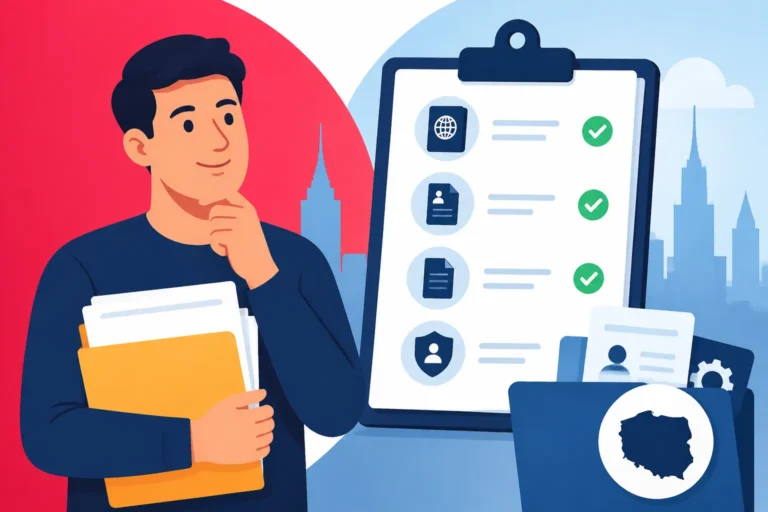
This is where the rubber meets the road. Getting your documents in order is paramount. While the exact list can vary slightly depending on your specific situation and the Urząd Wojewódzki (regional administrative office) you're dealing with, here's a general checklist for an employment-based residence permit (like the Single Permit or Blue Card):
- Passport: A valid travel document, typically with at least two blank pages and validity extending beyond your intended stay. You'll need copies of all pages with stamps and visas.
- Application Forms: Duly filled-out application forms (
Wniosek o zezwolenie na pobyt czasowy). These are usually available online from your localUrząd Wojewódzkiwebsite. Double-check for the correct version; they sometimes update them. - Photos: Recent passport-style photographs (usually 4-6, meeting Schengen requirements: 3.5cm x 4.5cm, white background, looking straight ahead).
- Employment Contract/Offer: Your signed employment contract or a binding job offer from a Polish company. This is your core proof of employment.
- University Diplomas/Qualifications: Proof of your educational background, especially crucial for the Blue Card. Diplomas should be apostilled or legalised if issued outside Poland, and translated into Polish by a sworn translator.
- Proof of Funds: Documentation showing you have sufficient financial resources to support yourself while in Poland. This might be bank statements, salary slips from your current job (if applying from abroad), or proof of savings.
- Proof of Health Insurance: This is absolutely non-negotiable. You need valid health insurance that covers your stay in Poland, ideally for the entire duration of your permit. If your Polish employer will be contributing to the public health system (NFZ) for you, you'll need proof of this. Otherwise, a private international health insurance plan, like those offered by Cigna Global, is a common choice for expats, ensuring comprehensive coverage from day one. Our guide on What Health Insurance Do I Need for a Polish Residence Permit? provides a detailed breakdown of options.
- Proof of Accommodation: A rental agreement (
umowa najmu) orAkt Notarialny(notarial deed) if you own property. If you're staying with friends, a declaration from them along with proof of their residency might suffice. - PESEL Number: While not always required at the time of application, you'll eventually need a How to Get Your PESEL Number and Why It Matters for Healthcare. Your employer will usually help you obtain this, or you can apply for it yourself once you have a registered address (
zameldowanie). - Power of Attorney (if applicable): If someone is assisting you or applying on your behalf.
- Administration Fee: Proof of payment of the government administrative fee for the permit application.
Table: Key Requirements for Work-Based Residence Permits for Software Developers in Poland
| Feature/Permit Type | Single Permit (Zezwolenie na pobyt czasowy i pracę) | EU Blue Card (Niebieska Karta UE) | JDG (Self-Employment) Residence Permit |
|---|---|---|---|
| Purpose | Work for a specific employer in Poland & reside | Highly skilled work for an employer & reside | Reside & run own business/freelance in Poland |
| Primary Applicant | You, supported by employer | You, supported by employer | You |
| Key Qualification | Job offer/contract from Polish employer | Higher education + job offer + high salary | Viable business plan + sufficient funds |
| Minimum Contract Term | No explicit minimum, but usually 1+ year | Min. 1 year | N/A (Business activity must be sustained) |
| Salary Threshold | No specific national threshold beyond minimum wage | 150% of national average gross salary | Sufficient to cover living costs + business expenses |
| Flexibility to Change Job | Requires new permit (or modification) for new employer | After 2 years, easier to change; first 2 years, modification required | Not applicable (you are the business) |
| Processing Time | Can be 3-12 months (or more) | Often faster, but can still face delays (3-9 months) | Highly variable, depends on business complexity and initial funds (4-12 months) |
| Path to PR | Yes, after 5 years of continuous legal residence | Faster path to EU Long-Term Resident (after 5 years, conditions apply) | Yes, after 5 years of continuous legal residence |
Remember, always check the specific website of the Urząd Wojewódzki for the most up-to-date and exact list of documents, as regional offices can have slightly different requirements or preferred formats.
The Infamous Urząd Wojewódzki Appointment and Beyond
Once you've painstakingly gathered all your documents, the next step is to submit them. For the Single Permit and Blue Card, this means heading to the Urząd Wojewódzki responsible for your place of residence. Booking an appointment at the Urząd Wojewódzki for immigration matters can be a challenge in itself – slots fill up fast, and sometimes the online systems are less than user-friendly. You might find yourself refreshing a booking page at odd hours, hoping a slot appears. This is a common expat frustration, so you're not alone! Our guide on How to Book an Appointment at the Urząd Wojewódzki for Immigration offers some insider tips.
When you finally have your appointment, be prepared. Arrive early, have all your original documents AND copies, and often a sworn translator with you if your Polish isn't strong. The official processing time is usually 60-90 days, but in reality, prepare for longer. It's not uncommon for these applications to take anywhere from 3 months to over a year, especially in major cities like Warsaw or Krakow due to the sheer volume of applications. This waiting period can be incredibly stressful, particularly if your initial visa expires while your application is pending – but don't panic, if you applied correctly and on time, your stay is considered legal. The wait for the shiny new plastic Karta Pobytu (residence card) can feel like an eternity. Our article on How Long Does It Take to Get a Karta Pobytu in Poland? highlights just how varied the experience can be.
What to Expect During Processing Times (and How to Cope)
The waiting game is arguably the hardest part. You’ve submitted everything, paid your fees, done your biometrics (fingerprints and signature), and now… silence. Or sometimes, a letter arrives asking for more documents (uzupełnienie braków formalnych), often with tight deadlines. This is incredibly common and shouldn't be seen as a negative sign, just part of the process.
- Patience is Key: Seriously, cultivate it. Expect delays and try not to build up too much anxiety.
- Stay Informed: Keep an eye on your mailbox for any correspondence from the
Urząd. Make sure your mailing address is correct and accessible. - Track Your Application: Some
Urząd Wojewódzkioffices have online tracking systems, but many don't. You might have to call or email to check status, which can be difficult without strong Polish language skills. - Legal Counsel: If your case is complex or you're feeling overwhelmed, consider hiring a lawyer specialising in immigration. While an added expense, it can save you significant stress and potential pitfalls.
- Travel Restrictions: While your application is pending, you generally cannot leave Poland and re-enter, especially if your previous visa has expired. If you must travel, consult with the
Urządor legal expert about options like a temporary travel document.
This entire administrative ballet can be a drain, but remember, countless expats have gone through it successfully. Keep your documents organised, stay polite, and be persistent.
Life as a Software Developer in Poland: Beyond the Visa
Once that Karta Pobytu is in your hand, a whole new chapter begins! But getting the visa is just the first hurdle. Settling into life and work in Poland has its own unique flavour.
Finding Your Tech Hub: Cities and Opportunities
Poland's tech sector is dynamic and rapidly growing, attracting global companies and nurturing local startups. As a software developer, you'll find opportunities in various cities:
- Warsaw: The capital is a major economic and tech hub, offering a wide range of roles from large multinational corporations to vibrant startups. Salaries are generally highest here.
- Krakow: A strong contender, particularly renowned for its IT outsourcing and service centres, with a lively expat community and beautiful historical charm.
- Wroclaw: Another significant tech city, especially strong in R&D and innovative tech companies, often praised for its quality of life.
- Gdansk/Tri-City (Gdańsk, Gdynia, Sopot): A growing tech scene by the Baltic Sea, offering a slightly different pace of life.
- Poznan & Lodz: Emerging tech cities with competitive opportunities and a slightly lower cost of living.
Platforms like LinkedIn, Pracuj.pl, Just Join IT, and No Fluff Jobs are excellent resources for finding positions. Many companies specifically target English-speaking developers. You can learn more about where to focus your job hunt in our detailed article How to Find Work in Poland's IT and Tech Sector.
Settling In: PESEL, Bank Accounts, and Accommodation
With your visa and job secured, the practicalities of daily life come into play.
Firstly, getting your PESEL number (a national identification number) is crucial for almost everything else: opening a bank account, registering for healthcare, and accessing public services. Your employer or landlord can often help you with the How to Get a PESEL and NIP Number in Poland application once you have your zameldowanie (residential registration).
Next, you'll need a bank account. While you might initially rely on international services like Revolut or Wise, a local Polish bank account is essential for salary payments, paying bills, and managing daily finances. Banks like PKO BP, Santander, mBank, and ING are popular and generally expat-friendly. Many offer English-language online banking and support. Our guide on The Expat Guide to Opening a Bank Account in Poland walks you through the process.
Finally, finding accommodation. This can be tricky, especially in competitive cities. Websites like Otodom.pl and Morizon.pl are popular, but working with a local real estate agent who understands the expat market can be invaluable. Decide if you prefer a modern city apartment or something more suburban. And if you’re moving all your worldly possessions, remember that a reliable moving service, like those listed on Sirelo, can make the relocation much smoother, especially when dealing with international logistics. They can connect you with movers who specialise in international relocations, reducing the stress of transporting your belongings across borders.
Life in Poland as a software developer offers a fantastic blend of career opportunity and a rich cultural experience. The administrative hurdles are real, but they are surmountable. You've got this!
Disclaimer
Please remember that immigration laws and procedures in Poland can change rapidly. While I've done my best to provide accurate and up-to-date information, this guide is for informational purposes only and does not constitute legal advice. Always verify current requirements with the official Polish Urząd Wojewódzki websites, relevant embassies or consulates, or consult with a qualified immigration lawyer in Poland before making any decisions.