Is There a Waiting Period for NFZ Coverage in Poland?
One of the most stressful aspects of moving to a new country is the terrifying thought of falling ill before your paperwork is processed. In Poland, the bureaucracy can feel like a labyrinth, and many expats worry they will be left in a "coverage gap" where they are neither insured in their home country nor yet registered in the Polish system. This guide clarifies exactly when your NFZ coverage begins, the hidden "financial waiting periods" for voluntary insurance, and how to stay protected during the transition.
Understanding the Concept of the Waiting Period in the Polish System
When people ask if there is a waiting period for the Narodowy Fundusz Zdrowia (NFZ), the answer depends entirely on your legal status and how you are entering the system. Unlike some private insurance plans that have a "moratorium" on pre-existing conditions or a three-month delay before you can claim, the Polish public system is designed to be inclusive. However, "inclusive" does not always mean "instant." The delay is rarely a statutory "waiting period" and is more often an administrative or financial one.
When Coverage Starts for Employees
If you are moving to Poland to take up a traditional job, I have good news: there is technically no waiting period. Under Polish labor law, your right to healthcare begins on the very first day of your employment contract. Your employer is legally obligated to report you to the Social Insurance Institution (ZUS) within seven days of your start date. Once that report is filed, your coverage is backdated to that first day.
For example, if your contract starts on the 1st of the month, but your HR department doesn't get around to the paperwork until the 5th, you are still covered for an emergency that happens on the 2nd. The catch? The electronic system (eWUŚ) might not show you as "green" (insured) for a week or two. In these early days, you might need to sign a declaration at the doctor’s office stating you are insured, or show your signed employment contract as proof. Understanding How Poland's National Health Fund (NFZ) Works: A Full Overview will help you realize that the system is built on these contributions, and as long as the contribution is "owed," you are covered.
The Voluntary Insurance Waiting Period and the Infamous Fee
If you are a digital nomad, a freelancer, or a non-EU spouse not yet covered by a partner’s plan, you might look into voluntary insurance. This is where the concept of a waiting period takes a different, more expensive form. The NFZ doesn't make you wait months to see a doctor, but they do charge an "additional fee" (opłata dodatkowa) if you have had a gap in your insurance coverage history.
If you haven't been insured in Poland (or another EU/EFTA country) for more than three months, the NFZ views this as a risk. To "buy your way back in," you must pay a one-time fee that increases based on how long you were uninsured. If your gap is over a year, this fee can be several thousand PLN. In this sense, the "waiting period" is effectively a financial hurdle. You aren't waiting for time to pass; you are waiting for your bank account to clear the entry cost. This is why many newcomers find that How Do I Voluntarily Insure Myself with the NFZ in Poland? is one of the most complex procedures to navigate.
What Happens During the Administrative Gap
Even when the law says you are covered, the reality of Polish administration can create a functional waiting period. To be registered for healthcare, you typically need a PESEL number. While you can technically get medical help without one in an emergency, the lack of a PESEL makes every interaction with the Przychodnia (clinic) ten times harder.
Imagine arriving in Warsaw on a Monday. You have your apartment and your work contract, but you haven't visited the city office yet. If you trip on those beautiful (but uneven) Old Town cobblestones and break your ankle, the hospital will ask for your PESEL and proof of insurance. Without these, you might be billed as a private patient initially. You can later claim this back once your registration is finalized, but the immediate stress is a "gap" most of us want to avoid. This is why learning How to Get Your PESEL Number and Why It Matters for Healthcare should be your absolute priority in your first 48 hours.
Navigating the Voluntary NFZ Insurance Wait
For those who are not employed by a Polish company—such as those on a B2B contract or staying on a specific type of residence permit—voluntary insurance is the go-to solution. However, the bureaucracy here is thick. You don't just sign up online; you often have to visit the NFZ branch in person, sign a contract, and then take that contract to ZUS to register.
The Graduated Entry Fee for Long Gaps
The NFZ is very protective of its pool of funds. They want to prevent people from only joining the public system when they find out they need an expensive surgery. To combat this, they implemented a sliding scale fee for anyone who has been without public insurance for a significant amount of time.
| Length of Gap in Coverage | Entry Fee (Approximate Percentage of Average Salary) |
|---|---|
| 3 months to 1 year | 20% of the basis (approx. 1,500+ PLN) |
| 1 year to 2 years | 50% of the basis (approx. 3,800+ PLN) |
| 2 years to 5 years | 100% of the basis (approx. 7,600+ PLN) |
| 5 years to 10 years | 150% of the basis (approx. 11,400+ PLN) |
| Over 10 years | 200% of the basis (approx. 15,000+ PLN) |
These fees are a massive shock to most expats. If you are moving from outside the EU, the NFZ will look at when you arrived in Poland. If you wait six months after arriving to apply for NFZ, they will count those six months as a "gap" and charge you accordingly. This is why it is vital to understand Registering with the NFZ in Poland: The Complete Expat Guide (2027) the moment you land.
Exemptions and Ways to Waive the Fee
There are ways to avoid this "waiting fee," but they require meticulous documentation. If you were insured in another EU or EFTA country during your "gap" period, you can provide the E104 form (or similar documentation) to prove continuous coverage. This waives the entry fee entirely.
For non-EU citizens, if you can prove you were covered by a mandatory state insurance system in your home country until shortly before arriving in Poland, you can sometimes negotiate with the NFZ clerks. However, this is highly dependent on the specific clerk you meet and the bilateral agreements between Poland and your home nation. For many, the "waiting period" is simply the time it takes to gather these papers from their home country’s health department. While you are sorting this out, having a flexible plan like SafetyWing can be a lifesaver, as it covers you globally and doesn't require the mountains of Polish paperwork that the NFZ demands.
Bridging the Gap: Why Private Options Matter
Because the Polish public system has these administrative and financial "waiting zones," almost every veteran expat I know uses a two-tier approach. You want the NFZ for emergencies, hospital stays, and long-term care, but you need something else for the first few months or for day-to-day specialist visits.
The Risk of Being Uninsured
Being "in-between" insurance is a dangerous game in Poland. While the cost of a basic GP visit is relatively low (about 150-250 PLN), a single night in a hospital for an emergency appendectomy or a traffic accident can run into the tens of thousands of zlotys. If you are a non-EU citizen, your residency permit (Karta Pobytu) actually requires you to have "stable and regular" health insurance.
If you apply for your permit and your NFZ coverage hasn't kicked in yet because you are still fighting the "entry fee" battle, your application could be delayed or rejected. This creates a stressful cycle where you can't get insurance because you don't have a permit, and you can't get a permit because you don't have insurance. To break this cycle, most of us use a bridge. Understanding What Happens If I Get Sick Before My NFZ Registration Is Complete? is essential for anyone moving here without a pre-signed employment contract.
SafetyWing and Other Digital Nomad Solutions
For those of us who live a more mobile life—perhaps you are a freelancer working on a B2B basis or a digital nomad waiting for your business to be registered—the NFZ "waiting period" is simply too long and rigid. This is where contextual solutions like SafetyWing come into play. SafetyWing is designed specifically for people who are in between "home" and "new home."
It works on a subscription basis, which is perfect for the 3 to 6 months it often takes for the Polish Urząd (Office) to process a residency card. Since SafetyWing offers travel medical insurance that meets the basic requirements for many visa types, it acts as the perfect bridge. You can start it before you even leave your home country, ensuring that from the moment you step off the plane at Chopin Airport, you aren't part of the "uninsured" statistic. Unlike the NFZ, there’s no need to visit a gray office building in the outskirts of the city to get started.
Practical Steps to Ensure Continuous Coverage
To minimize the "waiting period" for NFZ coverage, you need to be proactive. Do not wait for the system to find you; you must find the system. The Polish bureaucracy rewards those who arrive with a folder full of stamped documents.
Timelines for Registration
The moment you have your rental contract, get your Zameldowanie (residence registration). This is the key that unlocks the PESEL, which in turn unlocks the NFZ. If you are an employee, check with your HR on day two to ensure they have submitted the ZUS ZUA form. This form is the formal start of your insurance.
For the self-employed, the timeline is even tighter. When you register your business (JDG), you have only seven days to report yourself to ZUS. If you miss this window, you are technically uninsured until the paperwork is corrected. For more on the costs involved once you are registered, see Understanding ZUS Health Contributions (Składka Zdrowotna) in Poland.
Transferring EU Coverage (EHIC/EKUZ)
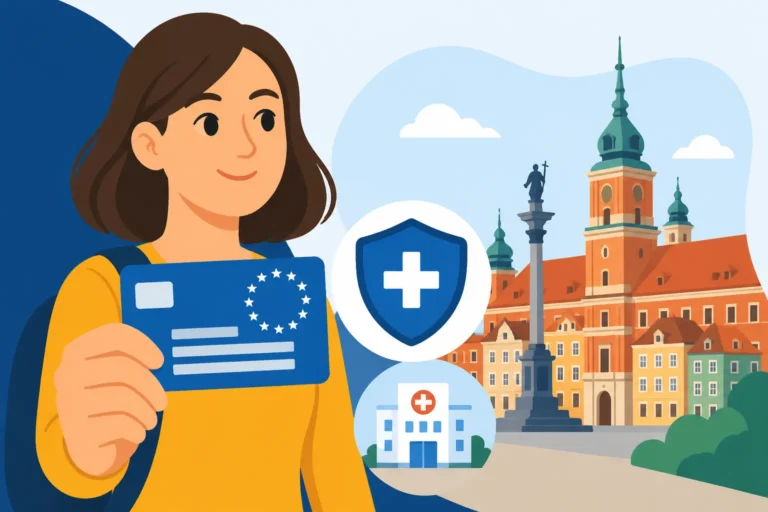
If you are an EU citizen, you have a massive advantage: the EKUZ (EHIC) card. This card covers you for "necessary" medical treatment during a temporary stay. However, "temporary" is the keyword. Once you register as a resident in Poland, your foreign EHIC card is technically no longer valid for your primary care.
You must transition to the Polish system. The "waiting period" here is zero, as the transition is meant to be seamless. You use your EHIC for the first few weeks, and then your NFZ coverage takes over the moment you are registered. For a deeper dive into this, read How to Use Your EHIC (EKUZ) Card in Poland as an EU Citizen.
Comparing Coverage Activation Timelines
| Insurance Type | Waiting Period / Activation Time | Proof Required |
|---|---|---|
| Employment Contract | Immediate (from contract start date) | ZUS ZUA confirmation or contract |
| B2B / Self-Employed | From date of registration with ZUS | ZUS ZZA/ZUA confirmation |
| Voluntary NFZ | Immediate after contract is signed | Signed NFZ contract + ZUS proof |
| Student Insurance | From the date of the contract with NFZ | Student ID + NFZ contract |
| SafetyWing | Selected start date (can be immediate) | Digital certificate |
The reality of living in Poland is that you will eventually want to be part of the public system. It is the only way to access the full range of Polish specialists without paying 300 PLN per visit. However, given the potential for administrative delays and the steep "gap fees" for voluntary insurance, I always tell new arrivals to have a backup plan. Whether it's a private subscription or a global plan like SafetyWing, never rely on the speed of a Polish government office when your health is on the line.
For a bird's-eye view of your options, check out The Complete Guide to Healthcare in Poland for Expats (2027), and remember: in Poland, if a document isn't stamped and filed, it doesn't exist. Start your registration early, keep your papers organized, and always have a bridge policy for those first 90 days.
Disclaimer
This guide is for informational purposes only and does not constitute legal or professional medical advice. Polish immigration and healthcare laws, including ZUS contribution rates and NFZ entry fees, are subject to frequent changes. Always verify current requirements with the official Narodowy Fundusz Zdrowia (NFZ) or Zakład Ubezpieczeń Społecznych (ZUS) websites or consult with a qualified legal professional before making decisions regarding your health insurance coverage.