How Much Does an Ambulance (Karetka) Cost in Poland?
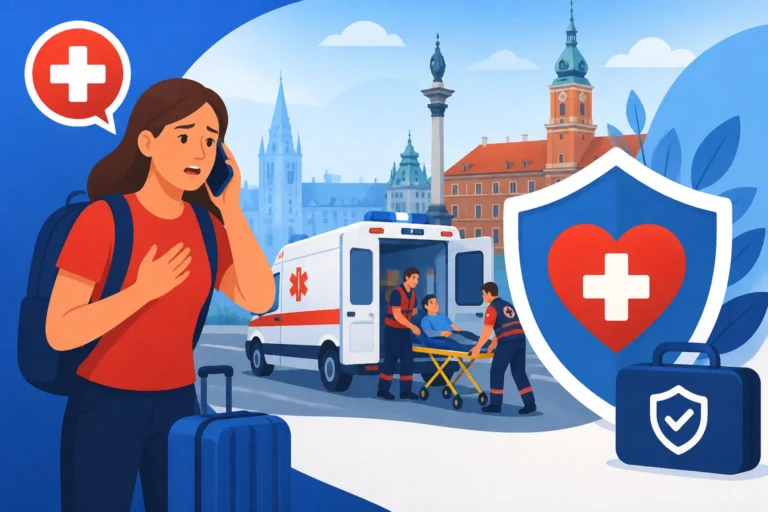
Waking up in the middle of the night with sharp chest pains or witnessing a serious accident on a cobblestone street in Krakow is a terrifying experience, made even worse by the paralyzing fear of the unknown costs that follow. Many foreigners hesitate to call for help because they worry about receiving a massive bill they cannot afford. This guide provides a detailed breakdown of when an ambulance is free, exactly how much it costs for the uninsured, and how to navigate the Polish emergency medical system without financial ruin.
Understanding the Polish Emergency Medical System and Coverage
In Poland, the emergency medical service is known as Państwowe Ratownictwo Medyczne (PRM). For the vast majority of residents, the sight of a yellow or white ambulance (karetka) does not come with a price tag, but the rules change significantly depending on your insurance status and the nature of the emergency. If you are legally employed in Poland, your employer is paying into the National Health Fund (NFZ), which grants you full access to emergency services at no out-of-pocket cost. This is the foundation of the system, but as many of us who have moved here know, the administrative side is rarely that simple.
Who is Covered for Free Emergency Transport
The primary group entitled to free ambulance services includes anyone covered by the NFZ. This encompasses employees, the self-employed who pay their contributions, and their registered family members. If you are an EU citizen, you are covered under the same terms as locals provided you have a valid European Health Insurance Card. For more on how this works, you can read about How to Use Your EHIC (EKUZ) Card in Poland as an EU Citizen.
However, the system also covers people who are not currently insured but are in a life-threatening state, such as during a sudden cardiac arrest or a major trauma. Polish law generally prioritizes saving a life over immediate proof of insurance. That said, once the life-threatening situation is stabilized at the hospital, the billing department will start looking for your insurance details. If you are between jobs or waiting for paperwork, it is vital to understand How to Keep Health Coverage Between Jobs in Poland to avoid retroactive billing for the hospital stay that follows the ambulance ride.
The Distinction Between Emergency and Medical Transport
A common point of confusion for expats is the difference between a "Life-Saving Mission" and "Medical Transport" (Transport Medyczny). An ambulance called via 112 or 999 for a genuine emergency is funded by the state for those with insurance. On the other hand, if you need an ambulance simply because you have a broken leg and need a ride to a follow-up appointment, or if you want to be transferred from one hospital to another for convenience, this is considered medical transport.
Medical transport is often not free unless specifically ordered by a doctor under strict NFZ guidelines. If you hire a private company for this, you will be paying per kilometer and for the time of the medical staff. For expats using services like SafetyWing, these costs are often reimbursable if the transport is medically necessary, but you must keep every single receipt and "faktura" (invoice) the provider gives you.
Types of Ambulances and Their Impact on Cost
When you see an ambulance in Poland, look at the letter on the side. A "P" stands for Podstawowa (Basic), manned by paramedics or nurses. An "S" stands for Specjalistyczna (Specialist), which includes a physician. For the patient, the cost remains the same under the NFZ, but for those paying out of pocket, the "S" team is significantly more expensive because you are paying for the expertise of a doctor. Understanding Emergency Medical Care in Poland: What Every Expat Needs to Know involves knowing that you don't get to choose which one shows up; the dispatcher decides based on the severity of your reported symptoms.
Estimated Costs for Uninsured Patients and Foreigners
If you find yourself in Poland without NFZ coverage or a valid EHIC card, you are considered a "private" patient. This often happens to digital nomads, tourists, or those in the very early stages of their residency application. In these cases, the hospital or the regional ambulance station will issue a bill for the intervention. These rates are not set nationally; they are determined by regional health authorities (Wojewódzka Stacja Pogotowia Ratunkowego) and can vary between Warsaw, Wroclaw, and smaller towns.
Average Rates for Emergency Interventions
For an uninsured person, the cost of an ambulance call-out typically ranges from 500 PLN to 1,500 PLN. This fee usually covers the arrival of the team, basic stabilization, and transport to the nearest [Hospital Emergency Department (SOR) in Poland]. If specialized equipment or expensive medications are used during the journey, the price can climb higher. It is a significant sum, but compared to the thousands of dollars one might pay in the United States, it is relatively manageable—though still an unwanted surprise.
If you are a frequent traveler or a digital nomad, having a policy with SafetyWing can provide peace of mind, as they are designed to handle these sudden, high-cost medical emergencies that fall outside the local public system. When the bill arrives, you don't want to be debating the conversion rate of Złoty to your home currency while recovering from a medical crisis.
The Cost of Medical Transport and Non-Emergency Services
If you are not in a life-threatening situation but still require an ambulance—perhaps to move a bedridden relative—you will be looking at private transport rates. These are generally calculated as:
- A base "start" fee (usually 150–300 PLN).
- A rate per kilometer (usually 5–10 PLN per km).
- An hourly rate for the medical staff (paramedics vs. doctors).
For many, this is where The Cost of Healthcare in Poland: A Complete Breakdown for Foreigners (2026) becomes very relevant. You can easily spend 600–800 PLN for a simple cross-city transfer. If you have a private subscription, it is worth checking Understanding Private Medical Subscriptions (Medicover, LUX MED) in Poland to see if transport is included in your package, as some premium tiers offer a limited number of "free" medical transports per year.
Fines for Unjustified Calls (False Alarms)
This is a scenario every expat should fear more than the medical bill itself. Calling an ambulance for something trivial—like a mild fever, a sore throat, or because you want a "faster" way to see a doctor at the hospital—can result in a heavy fine. Under Polish law, if the paramedics arrive and determine that there was absolutely no medical emergency and the caller acted in bad faith or gross negligence, they can involve the police.
Fines for an "unjustified call" can range from 500 PLN to over 1,500 PLN. Furthermore, the dispatcher has the right to refuse to send an ambulance if the symptoms don't warrant it. In those cases, you should instead look for a [Lekarz Nocnej i Świątecznej Opieki Zdrowotnej] (Night and Holiday Healthcare), which is the correct way to handle non-life-threatening illnesses outside of business hours.
| Service Type | NFZ Insured Cost | Uninsured (Approx.) | False Alarm Fine |
|---|---|---|---|
| Emergency Ambulance (P) | 0 PLN | 600 – 900 PLN | Up to 1,500 PLN |
| Specialist Ambulance (S) | 0 PLN | 1,000 – 1,800 PLN | Up to 1,500 PLN |
| Medical Transport (Internal) | 0 PLN (if ordered) | 300 – 600 PLN | N/A |
| Private Medical Transport | Full Price | Full Price | N/A |
What to Expect When Calling an Ambulance
When you dial 112 or 999, you will be connected to a dispatcher. This is often the most stressful part for non-Polish speakers. While many dispatchers in major cities like Warsaw or Krakow speak English, it is not guaranteed. You need to be prepared to give your location clearly. Using the "mObywatel" app or having your address written down in Polish near your door is a life-saver.
The Dispatcher's Interview
The dispatcher will ask several key questions:
- What is happening? Describe the symptoms clearly.
- Where is it happening? Give the exact address, floor number, and entry code if applicable.
- Who is the patient? Give the name and approximate age.
- Your contact details.
If the dispatcher determines that an ambulance is necessary, stay on the line until they tell you to hang up. If you are worried about the cost because you are uninsured, don't let that stop you in a true emergency. If you have international coverage through a provider like SafetyWing, you can focus on getting the care you need first and handling the claims process later.
Documentation Needed for the Paramedics
When the team arrives, they will ask for your ID. For expats, this means your passport or residence card. If you have a [PESEL number], give it to them immediately. This number is the key to the entire Health Insurance in Poland: Mandatory, Private and Subscription Options Explained database. If you have your insurance through work, they can usually verify your coverage in the eWUŚ system using your PESEL.
If you do not have a PESEL, show them your private insurance card or your EHIC card. If you are an EU citizen and forget your card, you can often provide a "Replacement Certificate" later, but it is much easier to have the physical card or a photo of it on your phone. Paramedics will also ask about your current medications and allergies. It is highly recommended to have a small "emergency card" in your wallet with these details written in Polish.
Arriving at the Hospital (SOR)
Once you arrive at the hospital, the ambulance crew will hand you over to the staff at the Szpitalny Oddział Ratunkowy (SOR). This is where the triage process begins. Even if you arrive by ambulance, you are not guaranteed immediate treatment unless your condition is critical. You will be assigned a color (Red, Orange, Yellow, Green, Blue) based on urgency. For a deeper look into this process, check our guide on Understanding Hospital Care at a Szpital in Poland. If you are uninsured, the SOR will eventually ask how you intend to pay for the diagnostics and stay, which is why having an active policy is so vital.
Insurance Solutions and Avoiding High Bills
Navigating the Polish system is a balancing act between the public NFZ and private alternatives. Many expats choose to have both to ensure they are covered for every eventuality. While the NFZ is excellent for emergencies and major surgeries, private subscriptions are better for getting a quick appointment with a specialist.
Using Private Insurance for Reimbursement
If you are a freelancer or a digital nomad and you are not yet registered for the NFZ, you should definitely have an international health insurance policy. Companies like SafetyWing are specifically built for people who live between borders. If you end up paying for an ambulance out of pocket, you must request a "Faktura VAT" from the ambulance station or the hospital. This invoice must include your full name, address, and a description of the service.
Without this specific document, getting a reimbursement from your insurance provider will be nearly impossible. Most Polish medical facilities are used to issuing these, but you may need to visit the administrative office of the hospital (usually called "Sekretariat" or "Dział Rozliczeń") the day after your emergency to get the paperwork finalized.
Registering for the NFZ as a Foreigner
The best way to ensure an ambulance ride costs you 0 PLN is to be properly integrated into the public system. If you are working on a standard contract (Umowa o Pracę), this happens automatically. If you are a freelancer, you should look into How to Register with the NFZ as a JDG (Sole Trader) Owner. This gives you the security of knowing that no matter what happens, the state has you covered.
For those who are not working but have a residence permit, there is the option of "Voluntary Insurance." You pay a monthly fee (currently around 600-700 PLN) to the NFZ. It might seem like a lot, but considering that a single emergency and a three-day hospital stay can cost 10,000 PLN or more for the uninsured, it is a wise investment in your safety and financial stability. You can learn more about this in our guide on How to Voluntarily Insure Yourself with the NFZ in Poland.
Final Thoughts on Emergency Costs
In Poland, the cost of an ambulance is rarely about the ride itself; it's about the insurance status behind the patient. If you are covered, it's free. If you aren't, it's a few hundred to over a thousand Złoty. The most important thing is to never let the fear of a bill stop you from seeking help in a life-threatening moment. Poland’s medical professionals are highly trained and the emergency system is robust. By ensuring your paperwork is in order—whether through the NFZ, a private subscription, or a global policy like SafetyWing—you can focus on what truly matters: your health and recovery.
Disclaimer
The information provided in this guide is for informational purposes only and does not constitute legal or medical advice. Healthcare regulations and costs in Poland can change frequently. Always verify your insurance coverage with your provider and consult with the National Health Fund (NFZ) or a qualified legal advisor regarding your specific residency and insurance status. In a life-threatening emergency, always dial 112 or 999 immediately.