How Do I Transfer My EU Health Insurance to Poland?
Moving across borders within the European Union is often marketed as a seamless experience, but many expats arrive in Poland expecting their home country's health insurance to follow them automatically. The reality is a complex web of S1 forms, EHIC limitations, and the specific requirements of the National Health Fund (NFZ). This guide solves the confusion by mapping out exactly how to transfer your EU health coverage to Poland legally and effectively.
The Reality of EU Healthcare Coordination in Poland
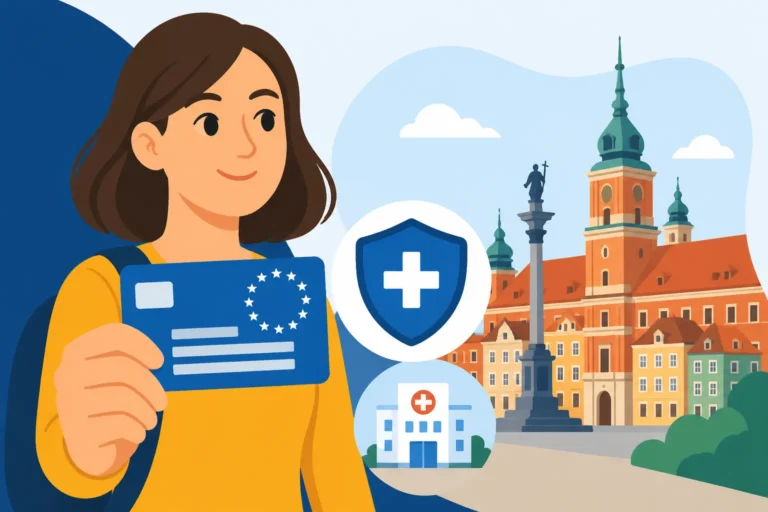
When you first pack your bags for a new life in Krakow or Warsaw, you likely have your European Health Insurance Card (EHIC) tucked neatly into your wallet. In Poland, this card is known as the EKUZ. While it is a powerful tool, many newcomers mistakenly believe it serves as a permanent replacement for local insurance. I have seen countless expats face stressful situations at the doctor's office because they relied solely on their home country's card for months after officially moving. The EU coordination rules are designed for travelers, not necessarily for those who have shifted their "center of life" to a new member state.
Why Your EHIC is Not a Long Term Solution
The EHIC is intended for "necessary" and "unplanned" medical treatment during a temporary stay. If you are a student, a tourist, or a posted worker for a short duration, the EHIC is your best friend. However, the moment you register your residence or start a job in Poland, your status changes in the eyes of the Polish authorities. How to Use Your EHIC (EKUZ) Card in Poland as an EU Citizen provides a deep dive into what is actually covered under this card, but the short answer is: it won't cover your routine check-ups or management of long-term chronic conditions once you are a resident.
If you are caught in the "limbo" period—where you have left your home country but haven't yet secured Polish employment or residency—you might find yourself uninsured for non-emergency care. This is where many expats look for bridge solutions. Services like SafetyWing can be incredibly helpful during this transition, offering a safety net while you navigate the Polish bureaucracy. SafetyWing provides the kind of flexibility that the rigid public system often lacks during those first few weeks on the ground.
The Distinction Between Residency and Temporary Stay
In Poland, the administrative line between a visitor and a resident is often drawn at the 90-day mark. If you plan to stay longer, you are required to register your stay. This registration triggers several changes in your healthcare obligations. If you are still covered by your home country's social security system (for example, if you are a pensioner or a remote worker for a company back home), you don't necessarily "transfer" your insurance in the sense of ending it; rather, you export the right to use the Polish system funded by your home country. Understanding this distinction is vital to ensure you don't accidentally end up with a massive bill from a Polish hospital that doesn't recognize your "tourist" status.
The S1 Form Your Golden Ticket to Portability
If you are an EU citizen who is moving to Poland but remains insured in another EU country—perhaps you are a pensioner, a cross-border worker, or the dependent of someone working in another EU state—the S1 form is your most important document. This form allows you to register with the Polish National Health Fund (NFZ) while your home country continues to foot the bill. I remember the first time I saw an S1 form; it looked like just another piece of paper, but in reality, it is the bridge that connects two different national bureaucracies.
Obtaining the S1 from Your Home Institution
You cannot get an S1 form from the Polish authorities. You must request it from the health insurance institution in the country where you are currently insured. For example, if you are moving from Germany, you would contact your Krankenkasse. If you are moving from France, it would be the CPAM. This should be done before you leave, as doing it remotely can sometimes lead to weeks of postal delays. Once you have this document, you are effectively "exporting" your healthcare rights.
During the weeks it might take for your S1 to arrive by mail, you are technically in a vulnerable spot. This is another scenario where having a plan from SafetyWing can alleviate the stress of "waiting for the postman." Having that private backup ensures that if you trip on a cobblestone street in Wroclaw while waiting for your S1, you aren't left negotiating with a hospital billing department in a language you might not yet speak fluently.
Submitting the S1 to the National Health Fund NFZ
Once you have the physical S1 form, you must take it to the regional branch of the NFZ (the Wojewódzki Oddział NFZ) that corresponds to where you live. If you are in Warsaw, you will likely head to the office on ul. Chałubińskiego. You will need to fill out an application for registration. The officials will verify the form and, once processed, you will be granted the same rights to Polish public healthcare as any Polish citizen. This includes access to specialists, hospital stays, and subsidized prescriptions. However, the process isn't instant. It can take anywhere from a few days to a few weeks for your status to be updated in the electronic system known as eWUŚ.
| Coverage Type | Best For | Who Pays? | Polish Name |
|---|---|---|---|
| EHIC / EKUZ | Tourists & Short Stays | Home Country | EKUZ |
| S1 Form | Pensioners / Cross-border | Home Country | Formularz S1 |
| Employment | Local Workers | ZUS (Employer) | Ubezpieczenie Obowiązkowe |
| Voluntary | Freelancers / Non-workers | Individual | Ubezpieczenie Dobrowolne |
Navigating the Polish National Health Fund Registration
For most expats moving for work, the "transfer" of insurance happens automatically through the payroll system. If you sign a Polish employment contract (Umowa o Pracę), your employer is legally obligated to register you with ZUS (the Social Insurance Institution). A portion of your salary is then directed to the NFZ. This is the most common way foreigners enter the system. However, even if your employer does the heavy lifting, you still have some administrative steps to take to actually use the system.
Obtaining Your PESEL Number for Health Access
You cannot truly navigate the Polish healthcare system without a PESEL number. This 11-digit identification number is the "master key" for everything from opening a bank account to seeing a doctor. When you go to a clinic (Przychodnia), the receptionist will ask for your PESEL to check your insurance status in the eWUŚ system. If your "transfer" of insurance from your home country to a Polish employer has just happened, it might take a few days for the green light to appear in the system. To understand how to get this sorted, check out How to Get Your PESEL Number and Why It Matters for Healthcare. Without this number, you are often treated as a private patient, which can be expensive.
Furthermore, getting your PESEL allows you to set up an Internetowe Konto Pacjenta (IKP), which is an online patient portal. This portal is more essential than ever. It tracks your Understanding the e-Recepta (E-Prescription) system in Poland history, your referrals, and your vaccination records. I highly recommend setting this up as soon as your PESEL is issued.
Choosing a Primary Care Physician
Once your insurance is active—whether through an S1 form or a Polish job—you need to choose a "Lekarz POZ" (Primary Care Physician). This is not assigned to you automatically. You must visit a local clinic and fill out a declaration form. This is a crucial step in the transfer process because, in Poland, the family doctor acts as the gatekeeper to the rest of the system. If you need to see a cardiologist or a dermatologist, you generally need a referral from your POZ.
Finding a doctor who speaks English can be a challenge in smaller towns, but in cities like Gdansk or Krakow, it is much easier. For more detailed steps on this, refer to The Expat Guide to Finding a Family Doctor (Lekarz Rodzinny) in Poland. Don't wait until you are sick to do this; the registration process can take a day or two, and you don't want to be filling out paperwork while running a fever.
Bridging the Gap and Considering Private Coverage
The transition between systems is rarely perfect. There is often a gap between when your home country insurance stops considering you a resident and when the Polish NFZ system fully recognizes you. Furthermore, the public system in Poland, while comprehensive, is notorious for long wait times for specialists. This is why many expats choose a hybrid approach.
Managing the Bureaucratic Waiting Period
If you are moving as a freelancer or are currently looking for work, you may need to look into How to Voluntarily Insure Myself with the NFZ in Poland. This requires a monthly payment and a bit of a "buy-in" fee if you haven't been insured in the EU recently. During the month or two it takes to get this finalized, I always suggest having a private policy. SafetyWing is a popular choice for this exact reason; it’s designed for people who are between "homes" and need a reliable buffer that works globally. It gives you the peace of mind to focus on your move rather than worrying about what happens if you get an ear infection before your NFZ card arrives.
Integrating Private Subscriptions with Public Care
Most Polish employers also provide a private medical subscription as a perk. Companies like Medicover and LUX MED are ubiquitous in Polish office culture. It is important to understand that these are not "health insurance" in the traditional sense; they are prepaid medical packages that give you fast access to private doctors. However, they do not cover major surgeries or emergency hospitalizations—that is what the NFZ (or a robust private policy) is for.
Many expats find that Understanding Private Medical Subscriptions (Medicover, LUX MED) in Poland is the best way to handle day-to-day health issues while keeping the NFZ as a backup for serious issues. If you are moving with children, you will also want to know How to Register Family Members for Health Insurance in Poland to ensure your spouse and kids are covered under your contribution or your S1 form.
The Role of ZUS and Contributions
If you are working as a sole trader, you will need to handle your own contributions. Understanding ZUS Health Contributions (Składka Zdrowotna) in Poland is essential for anyone running a business. The rules changed significantly with recent tax reforms, and the amount you pay is now tied to your income. Ensuring these payments are made on time is the only way to keep your "transferred" healthcare rights active. If you miss payments, your eWUŚ status will turn red, and you may be denied non-emergency care at public clinics.
In the end, transferring your EU health insurance to Poland is about proving your right to care through the correct documentation. Whether you use the S1 form for its portability or enter the system via local employment, the key is proactivity. Don't let the paperwork pile up. Use digital tools like the IKP, secure a bridge plan like SafetyWing for the move-in phase, and make sure your PESEL is ready to go. Poland’s healthcare system is modern and high-quality, but it requires you to follow the rules of the administrative game to access it.
Disclaimer
This guide is provided for informational purposes only and does not constitute legal or medical advice. Healthcare regulations and EU coordination rules are subject to change. While we strive to provide the most up-to-date information for 2026, you should always consult with the National Health Fund (NFZ), ZUS, or a qualified legal professional regarding your specific residency and insurance status in Poland. Always verify current procedures at your local regional NFZ branch.