How Do I Add My Spouse to My Polish Health Insurance?
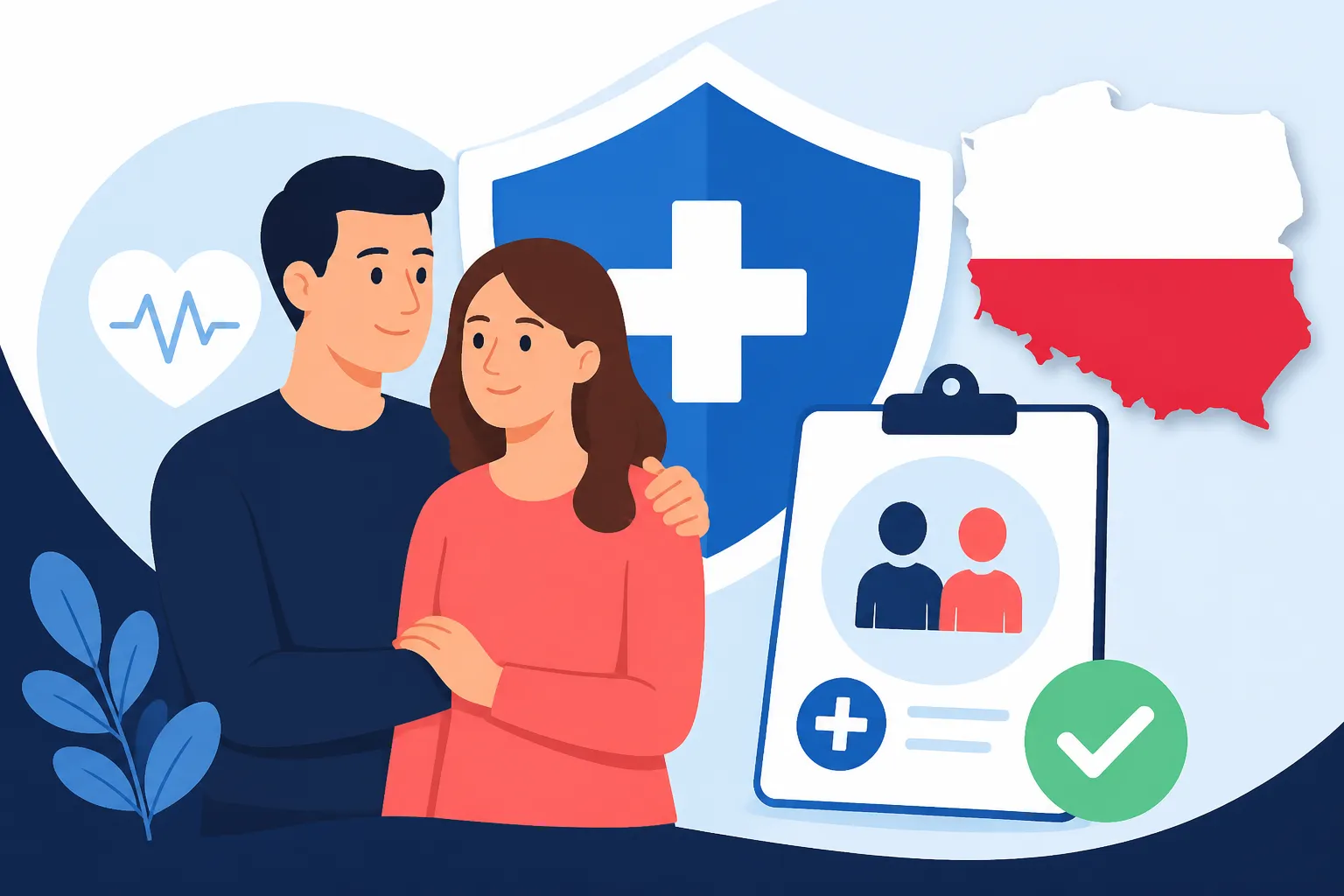
One of the most stressful moments for any expat is realizing your spouse is not actually covered by your health insurance despite your monthly salary deductions. Moving to a new country like Poland involves a mountain of paperwork, and healthcare is often the most confusing peak to climb. This guide simplifies the process of adding your spouse to your National Health Fund (NFZ) coverage, ensuring your family stays protected without unnecessary legal headaches.
Understanding the Concept of Family Insurance in Poland
In the Polish administrative system, adding a family member to your insurance is known as "zgłoszenie członka rodziny do ubezpieczenia." Unlike some countries where you might have a "family plan" that carries a higher premium, the Polish public system allows you to add a spouse (and children) to your existing coverage at no additional monthly cost. Your ZUS contributions remain the same, but the umbrella of protection expands. However, this is not a passive process. The state does not know you are married unless you explicitly tell them through the correct channels and forms.
Who Qualifies as a Spouse Under the NFZ
To add your partner to your insurance, you must be in a legally recognized marriage. Poland does not currently recognize civil partnerships or "de facto" relationships for the purposes of NFZ co-insurance. This is a common point of frustration for many international couples who have lived together for years but lack a formal marriage certificate. If you are legally married, your spouse can be added to your insurance provided they do not have their own mandatory insurance coverage—meaning they aren't currently employed in Poland, aren't registered as unemployed with the labor office, and don't run their own business.
If your marriage took place outside of Poland, you will likely need a sworn translation (tłumacz przysięgły) of your marriage certificate. The bureaucrats at ZUS or your HR department will rarely accept a document in English or any other foreign language without the official Polish equivalent. It is a small but vital step that often trips up newcomers. For more details on the broader system, you can read How Poland's National Health Fund (NFZ) Works: A Full Overview.
Why Coverage is Not Automatic
Many expats assume that when they list a spouse on a visa application or a residence permit form, the health insurance system is updated automatically. This is a dangerous misconception. The immigration authorities (Urząd Wojewódzki) and the social security institution (ZUS) operate on different databases. You could live in Poland for a year thinking your spouse is covered, only to be hit with a massive bill after an emergency room visit because the "zgłoszenie" was never filed.
The responsibility to initiate this always lies with the "main" insured person—the one who is working or running a business. You must proactively submit the ZUS ZCNA form. This form is the golden ticket to healthcare for your family. Without it, your spouse technically remains uninsured in the eyes of the public system, even if they have a valid Karta Pobytu. To understand the financial side of these contributions, check out Understanding ZUS Health Contributions (Składka Zdrowotna) in Poland.
The Step-by-Step Registration Process
The method you use to add your spouse depends entirely on your employment status in Poland. Whether you are climbing the corporate ladder in a Warsaw skyscraper or running a solo consultancy from a cafe in Krakow, the paperwork trail differs slightly.
If You are Employed on an Umowa o Pracę
If you are working on a standard employment contract (Umowa o Pracę), your employer’s HR or accounting department is your best friend. In this scenario, they act as the intermediary between you and ZUS. You do not need to go to the ZUS office yourself. Instead, you inform your HR representative that you wish to add a family member to your insurance.
They will provide you with a questionnaire or a version of the ZUS ZCNA form to fill out. You will need your spouse’s full name, PESEL number, and date of birth. Once you submit this to your HR department, they have seven days to register your spouse with ZUS. It is highly recommended to ask for a confirmation of the submission (a printout from the PUE ZUS system) to keep in your records. This is especially important for Understanding Polish Employment Contracts and Worker Rights (2027) as it ensures your employer is fulfilling their legal obligations toward your family.
If You are Self-Employed (JDG)
For the brave souls running a Jednoosobowa Działalność Gospodarcza (JDG), you are your own HR department. This means the paperwork falls squarely on your shoulders. You will need to log into the PUE ZUS platform using your Trusted Profile (Profil Zaufany). Within the "Płatnik" (Payer) tab, you will find the option to create a new document—the ZUS ZCNA.
The process involves entering your spouse’s details and indicating the date they should be covered from (usually the date they arrived in Poland or the date your marriage began, whichever is later). It can be intimidating to navigate the Polish-only interface of PUE ZUS, but once the form is sent electronically, the update is nearly instantaneous. If you are just starting your business journey, you might find our guide on How to Register with the NFZ as a JDG (Sole Trader) owner particularly helpful.
Necessary Documentation for the Urząd
While the digital forms are primary, you should always have a "paper backup" ready. The most critical document is the PESEL number for your spouse. Without a PESEL, digital registration is significantly more complicated, and in some cases, the system won't even let you proceed. You will also need a copy of your marriage certificate. If it’s a foreign document, ensure the translation is done by a translator registered in Poland.
Sometimes, a clerk might ask for proof of address (Zameldowanie), though this is becoming less common for insurance purposes. Having these documents organized in a folder—what I like to call the "Expat Survival Kit"—will save you hours of stress. For those still waiting on their ID numbers, What Documents Do I Need to Get a PESEL in Poland? provides a clear roadmap for that essential first step.
Practical Considerations and Common Hurdles
Even with the best intentions, the Polish bureaucracy can be a labyrinth. There are specific hurdles that expats face that a local might never encounter.
The PESEL Hurdle for Foreign Spouses
The biggest roadblock to adding a spouse is often the lack of a PESEL number. Many spouses arrive on a visa and don't immediately get their PESEL because they aren't working. However, for NFZ registration, the PESEL is the primary identifier. If your spouse is waiting for their residency appointment or PESEL assignment, there is a dangerous gap in coverage.
During this waiting period, your spouse is essentially "invisible" to the public health system. This is where many expats look for temporary bridges. While you wait for the Polish wheels of bureaucracy to turn, having a flexible plan like SafetyWing can be a literal lifesaver. It provides the medical coverage needed for emergencies while you navigate the weeks or months it takes to get that official PESEL and complete the ZUS registration. SafetyWing is particularly useful because it understands the nomadic or transitional nature of expat life.
Bridging the Gap with Private Solutions
Once registered with the NFZ, you will realize that while the public system covers surgeries and hospital stays, the wait times for specialists can be astronomical. Most expats choose to supplement their NFZ coverage with a private medical subscription like Medicover or Lux Med. When you have a private subscription through your employer, you can usually add your spouse for a relatively small monthly fee (often between 60 to 150 PLN).
It is important to remember that these private subscriptions are not a substitute for the mandatory NFZ registration; they are an "add-on" for convenience. You still need the NFZ for emergencies and major procedures. Using SafetyWing alongside a private subscription during your first few months in Poland is a common strategy for those who want total peace of mind. For a deeper dive into the differences, see Public vs Private Healthcare in Poland: Which Should Expats Choose?.
What Happens During Job Transitions
A frequently overlooked risk is what happens when you change jobs. When you leave an employer, they "de-register" you from ZUS. Crucially, this also automatically de-registers your spouse. When you start your new job, your new employer will register you, but they often forget to ask about your family. You must tell your new HR department on day one that you need to add your spouse again.
If there is a gap of more than 30 days between jobs, your spouse technically loses the right to free healthcare. This "gap" is a high-risk zone. If an accident happens during a two-week break between contracts, the NFZ will not foot the bill. Again, this is where a rolling monthly insurance like SafetyWing serves as a vital safety net, ensuring that a simple career move doesn't leave your family vulnerable. You can read more about this in What Happens to My Healthcare If I Lose My Job in Poland?.
Comparing Coverage and Managing Costs
To help you visualize the different layers of protection available for your spouse, I’ve put together a comparison of the most common options expats use in Poland.
| Feature | NFZ (Co-insured Spouse) | Private Subscription (e.g., Medicover) | Nomad/Expat Insurance (SafetyWing) |
|---|---|---|---|
| Cost | Free (Included in your salary tax) | 60 – 200 PLN per month | Starts at ~$45 / 4 weeks |
| Wait Times | Can be very long for specialists | Usually 1-5 days | N/A (Reimbursement based) |
| Hospital Stays | Fully covered in public hospitals | Only covered in specific luxury clinics | Emergency coverage included |
| Ease of Setup | Requires ZUS ZCNA form & PESEL | Very easy via HR or Website | Instant online signup |
| Language | Primarily Polish | English-speaking staff common | 24/7 English support |
This table highlights why a multi-layered approach is often the best. The NFZ is your foundation, but the private subscription makes daily life easier, and SafetyWing provides that essential bridge during transitions or when the Polish system feels too slow to react.
Navigating the IKP (Internetowe Konto Pacjenta)
Once your spouse is successfully added to your insurance, the next step is to ensure they have access to their own Internetowe Konto Pacjenta (IKP). This is the digital portal where all Polish medical history, e-prescriptions, and referrals are stored.
Setting Up the Account
Even though your spouse is covered under your insurance, they have their own IKP account linked to their PESEL. To log in, they will need a Profil Zaufany (Trusted Profile). Once inside, they can see that they are "insured" and which branch of the NFZ they belong to (e.g., Mazowiecki for Warsaw). This is also where they can download their e-prescriptions directly to their phone. For a complete walkthrough, see How to Set Up an Internetowe Konto Pacjenta (IKP) Patient Account.
Managing E-Referrals and E-Prescriptions
The Polish healthcare system has gone almost entirely paperless. If your spouse sees a doctor at a public clinic (Przychodnia), the doctor will issue an e-skierowanie (e-referral) for a specialist. This referral is visible in the IKP. Without being properly added to your insurance, the system may block the issuance of these digital documents. Being correctly registered ensures that when your spouse needs a Understanding the e-Recepta (E-Prescription) System in Poland, they can get it without a frantic call to ZUS at the pharmacy counter.
Final Advice for a Smooth Transition
Don't wait until someone gets sick to check if the registration worked. The most empathetic advice I can give after years in Poland is to verify, verify, and verify again. Ask your HR for the ZUS ZCNA confirmation. Log into the IKP and check the insurance status. If the light is green, you can breathe easy.
If you are currently in the middle of a move and your spouse’s paperwork isn't ready yet, don't leave them uninsured. The cost of a few weeks of SafetyWing is a pittance compared to the cost of an uninsured hospital stay in a foreign country. Poland is a beautiful place to build a life with your partner, and getting the healthcare side right is the first step toward true peace of mind in your new home.
Disclaimer
This article is for informational purposes only and does not constitute legal or professional medical advice. Polish regulations and ZUS procedures are subject to frequent changes. Always verify the latest requirements with the National Health Fund (NFZ), the Social Insurance Institution (ZUS), or a qualified legal professional before making administrative decisions.