How Much Does Public Transport Cost in Warsaw?
Moving to a new city, or even just visiting, often throws up unexpected administrative hurdles and cultural quirks, and figuring out public transport in Warsaw can feel like deciphering an ancient riddle. You’re trying to get around, see the sights, or simply get to work, and suddenly you’re faced with zones, different ticket types, and machines that don’t always speak your language. This guide is here to demystify the public transport system in Warsaw, breaking down exactly how much it costs, what your options are, and how to navigate it all without losing your cool (or getting fined!).
Navigating Warsaw’s Public Transport: A Quick Overview
Warsaw’s public transport system, managed by Zarząd Transportu Miejskiego (ZTM), is surprisingly efficient once you get the hang of it. It’s an integrated network designed to get you wherever you need to go, from the bustling city centre to the quiet suburbs. However, for newcomers, the sheer number of options and the subtle nuances can be a bit overwhelming.
Understanding the Integrated System (ZTM)
The ZTM system combines buses, trams, two metro lines, and the Szybka Kolej Miejska (SKM) urban fast train service into one seamless network. This means you can use a single ticket across all these modes of transport, which is a huge relief compared to cities where you need different tickets for different services. Whether you’re zipping underground on the metro, cruising through the city on a tram, or taking a bus to a quieter neighbourhood, your ticket covers it. This integrated approach is incredibly convenient, making daily commutes and sightseeing expeditions much simpler once you understand the basic principles.
It’s a real game-changer for daily life here. Imagine needing to go from Wilanów to Centrum, perhaps even catching a train from Warszawa Centralna; you can seamlessly switch from bus to metro, or from tram to SKM, all on the same validated ticket. This is why understanding this integrated approach is your first step to feeling like a local. It drastically cuts down on mental load and the fumbling for new tickets at every transfer.
Zones and Their Impact on Cost
One of the first things you’ll encounter that directly impacts ticket prices is Warsaw’s zone system. The city is divided into two tariff zones: Zone 1 and Zone 2. Understanding which zone you’re in, and which zone your destination is in, is absolutely critical for calculating your fare correctly.
Zone 1 covers the vast majority of the city centre, including most residential areas, business districts, and tourist attractions like the Old Town, Łazienki Park, and the museums. Most expats living and working within the city will primarily be using Zone 1 tickets. However, if your journey takes you further afield, perhaps to one of the more distant boroughs like Wawer, Białołęka, or even to the Chopin Airport (WAW), you might cross into Zone 2. The airport, for instance, falls into Zone 1, which often surprises people, making it relatively affordable to get there from the city center using public transport. On the other hand, destinations like Marki or Łomianki, which are outside the strict administrative boundaries of Warsaw but served by ZTM buses, are firmly in Zone 2. Always double-check your route on an app like Jakdojade or Google Maps, as it will clearly indicate if your journey crosses zones. A wrong zone ticket is effectively no ticket at all in the eyes of an inspector!
The Nitty-Gritty: Public Transport Ticket Types and Costs
Now, let’s get down to the brass tacks: what kind of tickets are there, and how much are you actually going to pay? Warsaw offers a range of options, from quick single-use tickets to passes for long-term residents, catering to everyone from the fleeting tourist to the seasoned expat.
Short-Term Tickets: For Tourists and Occasional Riders
For those just visiting Warsaw or only using public transport occasionally, short-term tickets are your go-to. These are timed tickets, meaning they are valid for a specific duration from the moment you validate them, allowing for transfers between different lines and modes of transport within that time.
- 20-minute ticket: This is your cheapest option, ideal for very short journeys or quick hops on the metro. It costs 3.40 PLN for a regular fare. If you’re just going a few stops, it’s perfect. However, be mindful of transfers; if your journey involves multiple changes, you might quickly run out of time.
- 75-minute ticket (Zone 1): A more flexible option for longer trips within Zone 1, allowing for transfers. This ticket costs 4.40 PLN for a regular fare. This is often the sweet spot for many tourists exploring the city or residents making a moderately long trip.
- 90-minute ticket (Zone 1+2): If your journey takes you across both zones, or if you simply need more time for a complex route, this is the one you need. It costs 7.00 PLN for a regular fare. This ticket type is crucial if you’re venturing to the outer edges of the ZTM network.
It’s crucial to understand the difference between a single ride and a timed ticket. In Warsaw, almost all regular tickets are timed. This means you can hop on a bus, then a tram, then the metro, all with the same ticket, as long as you complete your journey within the allocated time from your initial validation. This flexibility is fantastic, but it also means you have to keep an eye on the clock. For detailed cost breakdowns and other essential information for settling in, you might find our guide on The Complete Guide to Cost of Living in Poland for Expats (2026) helpful, as transport is a major budget item.
Long-Term Passes: The Expat’s Best Friend
If you’re living in Warsaw, short-term tickets will quickly become uneconomical. The real savings come with long-term passes, which require a personalized Warsaw City Card (Warszawska Karta Miejska or WKM). This card is essentially your public transport ID.
- 30-day pass: This pass offers unlimited travel within your chosen zone(s) for a month. A regular 30-day pass for Zone 1 costs 110.00 PLN, and for Zone 1+2 it’s 180.00 PLN. This is by far the most popular choice for residents and commuters.
- 90-day pass: For even greater savings, the 90-day pass is an excellent option. A regular 90-day pass for Zone 1 costs 280.00 PLN, and for Zone 1+2 it’s 460.00 PLN. This is ideal for those planning a longer stay and wanting to minimize their recurring expenses.
To get a personalized WKM card, you’ll need a photo and a completed application form, which can be submitted at ZTM Customer Service Points (Punkty Obsługi Pasażerów ZTM). While a PESEL number isn’t strictly mandatory for the card itself, having one certainly streamlines many administrative processes in Poland, including potentially confirming eligibility for certain discounts. You can learn more about this in our article How to Get Your PESEL Number and Why It Matters for Healthcare. Once you have your personalized card, you can top it up at ticket machines, kiosks, or online.
Many employers also offer subsidized transport cards as part of their benefits package, so always check with your HR department. For instance, if you’re commuting to work daily, this could be a significant saving that impacts your overall cost of living. When you’re first arriving, trying to figure out all these systems, it can feel like a lot – especially when you’re still getting your bearings. Companies like Sirelo can be really helpful resources when planning your move, offering support and advice on all sorts of logistical challenges that indirectly impact your daily commute and life setup.
Special Tickets and Concessions
Warsaw’s public transport system also offers various special tickets and concessions, which can be a lifeline for specific groups. These discounts are not always obvious but can provide significant savings.
- Reduced Fares: A reduced fare ticket is typically 50% of the regular fare. Eligibility for reduced fares includes students (under 26 with a valid Polish student ID or international student card accepted in Poland), children (up to their 7th birthday), seniors (over 70 for free travel in Zone 1, over 65 for reduced fares), and certain disabled individuals. Make sure you always carry the necessary ID to prove your eligibility, as inspectors are rigorous.
- Weekend Ticket (Bilet Weekendowy): This gem allows unlimited travel within Zone 1 and 2 from Friday 7 PM until Monday 8 AM for just 24.00 PLN. It’s perfect for exploring the city during a leisure weekend without worrying about individual tickets. There’s also a Group Weekend Ticket for up to 5 people for 40.00 PLN, an absolute steal for families or friends traveling together.
- Warsaw Pass: While not a ZTM product, the official “Warsaw Pass” often includes unlimited public transport for a set period (e.g., 24, 48, or 72 hours) alongside museum entries and other benefits. It’s designed for tourists and can offer good value if you plan extensive sightseeing.
Always remember that for reduced fares and special tickets, proof of eligibility is paramount. Having your ID, student card, or other relevant documents readily available will save you a lot of hassle. Getting settled and knowing your rights as a resident is key. Our guide on How to Register Your Residence (Zameldowanie) in Poland: The Complete Guide can provide further details on official registrations that might help with certain benefits.
Where and How to Buy Tickets (and Avoid Fines!)
Getting your head around the ticket types is one thing, but knowing where and how to buy them, and crucially, how to validate them, is another challenge entirely. Poland’s system is quite advanced, offering both traditional and modern purchasing methods, but the validation step is non-negotiable.
Physical Purchase Points
For those who prefer a tangible ticket or aren’t comfortable with digital options, there are plenty of ways to purchase physical tickets.
- Ticket Machines (Biletomaty): These ubiquitous red or silver machines are found at nearly every metro station, many tram and bus stops, and even on some newer buses and trams themselves. They offer multiple language options, including English, and accept both cash and card payments. You can purchase all types of short-term and long-term tickets here. They are usually quite intuitive, guiding you through the process step-by-step.
- Kiosks (Kioski) and Shops: Many small shops and newsstands, particularly those affiliated with chains like Żabka, Ruch, or even Poczta Polska (the post office), sell ZTM tickets. Look for the ZTM logo displayed prominently. These can be handy if you’re in an area without a ticket machine. While useful, remember that staff might not always speak English, so it helps to know what you want.
- Onboard Purchases: Some older trams and buses have ticket machines onboard, but they are often cash-only or card-only and might not offer the full range of tickets. Newer vehicles often have machines that accept cards. It’s generally best to buy your ticket before boarding, especially during peak hours, as fumbling for change or waiting for a slow machine can hold everyone up.
Always ensure you purchase the correct ticket for your journey (zone and time) and that it’s valid. The physical tickets are small paper cards that need to be validated immediately upon boarding.
Digital Ticketing Apps: Your Smartphone is Your Ticket
For tech-savvy expats and tourists, digital ticketing apps are a game-changer for convenience. They allow you to purchase and activate tickets directly from your smartphone, eliminating the need to find a machine or carry cash.
- Jakdojade: This app is a must-have for anyone navigating Polish public transport. Not only does it allow you to purchase tickets for Warsaw (and many other Polish cities), but it also provides real-time schedules, route planning, and information on delays. You select your ticket, pay via card or BLIK (a popular Polish mobile payment system), and activate it when you board.
- moBilet / skyCash / mPay: These are other popular apps that offer similar functionalities for purchasing ZTM tickets. They are user-friendly and integrate various payment methods. The key benefit is the sheer ease and speed – no more scrambling for tickets when the bus is already pulling up.
Using these apps requires a reliable internet connection. For new arrivals or tourists, securing an eSIM from a provider like Airalo can be a lifesaver, ensuring you have data from the moment you land. This way, you can download Jakdojade, navigate to your accommodation, and buy your first public transport ticket without needing to find a local SIM card immediately. The convenience of having your ticket on your phone means one less thing to worry about when settling in. For more general financial advice and how to handle payments, consider our guide on How to Open a Bank Account at a Polish Bank as a Foreigner.
Validation is Key: Don’t Forget to Tap!
This is perhaps the single most important piece of advice: always, always validate your ticket immediately upon boarding. Whether it’s a physical paper ticket or a digital one, validation is what makes it active.
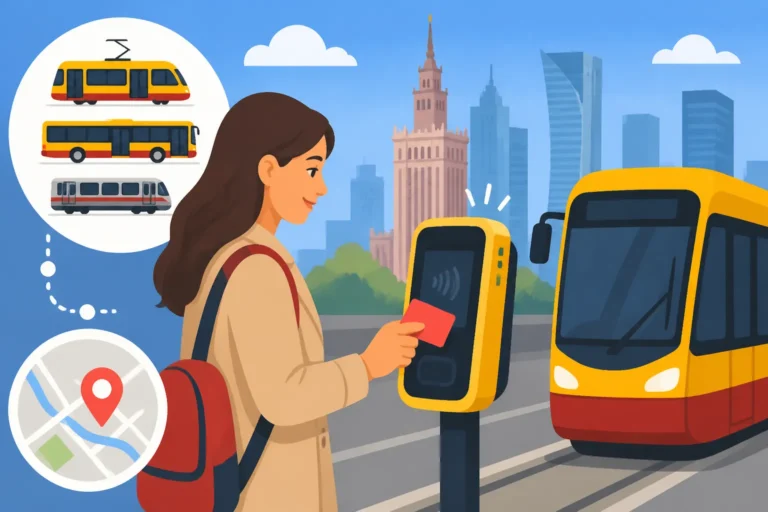
- Physical Tickets: Insert your paper ticket into one of the small, usually yellow or red, validation machines found near the doors of buses, trams, and at the entrance gates of metro stations. You’ll hear a beep and the machine will stamp a date and time on your ticket. If you’re using a long-term pass on your WKM, simply tap the card against the validator.
- Digital Tickets: With apps like Jakdojade, after purchasing, you’ll see an “Activate” button. You must press this button when you board. Some apps might even require you to scan a QR code inside the vehicle. Forgetting to activate your digital ticket is the same as not having one.
The consequences of not validating are severe. ZTM inspectors (kontrolerzy biletów) are frequent and unforgiving. They wear plain clothes and often appear unexpectedly. If caught without a valid, validated ticket, you’ll face a hefty fine (currently around 266 PLN, but can be reduced if paid promptly). Ignorance is not an excuse. Even if you just bought the ticket but forgot to validate, you’ll be fined. Trust me, I’ve seen countless expats and tourists caught out by this, and it’s a frustrating, expensive lesson to learn. So, make it a habit: board, validate, relax.
Cost Comparison: Public Transport vs. Alternatives
While public transport in Warsaw is generally efficient and affordable, it’s worth considering other options depending on your needs, budget, and destination. Sometimes, the cheapest option isn’t always the most convenient, and vice-versa. Understanding these alternatives can help you make informed decisions.
Taxis and Ride-Sharing
For those times when public transport isn’t cutting it – perhaps it’s late at night, you’re carrying heavy luggage, or you just want a direct door-to-door service – taxis and ride-sharing apps are readily available.
- Ride-Sharing (Uber, Bolt, Free Now): These services are extremely popular in Warsaw and generally more affordable than traditional taxis. A typical ride across the city center might cost anywhere from 15 PLN to 40 PLN, depending on distance, time of day (surge pricing can significantly increase costs during peak hours or bad weather), and demand. They offer convenience, cashless payment, and the ability to track your ride. For late-night returns from a bar in Powiśle to your apartment in Ursynów, a Bolt or Uber is usually the most practical choice, even if it’s more expensive than a public transport ticket.
- Traditional Taxis: You’ll find plenty of traditional taxis (often marked with “Taxi” signs and specific company names) at taxi stands, especially around major transport hubs like Warszawa Centralna train station or Chopin Airport. Be cautious and always choose licensed taxis. Make sure the meter is running. While generally reliable, they tend to be more expensive than ride-sharing apps, with prices potentially starting at 8-10 PLN just for getting in, plus a per-kilometer charge. Always agree on a rough price or insist on the meter for longer journeys.
Choosing between public transport and a taxi often boils down to a balance of cost, speed, and comfort. For routine commutes, public transport wins on price, but for convenience, especially after a long journey or a night out, a ride-share service like Bolt is often worth the extra expense.
Cycling and Scooters
Warsaw is increasingly becoming a bike-friendly city, and electric scooters have exploded in popularity as a fun and flexible way to get around for shorter distances.
- Veturilo Bike Sharing: Warsaw boasts one of the largest city bike rental systems in Europe. Veturilo stations are scattered throughout the city. You register online, top up your account, and can rent bikes for short periods. The first 20 minutes are typically free, with subsequent minutes incurring small charges. It’s an excellent way to explore the city’s parks, riverside paths, and central districts on a nice day. For more information on getting around the city, and even if you decide to drive, our guide on Driving in Poland: Licences, Registration and Rules for Expats (2027) covers various transport options.
- E-Scooters (Lime, Bolt, Voi, etc.): Dockless electric scooters are everywhere in Warsaw. You rent them via an app, typically paying an unlocking fee and then a per-minute charge. They’re fantastic for zipping around for 15-30 minute journeys, covering distances that might be too far to walk but not quite long enough for a bus or tram. However, costs can add up if used extensively, and you need to be mindful of parking rules and pedestrian safety. They are often more expensive than a single public transport ticket but offer unparalleled flexibility for short, spontaneous trips.
These options offer a great deal of freedom and can be a healthier, more scenic alternative to buses and trams, especially in good weather. They are particularly good for navigating areas like the Old Town or along the Vistula, where public transport might not offer direct routes.
Walking: The Best Free Option
Let’s not forget the most basic and arguably the best way to experience any city: walking. Warsaw’s city centre is surprisingly walkable, with many key attractions within a reasonable stroll of each other.
For example, you can easily walk from the Old Town Square to the Royal Castle, then through the Krakowskie Przedmieście promenade down to Nowy Świat and on to the Palace of Culture and Science. These are relatively short distances that many visitors and residents cover on foot daily. Not only is walking free, but it also allows you to discover hidden gems, soak in the atmosphere, and stumble upon charming cafes or boutiques you might miss otherwise. It’s also an excellent way to get some exercise and save money, directly impacting your overall The Complete Guide to Cost of Living in Poland for Expats (2026) calculations. For those living centrally, a daily walk to work or the shops can dramatically reduce public transport costs.
Practical Tips for Expats and Tourists
Navigating Warsaw’s public transport, like any new system, has its learning curve. As an expat who’s been through it all, I’ve picked up a few pointers that can make your experience smoother and help you avoid common pitfalls.
Planning Your Journey
Warsaw’s public transport network is vast, but it’s also well-covered by modern technology, making journey planning incredibly easy. Don’t rely solely on paper maps or guesswork.
- Use Apps: As mentioned, Jakdojade is your best friend. It provides real-time updates on bus and tram locations, predicted arrival times, and identifies the fastest routes, including transfers. Google Maps is also excellent for public transport planning in Warsaw, integrating ZTM data seamlessly. Both will tell you exactly which lines to take, where to transfer, and how long your journey will likely be. They also clearly indicate if your route crosses into Zone 2, prompting you to buy the correct ticket. Always check these apps before you leave, especially if you’re unfamiliar with the area, as delays or temporary route changes (especially common during roadworks or festivals) are immediately reflected.
- Understand Peak Hours: Like any major city, Warsaw has peak hours (roughly 7-9 AM and 4-6 PM on weekdays) when public transport is most crowded. If you have flexibility, try to travel outside these times for a more comfortable experience. Metro lines, in particular, can get very busy. When planning your initial move, choosing an apartment that minimizes your commute during these hours can make a huge difference to your daily quality of life, which is something to consider when reviewing The Complete Guide to Renting an Apartment in Poland (2027).
Dealing with Inspectors
Encountering a ZTM inspector without a valid ticket is an experience no one wants. They are efficient, persistent, and not particularly lenient, especially with tourists or those feigning ignorance.
- Always Be Prepared: Assume there’s an inspector on every ride. Have your physical ticket validated, or your digital ticket activated, before you even sit down. If using a long-term pass, ensure it’s topped up and correctly validated. Keep your student ID or other concession documents handy if you’re using a reduced fare ticket.
- What to Expect: Inspectors usually block the exits and ask everyone to show their ticket. They will have a portable device to scan your physical ticket or WKM card. If you’re using an app, they will ask you to show the activated ticket on your phone and might ask for ID. If you cannot produce a valid ticket, they will issue a fine. They usually carry portable payment terminals to accept card payments for fines on the spot, or they will give you a payment slip.
- Language Barrier: While many inspectors might speak some English, don’t rely on it. A firm “Mam bilet” (I have a ticket) and showing your validated ticket or card should suffice. If you’re fined and don’t understand, politely ask for a written explanation or ask to speak to someone who speaks English. It’s generally best to cooperate, as arguing won’t help and can escalate the situation.
Keeping Up-to-Date with Changes
Warsaw is a dynamic city, and its public transport system sometimes changes to accommodate growth, events, or infrastructure projects. Staying informed is important for seamless travel.
- Official ZTM Channels: The ZTM website (ztm.waw.pl) has an English version and is the official source for all news, schedule changes, and fare updates. They also have social media channels (Facebook, X) where they post real-time updates.
- Expat Groups: Joining expat Facebook groups in Warsaw is invaluable. Fellow expats often share real-time information about transport disruptions, new regulations, or useful tips. It’s a great community resource for all sorts of local knowledge, whether you’re looking for job opportunities as discussed in The Expat Guide to Finding a Job in Poland (2027) or just trying to navigate daily life.
- Signage at Stops: Always pay attention to the information boards at bus and tram stops, and within metro stations. These often display temporary route changes or service advisories. While these are usually in Polish, sometimes they include English translations, or you can use a translation app to quickly grasp the crucial details. Getting into the habit of checking these is part of your The Expat Guide to Moving to Poland: Your First 90 Days (2026) and living like a local.
Warsaw Public Transport Ticket Costs at a Glance
To make things a bit clearer, here’s a quick summary of the most common ticket types and their regular (non-reduced) costs in PLN. Prices can change, so always double-check the ZTM website!
| Ticket Type | Zone | Validity | Regular Price (PLN) | Best For |
|---|---|---|---|---|
| 20-minute | 1 | 20 minutes | 3.40 | Very short journeys, few stops, no transfers |
| 75-minute | 1 | 75 minutes | 4.40 | Longer journeys within Zone 1, with transfers |
| 90-minute | 1+2 | 90 minutes | 7.00 | Journeys crossing zones, longer complex routes |
| Single-fare group ticket (10-minute) | 1+2 | 10 minutes (for up to 10 people in one group on one vehicle) | 4.60 | Short group travel on one vehicle |
| 30-day Pass | 1 | 30 days | 110.00 | Regular commuters, residents, frequent Zone 1 travel |
| 30-day Pass | 1+2 | 30 days | 180.00 | Regular commuters living/working across zones |
| 90-day Pass | 1 | 90 days | 280.00 | Long-term residents, best value for Zone 1 |
| 90-day Pass | 1+2 | 90 days | 460.00 | Long-term residents, best value for Zone 1+2 |
| Weekend Ticket | 1+2 | Fri 7 PM – Mon 8 AM | 24.00 | Weekend exploring for individuals |
| Group Weekend Ticket | 1+2 | Fri 7 PM – Mon 8 AM | 40.00 | Weekend exploring for groups (up to 5 people) |
This table provides a good overview, but remember that reduced fares are half these prices for eligible individuals. Always consider your usage patterns: for a few trips a week, short-term tickets might be fine, but for daily commuting, a monthly or quarterly pass is always the most economical choice.
Disclaimer
This article is for general informational purposes only and does not constitute professional advice. Laws, prices and regulations vary by location and change over time. Consult a qualified professional for guidance on your specific situation.