How Do I Travel by Train Between Warsaw and Krakow?
Trying to figure out the best way to travel between Poland's bustling capital, Warsaw, and the historic charm of Krakow can feel like a puzzle, especially when you're new here. There are buses, trains, even flights, but for a comfortable, efficient, and truly scenic journey, the train often comes out on top. This guide is here to cut through the confusion and walk you through everything you need to know about making that iconic journey by train, ensuring a smooth and enjoyable experience, just like a seasoned expat would.
Why the Train is Your Best Bet for Warsaw to Krakow
When you're settling into Poland, especially if you've already navigated the complexities of finding your new home and setting up utilities, you quickly realize that reliable internal travel is key to exploring your new home. For the popular route between Warsaw and Krakow, the train consistently offers a superior experience compared to other options, and for good reason. It’s not just about getting from A to B; it's about how you get there.
Speed and Efficiency: Beating the Traffic Jams
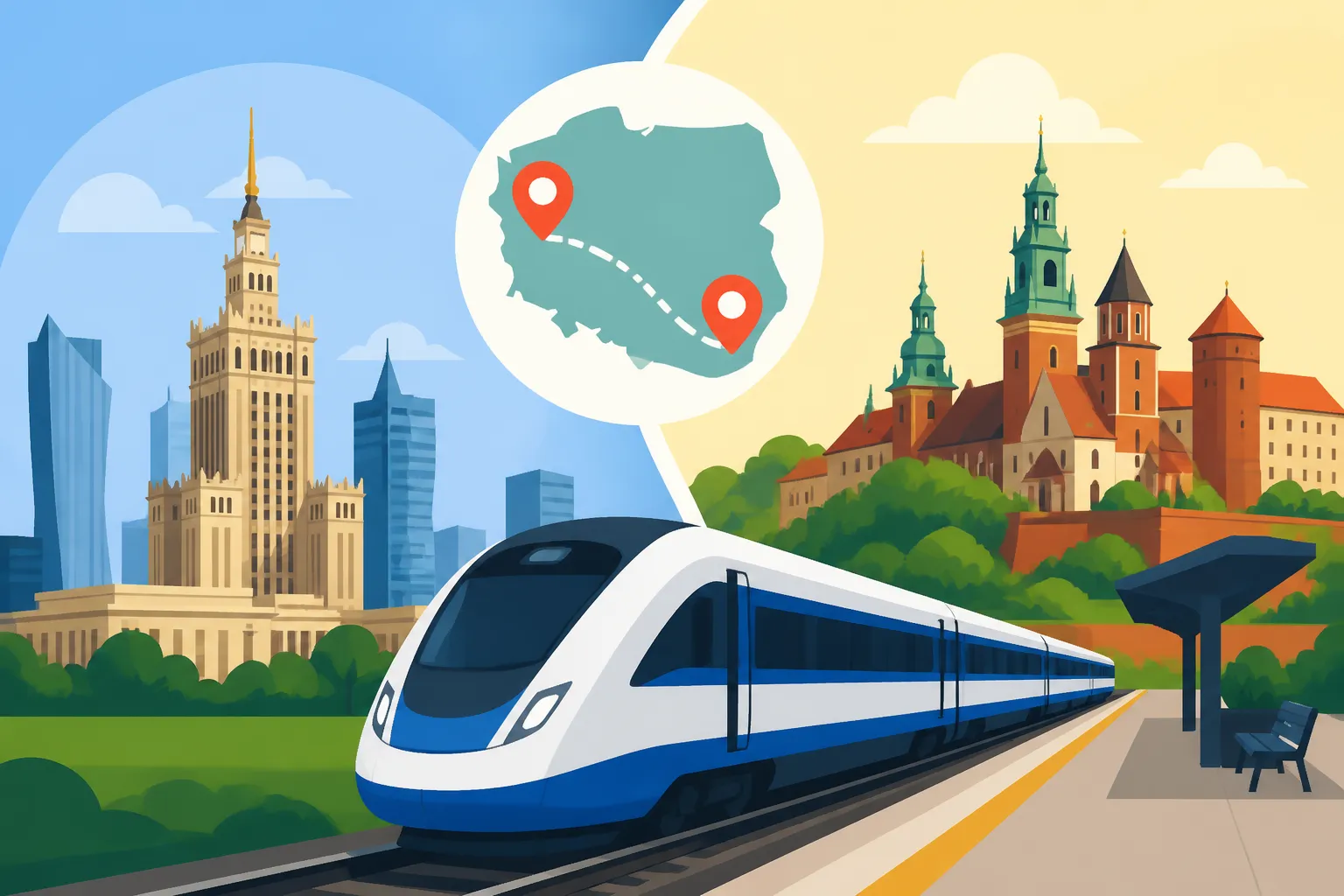
One of the biggest frustrations with bus travel in Poland, especially on a busy route like Warsaw to Krakow, is the unpredictability of road traffic. While the highways have improved significantly, unexpected accidents, construction, or even just rush hour congestion around major cities can add significant time to your journey. Buses might be cheaper, but that saving often comes at the cost of your precious time and peace of mind. Trains, particularly the high-speed EIP (Express InterCity Premium) services, operate on dedicated railway lines, largely unaffected by road conditions. This means a more consistent and predictable travel time, often completing the journey in just 2.5 to 3 hours. When you've got plans in Krakow, knowing exactly when you'll arrive is invaluable.
Comfort and Convenience: More Than Just a Seat
Let’s be honest, squeezing into a bus seat for several hours, with limited legroom and often no personal space, isn't anyone's idea of fun. The train, on the other hand, offers a completely different level of comfort. You get spacious seating, often with tables, allowing you to work, read, or simply stretch out. On longer journeys, being able to stand up, walk around, and even visit the dining car (Wagon Restauracyjny) makes a huge difference. Think about it: you can grab a coffee, enjoy a snack, or just clear your head without feeling cooped up. Plus, trains usually depart and arrive right in the city centres – Warszawa Centralna and Kraków Główny are incredibly well-connected, meaning less hassle with transfers compared to bus stations often located on city outskirts. You'll also appreciate having somewhere safe and accessible to store your luggage, which can be a real headache on crowded buses. If you’re just moving into the country, having handled the logistics with a service like Sirelo, the last thing you want is a cramped journey to your next Polish city.
Reliability and Accessibility: A Smoother Journey for All
Polish trains, especially the PKP Intercity services, are generally very reliable. While delays can happen, they are less frequent and usually shorter than those experienced on the roads. For expats still getting their bearings, this consistency is a huge plus. The main train stations, like Warszawa Centralna and Kraków Główny, are centrally located and easily accessible by local public transport. This makes the start and end of your journey much smoother. If you're pondering how to get around without a car, our guide on The Expat Guide to Public Transport in Poland offers even more insights into navigating the urban sprawl. Furthermore, trains often provide better facilities for passengers with disabilities, including accessible carriages and assistance upon request, ensuring that travel is an option for everyone.
Navigating PKP Intercity: Poland's National Rail Service
When you decide to travel by train in Poland, you'll almost certainly be using PKP Intercity, which is the national long-distance passenger rail operator. They manage the routes connecting major cities like Warsaw and Krakow, offering different categories of trains, each with varying levels of speed, comfort, and, naturally, price. Understanding these categories is key to choosing the right ticket for your needs.
Express InterCity Premium (EIP) – The Pendolino Experience
The EIP trains, often referred to as Pendolino, are Poland's flagship high-speed service. These are the fastest, most modern, and most comfortable trains you can take between Warsaw and Krakow. They offer a premium experience with comfortable, ergonomic seats, power outlets at every seat, and complimentary refreshments (a drink and a snack, sometimes more substantial depending on the class and time of day). There's also usually free Wi-Fi, though signal strength can vary on the route, and a dining car for more elaborate meals. The journey time on an EIP train from Warszawa Centralna to Kraków Główny typically ranges from 2 hours 20 minutes to 2 hours 45 minutes, making it the quickest option. If you're looking for the most efficient and comfortable journey, and don't mind paying a bit extra, EIP is the way to go. These trains offer both 1st and 2nd class.
Express InterCity (EIC) – Fast and Comfortable
EIC trains are another excellent option, offering a high standard of comfort and speed, albeit slightly slower and less luxurious than the Pendolino. They are still modern, well-maintained, and provide a very pleasant travel experience. You'll find comfortable seating, power outlets, and often a dining car. While complimentary refreshments aren't standard in 2nd class as they are on EIP, you can certainly purchase food and drinks on board. The journey time between Warsaw and Krakow on an EIC train usually falls within the 2 hours 45 minutes to 3 hours 15 minutes range. They are a great middle-ground if EIP prices are a bit steep but you still want a fast and comfortable ride. EIC trains also offer both 1st and 2nd class. Our in-depth guide, Understanding Train Travel with PKP Intercity in Poland, provides a broader context on these and other train categories across the country.
InterCity (IC) and Twoje Linie Kolejowe (TLK) – The Budget-Friendly Options
IC and TLK are the most economical long-distance train categories. These trains are generally older, slower, and less comfortable than EIP or EIC, but they are perfectly functional and a solid choice if you're on a tighter budget or not in a rush. Journey times between Warsaw and Krakow on IC or TLK trains can range from 3 hours 15 minutes to 4 hours or more, due to more stops and older rolling stock. While they might lack some of the amenities of their premium counterparts, they still offer a reliable way to travel. You'll find standard seating, and usually a bistro car where you can purchase snacks and drinks, but no complimentary service. Power outlets are not guaranteed at every seat, and Wi-Fi is less common. If you’re careful with your budget and planning out The Complete Guide to Cost of Living in Poland for Expats (2026), these trains offer a more wallet-friendly option for your intercity travels. Both IC and TLK typically offer 1st and 2nd class, with 1st class providing slightly more spacious seating.
To help you decide, here’s a quick comparison of the train types for the Warsaw-Krakow route:
| Train Type | Journey Time (Approx.) | Comfort Level | Amenities | Price Range (2nd Class) |
|---|---|---|---|---|
| EIP (Pendolino) | 2h 20m – 2h 45m | Premium | Modern seats, power, Wi-Fi, complimentary refreshments, dining car | Higher |
| EIC | 2h 45m – 3h 15m | High | Comfortable seats, power, dining car (paid) | Medium-High |
| IC | 3h 15m – 3h 45m | Standard | Standard seats, bistro car (paid) | Medium |
| TLK | 3h 30m – 4h+ | Basic | Standard seats, bistro car (paid) | Lower |
Note: Prices vary significantly based on how far in advance you book, demand, and promotions.
Your Ticket to Ride: Booking and Buying Train Tickets
Once you've decided on your preferred train category, the next step is securing your ticket. Thankfully, PKP Intercity has made the booking process fairly accessible for foreigners, with multiple options available.
Booking Online: The Easiest Way for Expats
For most expats, booking tickets online is by far the most convenient method. The primary platform is PKP Intercity's own website (intercity.pl), which is available in both Polish and English. This is where you'll find the most up-to-date schedules, availability, and promotional fares.
Here's a general step-by-step guide:
- Visit intercity.pl: Make sure you switch the language to English if needed (usually a flag icon or "EN" in the top right corner).
- Enter your journey details: Input "Warszawa Centralna" (Warsaw Central) as your departure station and "Kraków Główny" (Krakow Main) as your destination. Choose your travel date and time.
- Select your train: You'll see a list of available connections, categorised by EIP, EIC, IC, or TLK. Pay attention to the journey time and price.
- Choose your class and seat: You can select 1st or 2nd class. For some trains, you can also pick your seat from a carriage map, which is handy if you prefer a window, aisle, or want to sit with companions.
- Enter passenger details: You'll need to provide names for all passengers. If you have any discounts (e.g., student, senior, Karta Dużej Rodziny), make sure to select them here.
- Payment: You can pay with international credit/debit cards or through Polish payment systems like BLIK. Once paid, your e-ticket will be sent to your email address. You can print it or simply show it on your phone when the conductor checks tickets.
Booking in advance is highly recommended, especially for EIP and EIC services, as prices tend to increase closer to the departure date, and popular routes can sell out, particularly on weekends or holidays. The earlier you book, the better chance you have of snagging a cheaper "Promo" ticket.
Another useful platform is Bilkom.pl, which is a third-party aggregator that also allows you to buy tickets for PKP Intercity, as well as some regional train operators. It's user-friendly and sometimes offers a slightly different interface if you find the main PKP site cumbersome.
Using Mobile Apps for On-the-Go Booking
Several mobile apps can also make booking a breeze. The official PKP Intercity app is available for both Android and iOS and offers similar functionality to the website. Other popular apps include Jakdojade (primarily for public transport but also shows train connections) and KOLEO, which is another excellent choice for buying train tickets across various Polish operators, including PKP Intercity. These apps are especially useful if you're traveling spontaneously or need to make changes on the go. And speaking of staying connected, if you're like me and rely on your phone for everything, having a good eSIM like those offered by Airalo can be a lifesaver for booking on the go or just staying entertained during your journey.
Purchasing at the Train Station: For the Traditionalists
If you prefer face-to-face interaction or need assistance with your booking, you can always buy tickets directly at the train station.
- Ticket Offices (Kasa Biletowa): Look for these counters at Warszawa Centralna or Kraków Główny. Most larger stations will have at least one English-speaking agent, but it’s helpful to have your destination and preferred train time written down in Polish just in case. Be prepared for potential queues, especially during peak travel times.
- Ticket Machines (Biletomat): These self-service machines are available at most major stations and usually offer an English language option. They are convenient for quick purchases and accept both cash and card. Just select your destination, train, class, and follow the on-screen prompts.
- Conductor on Board: While technically possible to buy a ticket from the conductor once on the train, this should be a last resort. You typically need to immediately inform the conductor before finding a seat, and there's usually an additional fee charged. On EIP trains, buying a ticket from the conductor is generally not possible, so make sure you have your EIP ticket in advance to avoid any issues or fines.
Remember that getting your PESEL number and why it matters for healthcare is often one of the first bureaucratic hurdles you overcome in Poland, but when it comes to travel, your passport and a credit card are usually all you need for train tickets.
The Journey Itself: What to Expect Onboard
So, you’ve got your ticket in hand, whether it's a sleek e-ticket on your phone or a traditional paper one. Now, it’s time for the journey from Warsaw to Krakow. Knowing what to expect once you're on the train can make the trip even more relaxing and enjoyable.
Finding Your Train and Seat
Polish train stations, particularly Warszawa Centralna and Kraków Główny, are well-organised but can be busy. Always check the departure boards (tablica odjazdów) for your train number (numer pociągu), platform (peron), and track (tor). Give yourself ample time, especially if you have heavy luggage, as platforms can sometimes be a bit of a walk, and you might need to use stairs or escalators. Once you're on the platform, check the electronic displays on the train carriages themselves, which usually indicate the train number and destination.
Each ticket has a specific carriage number (wagon) and seat number (miejsce). Look for the numbers on the side of the train carriages to find your wagon, then once inside, find your seat. On EIP and EIC trains, seats are clearly numbered and usually reserved. On IC and TLK, while you'll have a seat number, sometimes people might be in your assigned seat, especially if the train is very full. A polite "Przepraszam, to jest moje miejsce" (Excuse me, this is my seat) usually does the trick.
Onboard Amenities and Services
The amenities vary depending on the train type you chose:
- Wi-Fi and Power Outlets: As mentioned, EIP and EIC trains typically offer free Wi-Fi and power outlets at most seats, making it easy to stay connected or charge your devices. For IC and TLK, Wi-Fi is less common, and power outlets are hit-or-miss. Having a portable charger is always a good idea, as is considering an eSIM from Airalo for consistent data if onboard Wi-Fi isn't reliable enough.
- Dining Car (Wagon Restauracyjny/Bistro): All PKP Intercity trains usually have a dining or bistro car. On EIP trains, this is a full restaurant car with a menu of hot meals, sandwiches, snacks, and drinks. EIC, IC, and TLK trains usually have a bistro section offering simpler fare like coffee, tea, soft drinks, sandwiches, and some hot snacks. It’s a great way to stretch your legs and grab a bite.
- Toilets: Clean toilets are available on all trains.
- Luggage Storage: Overhead racks are available for smaller bags, and larger luggage racks are typically found at the ends of the carriages or sometimes between seats.
The Scenic Route and What to See
The journey between Warsaw and Krakow isn't dramatically scenic compared to some mountain routes, but it does offer glimpses of the Polish countryside. You'll pass through agricultural lands, small towns, and forests. It's a great opportunity to just relax, perhaps catch up on some reading or listen to music, and watch Poland roll by outside your window. For those moving to Poland, this journey is often one of the first times you get to truly see the landscape outside the major cities. If you're fresh off the plane, our guide, The Complete Guide to Moving to Poland: Your First 90 Days (2027), provides broader insights into settling in.
Arriving in Krakow: From Station to City Centre
Welcome to Krakow! Your train will arrive at Kraków Główny, which is the city's main railway station and perfectly situated for easy access to all the city has to offer. Unlike some other European cities where the main station might be a bit out of the way, Krakow's station is virtually integrated into the city centre.
Stepping Off the Train: A Seamless Transition
Kraków Główny is located right next to Galeria Krakowska, a large shopping mall. This means you literally step off the train and into a vibrant hub of shops, cafes, and services. The station itself is modern and multi-level, with clear signage (often in English) to help you navigate. There are plenty of ATMs, currency exchange offices (kantor), and small shops where you can grab a quick bite or a drink.
Getting to Your Accommodation
From Kraków Główny, you have several excellent options to reach your hotel or apartment:
- Walking: If your accommodation is in the Old Town (Stare Miasto) or Kazimierz, you might find that it's within comfortable walking distance. The main market square (Rynek Główny) is just about a 10-15 minute walk from the station exit. It’s a pleasant stroll through pedestrian zones and bustling streets.
- Public Transport: Krakow has an extensive and efficient network of trams and buses. The main public transport hub, Dworzec Główny Wschód and Dworzec Główny Zachód, is located right outside the train station, offering numerous connections. You can buy tickets from machines at most stops, inside trams/buses, or using mobile apps like Jakdojade. Remember to validate your ticket immediately after boarding. Our guide on How to Use the Public Transport Ticket System in Polish Cities will be your best friend here.
- Taxis/Ride-Sharing: Official taxi stands are located outside the station. Be sure to use licensed taxis or popular ride-sharing apps like Bolt or Uber for transparent pricing. Avoid unofficial solicitors who might approach you inside the station.
- Airport Transfers: If you're heading straight to Krakow Airport (Balice), there's a dedicated train service (Koleje Małopolskie) that departs frequently from Kraków Główny, taking about 17 minutes.
Krakow is a wonderfully walkable city, and arriving directly in the heart of it by train is definitely the most convenient way to start your adventure. Enjoy the beautiful architecture, delicious food, and rich history that awaits you!
Disclaimer
The information provided in this guide is intended for general informational purposes only and may not reflect the most current regulations or service offerings. Train schedules, prices, and amenities can change. Always verify details with official sources like PKP Intercity's website or app before making travel plans. We are not responsible for any inaccuracies or outdated information.