Understanding the Polish Language Requirement for Citizenship
Alright, my friends, let's talk about something that often feels like the final boss battle for many expats on their journey to truly settling down in Poland: the Polish language requirement for citizenship. Believe me, I know how daunting it feels. You've navigated the visa maze, found a job, maybe even bought a place, and now the government wants you to prove you can conjugate verbs in a language famous for its seven cases and tongue-twisting consonants. This isn't just about ticking a box; it's a significant hurdle that many aspiring Polish citizens face, and this guide is here to help you understand it, conquer it, and come out the other side.
The Core Expectation: Why Language Matters for Polish Citizenship
When you're aiming for something as profound as Polish citizenship, it's not just about spending a certain number of years in the country or having a steady job. The authorities genuinely want to see that you've integrated, that you understand and can engage with Polish society, and for better or worse, language is seen as the primary gateway to that integration. It's a fundamental part of showing your commitment to making Poland your permanent home.
More Than Just a Test: The Philosophy Behind the Requirement
From the perspective of the Polish state, requiring language proficiency isn't just bureaucratic red tape; it's a statement about cultural and social cohesion. They want to ensure that new citizens can participate fully in civic life, communicate effectively in everyday situations, and understand the nuances of Polish culture without constant reliance on interpreters or others. Think about it: how can you truly feel at home, vote, engage with local government, or even help your kids with their schoolwork if you can't understand the language? It's about empowering you to be an active, self-sufficient member of the community.
For many of us, this can feel like an unfair burden. We've built lives here, contributed to the economy, and yet we're still asked to prove our "Polishness" through a challenging exam. It can be frustrating, especially if you're coming from a country where language isn't as central to the citizenship process. But understanding the underlying philosophy can help shift your perspective from a chore to a goal that will enrich your life here. It's not just for them; it's ultimately for you too.
The Legal Basis: Where It's Stated in Polish Law
The requirement for Polish language proficiency is enshrined in Polish law, specifically in the Act on Polish Citizenship (Ustawa o obywatelstwie polskim). For most foreigners applying for Polish citizenship through naturalisation, one of the key conditions is demonstrating knowledge of the Polish language. While there are exceptions, particularly for those applying through descent or marriage to a Polish citizen, the general rule is clear: you need to prove your chops.
This legal framework ensures consistency across all applications. It prevents arbitrary decisions and sets a standard for integration. It also dictates how you can prove this knowledge, usually through an official state certificate. This isn't some arbitrary rule cooked up by a local urząd; it's a nationwide mandate. It’s important to familiarize yourself with these specific articles of the law if you want to understand the exact letter of the requirement, but for most of us, knowing that it's a requirement and how to meet it is the priority. The process of obtaining Permanent Residence in Poland: The Complete Pathway (2027) often has similar language considerations, serving as a stepping stone.
Unpacking the B1 Level: What Does It Really Mean?
So, you're told you need B1 level Polish. If you're new to language learning, this might just sound like a random code. But B1 is a specific benchmark within the Common European Framework of Reference for Languages (CEFR), and it's helpful to understand what it truly entails. It's not about being perfectly fluent or speaking like a native; it's about functional communication.
Deconstructing the Common European Framework of Reference (CEFR)
The CEFR is an international standard that describes language ability on a six-point scale: A1 (beginner), A2 (elementary), B1 (intermediate), B2 (upper intermediate), C1 (advanced), and C2 (proficiency). B1 is generally considered the "threshold" level, where a learner becomes independent in the language.
At the B1 level, you should be able to:
- Understand the main points of clear standard input on familiar matters regularly encountered in work, school, leisure, etc.
- Deal with most situations likely to arise whilst travelling in an area where the language is spoken.
- Produce simple connected text on topics that are familiar or of personal interest.
- Describe experiences and events, dreams, hopes and ambitions and briefly give reasons and explanations for opinions and plans.
It's about being able to manage day-to-day life and express yourself in a range of common situations without constant strain. It means you can order food, ask for directions, understand a simple news report, write a basic email, and hold a conversation about your hobbies or job. It’s not about discussing philosophy or complex political theories, but about navigating the practicalities of living in Poland. For those thinking about their long-term stay, understanding The Complete Guide to Polish Residence Permits for Expats (2027) will show how language proficiency builds up over time.
Practical Skills Assessed: Reading, Writing, Listening, and Speaking
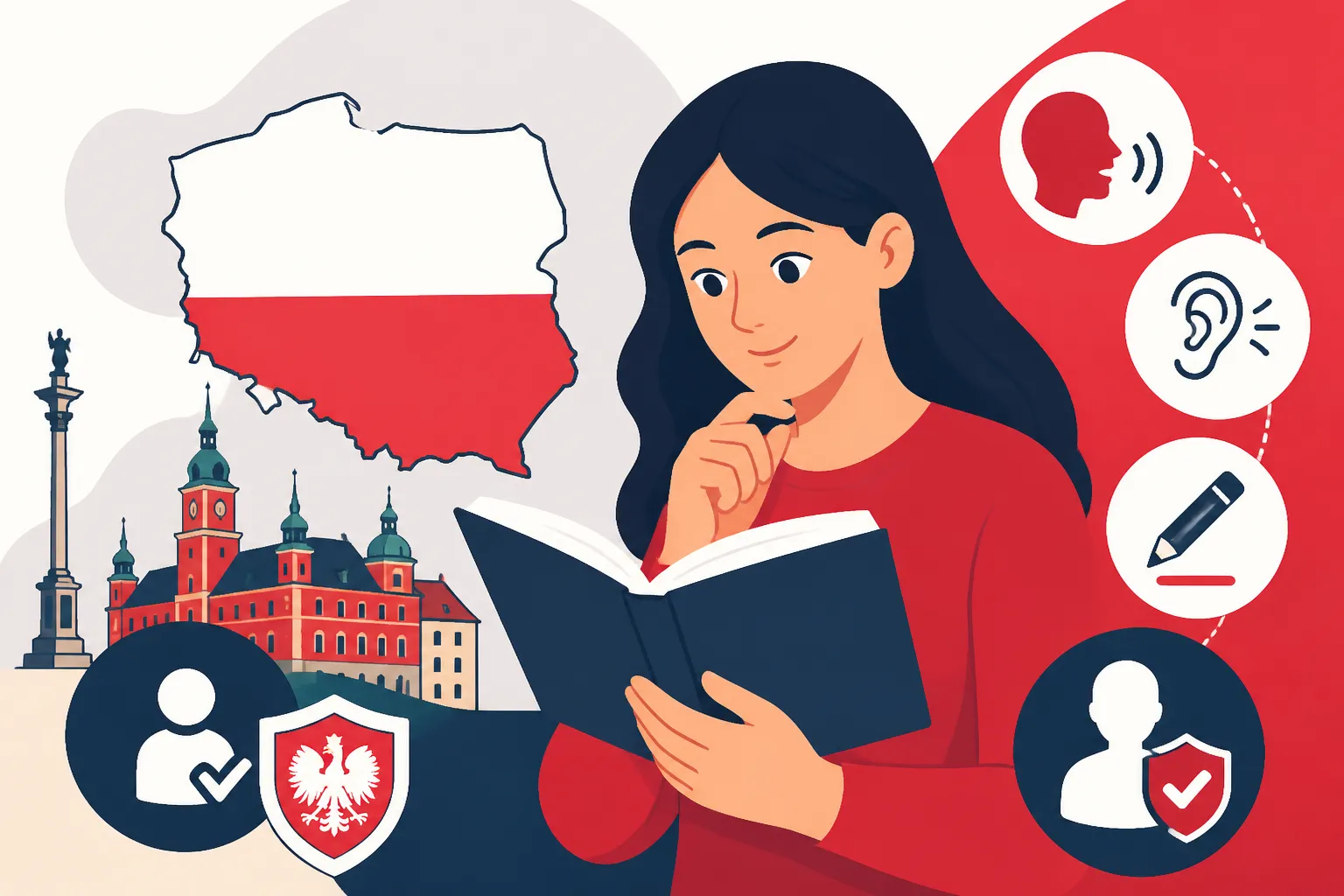
The Polish state certificate exam, which is the most common way to prove B1 proficiency for citizenship, rigorously tests all four core language skills:
- Reading (Rozumienie tekstów pisanych): You'll be given texts like newspaper articles, short stories, official notices, or emails and asked to answer comprehension questions. This section tests your ability to extract main ideas, specific information, and infer meaning from context. It's not just about vocabulary; it's about understanding real-world Polish texts.
- Listening (Rozumienie ze słuchu): This involves listening to audio recordings of conversations, announcements, or short reports and answering questions based on what you hear. The accents will be standard Polish, and the topics will be everyday scenarios. This section often trips people up because it requires quick processing of spoken Polish, which can be challenging, especially with background noise or natural speech rhythms.
- Writing (Poprawność gramatyczna i wypowiedź pisemna): You'll typically have two writing tasks. One might be a more structured exercise, like filling in gaps or transforming sentences, focusing on grammar. The other will be a free-response task, such as writing an email, a short letter, or an opinion piece on a familiar topic. Here, clarity, grammatical accuracy, appropriate vocabulary, and coherence are key.
- Speaking (Wypowiedź ustna): This is often the most nerve-wracking part. You'll usually have a conversation with an examiner, possibly involving role-playing a scenario (e.g., at a shop, doctor's office, or giving advice), describing pictures, and discussing a personal topic. They want to see if you can communicate spontaneously, express opinions, and interact effectively. This is where all those frustrating hours of trying to form sentences really pay off.
The exam really wants to see if you can use Polish in a practical sense, not just recite grammar rules. It’s a holistic assessment designed to ensure you're truly capable of functioning in a Polish-speaking environment.
Proving Your Polish Proficiency: Accepted Documents and Exemptions
So, how do you actually show the Polish government that you've hit that elusive B1 mark? The process is quite specific, and while the state certificate is king, there are other avenues and even some exemptions that can save you a lot of headache.
The Official State Certificate in Polish as a Foreign Language (Certyfikat Państwowy)
For the vast majority of applicants, the gold standard is the State Certificate in Polish as a Foreign Language. This is the most common and universally accepted proof of proficiency. These exams are organised by the State Commission for the Certification of Proficiency in Polish as a Foreign Language (Państwowa Komisja Poświadczania Znajomości Języka Polskiego jako Obcego) and are held a few times a year in various locations across Poland and even internationally.
You need to register well in advance, and the spots fill up quickly! The cost for the exam can be a few hundred zlotys, and if you don't pass, you'll have to pay again for a retake. This certificate is designed specifically to meet the legal requirements for citizenship, so it’s tailored to assess the B1 level skills as outlined earlier. Once you pass, you receive a certificate that is valid indefinitely and directly recognised by the Urząd Wojewódzki (Voivodeship Office) when you apply for citizenship. For more details on preparing, consider Learning Polish: A Complete Guide to Language Courses and Levels.
Educational Pathways: Diplomas and University Degrees
If the idea of an exam fills you with dread, don't despair! There are other ways to satisfy the language requirement. If you have completed certain levels of education in Poland, you might be exempt from taking the certificate exam. Specifically:
- Completion of a Polish primary or secondary school: If you attended and graduated from a public Polish school system, your diploma is usually sufficient proof of language knowledge.
- Completion of higher education (university) in Poland with Polish as the language of instruction: If you earned a degree from a Polish university where the courses were taught in Polish, this diploma often serves as proof. This is a big one for many international students who decide to stay and apply for citizenship. The important caveat here is "Polish as the language of instruction." If you studied in an English-language program, your degree won't count for the language requirement, even if you lived in Poland for years.
Always double-check the specific requirements with the Urząd Wojewódzki where you plan to apply, as interpretations can sometimes vary slightly, or there might be additional documents needed to confirm the language of instruction.
Navigating Special Circumstances and Exemptions
Life in Poland is rarely straightforward, and thankfully, the language requirement has a few nuances and exemptions.
- Minors: Children applying for citizenship, especially those under a certain age (often 16 or 18, check current regulations), may have relaxed or no language requirements, particularly if they are included in their parents' application or have already been integrated into the Polish school system.
- Marriage to a Polish Citizen: While marrying a Polish citizen doesn't automatically grant you citizenship, it shortens the residency requirement. However, for naturalisation, you still typically need to prove B1 Polish. The exception here might be for individuals who were married for a long time (e.g., 3 years) and have lived in Poland for a substantial period (e.g., 2 years) prior to application. Again, the language test is generally still a requirement, but there might be slightly different conditions for proving it.
- Karta Polaka Holders: If you hold a Karta Polaka (Pole's Card), which acknowledges your Polish origin, you typically have an easier path to permanent residence and then citizenship. In some cases, holding a Karta Polaka can exempt you from the language requirement altogether, as possessing the card itself implies a certain level of connection and, often, proficiency in the Polish language and culture. This is a significant advantage for those who qualify.
It's absolutely critical to confirm any potential exemptions directly with the Urząd Wojewódzki or a legal professional specializing in immigration. Don't assume anything, because rules can change, and your individual circumstances might be unique. Preparing your documents for a How to Apply for a Temporary Residence Permit (Karta Pobytu) in Poland or Understanding Naturalisation Requirements in Poland will involve similar diligence.
Preparing for the Polish Citizenship Language Exam
Okay, so you've determined you need to take the B1 exam. Now what? The preparation phase is crucial, and thankfully, there's a wealth of resources available. This isn't a test you can just waltz into; it requires dedication, consistent effort, and a strategic approach.
Finding the Right Resources: Courses, Tutors, and Self-Study Materials
Embarking on the journey to B1 Polish requires a multi-faceted approach. Think of it as building a house – you need a solid foundation, skilled help, and the right tools.
- Language Schools and Courses: This is often the most effective route. Enrolling in a dedicated Polish language school or course that specifically prepares students for the B1 state certificate exam is highly recommended. Many schools in major cities like Warsaw, Krakow, and Wroclaw offer such courses. They provide structured lessons, cover all four skills, and often use past exam papers for practice. The teachers are usually experienced in guiding expats through the intricacies of Polish grammar and pronunciation. These schools understand the exam format inside and out, offering invaluable tips and strategies. Look for schools accredited to teach Polish as a foreign language.
- Private Tutors: If group classes aren't your style or you need more personalised attention, a private tutor can be a game-changer. A good tutor can identify your weaknesses, provide targeted exercises, and give you constant feedback, especially on your speaking and writing. They can also help you practice mock exam scenarios one-on-one, which significantly reduces exam day anxiety. Many expats find tutors through online platforms or recommendations from other foreigners. Don't be afraid to try a few until you find one whose teaching style clicks with you.
- Self-Study Materials: Alongside formal lessons, self-study is indispensable.
- Textbooks: Invest in textbooks specifically designed for B1 Polish learners. Look for those that come with audio CDs for listening practice.
- Grammar Guides: A good Polish grammar book will be your best friend (or sometimes, your worst enemy, but a necessary one!).
- Vocabulary Apps: Apps like Memrise or Anki can help you rapidly expand your vocabulary. Focus on high-frequency words and phrases relevant to everyday life.
- Past Exam Papers: Critically important! The State Commission's website often publishes sample tests or you can find them in specialised books. Practicing with these gives you a clear idea of the exam structure, timing, and types of questions.
- Polish Media: Immerse yourself! Watch Polish TV shows (with Polish subtitles initially), listen to Polish radio or podcasts, and try reading simple Polish news articles. Even if you don't understand everything, it helps train your ear and familiarises you with natural language use. Websites like Polskie Radio or TVP VOD are great resources.
- Conversation Partners: Find Polish friends or language exchange partners. Speaking regularly is crucial for improving fluency and confidence. Don't be shy; most Poles appreciate the effort!
Remember, the key is consistency. A little bit every day is far more effective than cramming once a week. Some expats even find that a bit of practical experience, like setting up their How to Set Up an Internetowe Konto Pacjenta (IKP) Patient Account or navigating the public transport system in Polish, indirectly helps with language acquisition.
What to Expect on Exam Day: Structure and Logistics
Exam day can be stressful, but knowing what's coming can help. The State Certificate exam is typically divided into two main parts: the written exam and the oral exam.
The Written Exam (Usually Morning):
This part covers reading, listening, and writing.
- Timing: Expect several hours, usually with short breaks between sections.
- Format: You'll receive a booklet with all the questions and separate answer sheets. Ensure you read instructions carefully – in Polish, of course!
- Sections:
- Listening: You'll listen to audio files played aloud in the room. You usually get two listens for each audio.
- Reading: You'll work through various texts.
- Writing: You'll complete the grammar exercises and then write your longer text.
- Materials: Bring good pens, pencils, and maybe some water. Dictionaries are usually NOT allowed for B1, so check specific rules.
The Oral Exam (Usually Afternoon or a Different Day):
This is where you showcase your speaking skills.
- Timing: This is much shorter, typically 10-15 minutes per candidate.
- Format: You'll be in a room with one or two examiners. They are there to assess you, not trick you, so try to relax and engage.
- Tasks: You might start with some general questions about yourself, then move on to describing a picture, engaging in a role-play, or discussing a specific topic.
- Preparation: While waiting for your turn, you might be given a few minutes to prepare for certain tasks, like choosing a topic to discuss or looking at a picture.
Logistics:
- Location: Exams are held at designated centers, usually universities or language schools. Confirm the exact address and how to get there well in advance.
- ID: Bring your passport or Karta Pobytu, as strict ID checks are performed.
- Punctuality: Be on time, or even early. Latecomers might be turned away.
- Results: Results take time, often a few weeks or even months. You'll typically be notified by mail or email, and the certificate itself will be sent to you.
- Passing Score: You usually need to achieve a certain percentage in each section to pass the overall exam, not just an average. This means you can't be brilliant at speaking but terrible at writing and still pass.
Don't underestimate the role of mental preparation. A good night's sleep, a healthy breakfast, and trying to stay calm will serve you well. Even considering comprehensive insurance options like Cigna Global for peace of mind about your health during this stressful period can indirectly help you focus on your studies.
Beyond the Certificate: Language as a Bridge to Polish Life
Getting that B1 certificate in Polish is a monumental achievement, a tangible result of your hard work. But remember, it's just a piece of paper. The real reward, and the true purpose of the language requirement, lies in how it transforms your daily life in Poland.
The Untapped Benefits of Fluency in Daily Expat Life
Once you've achieved a functional level of Polish, the doors that open are incredible. Suddenly, navigating bureaucracy becomes less of a terrifying ordeal and more of a manageable chore. You can understand a lot more of the local news, engage in conversations with your neighbours beyond basic pleasantries, and even decipher the subtle humour in Polish memes.
Think about it:
- Navigating Officialdom: Renewing your Karta Pobytu or understanding the nuances of Filing Your Annual Tax Return (PIT) in Poland: The Complete Walkthrough (2027) becomes significantly less stressful when you can understand the forms and speak directly to officials. No more relying on Google Translate or hoping the official speaks English.
- Healthcare: Finding an English-speaking doctor is one thing, but being able to explain your symptoms clearly in Polish, understand the diagnosis, and fill prescriptions at an apteka without a hitch changes everything. While good health insurance, like from Cigna Global, is essential, language truly empowers you.
- Social Life: Polish people are generally welcoming, but forming deeper connections often requires bridging the language gap. You can join local clubs, attend community events, and truly feel like a part of the fabric of society, not just an observer.
- Work Opportunities: Even in international companies, knowing Polish can significantly boost your career prospects, allowing you to interact more effectively with local teams, clients, and suppliers.
- Cultural Immersion: Understanding the language unlocks the true depth of Polish culture – its literature, cinema, music, and even its unique sense of humour. You'll move beyond being a tourist and become a true resident.
The initial frustrations with learning Polish are real, believe me. But the long-term benefits far outweigh those struggles. It's an investment in your life here that pays dividends every single day. The process of moving and settling in, handled by services like Sirelo, might get you to Poland, but language truly makes it home.
Maintaining and Improving Your Polish Skills Post-Citizenship
Passing the B1 exam and getting your citizenship is not the finish line for your language journey; it's just the end of the first chapter. Languages are living things, and like any skill, if you don't use them, you lose them. To truly integrate and continue to thrive, you'll want to actively maintain and even improve your Polish.
- Keep Using It: Make a conscious effort to use Polish every day. Speak with friends, colleagues, and shopkeepers. Don't revert to English just because it's easier.
- Read Regularly: Pick up Polish books, newspapers, or online articles. Start with topics you enjoy to keep it engaging.
- Watch and Listen: Continue watching Polish films, TV series, and listening to podcasts or radio. It's excellent for keeping your comprehension sharp and picking up new vocabulary and idioms.
- Consider Higher Levels: If you're ambitious, why not aim for B2 or even C1? Many language schools offer advanced courses. The more fluent you become, the richer your experience in Poland will be.
- Engage in Polish Life: Get involved in local community activities, volunteer, or join a hobby group. These are fantastic ways to practice language in natural, social contexts. For example, understanding The Expat Guide to Public Transport in Poland or simply ordering coffee at your local kawiarnia becomes second nature.
Becoming a Polish citizen means embracing the country fully, and a huge part of that is embracing its language. It's a journey, not a destination, but a deeply rewarding one that will connect you to your new home in ways you never thought possible.
Disclaimer
The information provided in this guide is for general informational purposes only and does not constitute legal, financial, or immigration advice. While we strive to provide accurate and up-to-date information, regulations and procedures in Poland can change rapidly. It is essential to consult with an authorised legal professional or the relevant Polish authorities (such as the Urząd Wojewódzki or Polish consulate) for advice tailored to your specific situation regarding Polish citizenship and language requirements. We recommend verifying all information with official sources before making any decisions.