How Do I Find a Dentist That Accepts the NFZ in Warsaw?
Waking up with a throbbing toothache is stressful enough, but realizing you don't know how to access the public healthcare you pay for through your taxes adds a whole new layer of anxiety. Navigating the Polish dental system as an expat often feels like a bureaucratic maze. This guide breaks down exactly how to find a dentist in Warsaw that accepts the NFZ, what services are covered, and how to survive the administrative hurdles.
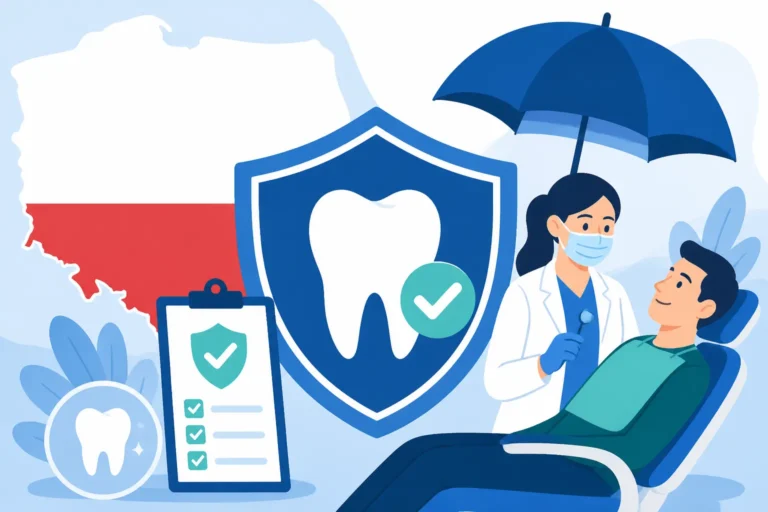
Understanding NFZ Dental Coverage: What Is Actually Free?
One of the biggest shocks for expats moving to Poland is discovering that "universal healthcare" does not mean "everything is free." When it comes to dentistry, the National Health Fund (NFZ) provides a very specific safety net, but it is far from comprehensive. If you are used to high-end private clinics, the public system will require a shift in expectations regarding both materials used and wait times.
Basic Services and the White Filling Rule
Under the NFZ, you are entitled to a general dental examination once a year and a basic cleaning (scaling) once a year. However, the most common point of frustration involves fillings. In Poland, the NFZ only covers high-quality white composite fillings for the front teeth—specifically from canine to canine (teeth 1 to 3). For your molars (the "back teeth"), the public system typically only covers "chemically cured" fillings or, in some cases, amalgam, though the latter is being phased out. If you want a light-cured white composite filling on a molar, you will almost always have to pay the difference or the full price out of pocket.
This is a crucial distinction to understand before you sit in the chair. You should always ask the dentist beforehand: "Czy to jest na NFZ, czy muszę dopłacić?" (Is this on the NFZ, or do I have to pay extra?). Many expats find that while the check-up is free, the actual work they want requires private payment. Understanding Public vs Private Healthcare in Poland: Which Should Expats Choose? can help you decide if the public route is worth the wait for your specific dental needs.
Pediatric Dentistry and Orthodontics
The rules change significantly when children are involved. The Polish state is much more generous with dental care for minors. Children and adolescents under the age of 18 are entitled to white fillings on all teeth, not just the front ones. Furthermore, they have access to preventative treatments like sealing and fluoration that adults do not.
Orthodontics is another area where the age limit is strict. NFZ covers removable orthodontic appliances for children up to the age of 12. Once a child turns 13, the public system no longer covers the cost of the braces themselves, though some follow-up visits might still be subsidized. For parents, Understanding Dental Care Coverage Under the NFZ in Poland is an essential deep dive into what you can claim for your family to avoid unexpected bills at the orthodontist.
Surgical Procedures and Emergencies
If you need a tooth extracted, the NFZ generally covers the procedure, including local anesthesia. This includes the removal of "wisdom teeth" (eighth teeth), though if the extraction is complex and requires a maxillofacial surgeon, the wait list in Warsaw can be several months long. For those in immediate, agonizing pain, there is a system called "Ostry Dyżur Stomatologiczny" (Emergency Dental Duty). These clinics operate after 7:00 PM on weekdays and 24 hours a day on weekends and holidays.
While these emergency clinics are a lifesaver, be prepared for long waits and a very "no-frills" experience. They are there to stop the pain or the infection, not to do aesthetic work. If you are a digital nomad or waiting for your residency to be processed, you might not yet have NFZ coverage. In these gap periods, having a plan like SafetyWing can provide a temporary safety net for emergency situations until your local paperwork is finalized.
How to Search for NFZ Providers in Warsaw
Finding the right clinic isn't as simple as a Google search, because many private clinics in Warsaw have "NFZ" mentioned on their websites only to clarify that they don't take it, or that their contract has expired. To find a legitimate provider, you need to use the official tools provided by the government, which are almost exclusively in Polish.
Using the Gdzie się leczyć Portal
The most reliable way to find an NFZ dentist is the "Gdzie się leczyć" (Where to get treated) portal. This is a database maintained by the National Health Fund. When you enter the site, you will need to look for the "Stomatologia" category. You should filter the results by "Województwo" (Province), which for Warsaw is "Mazowieckie," and then by "Miejscowość" (City), entering "Warszawa."
The portal will provide a list of clinics, their addresses, and phone numbers. It often includes a "first available date" feature, though this is notoriously inaccurate and should be taken with a grain of salt. It is much better to treat the list as a directory for phone calls. Knowing How Poland's National Health Fund (NFZ) Works: A Full Overview will give you the context needed to navigate these government portals more effectively.
Deciphering the Clinic Signage
In Warsaw, any clinic that has a contract with the state must display a specific logo: a blue and green square with the letters "NFZ" and the text "Narodowy Fundusz Zdrowia." If you are walking around districts like Mokotów or Praga and see a "Przychodnia" (Community Health Center), look for this sign on the door.
Most "Przychodnia" buildings are large, multi-specialist centers that almost always have a dental department. These are often the safest bet for finding an NFZ slot, as opposed to small, boutique dental offices which may only have a very limited NFZ contract for a few hours a week. If you are still getting settled, Understanding the Role of the Przychodnia (Clinic) in Poland explains how these centers function as the backbone of the public system.
The Strategy of the Phone Call
Once you have a list of clinics, you have to start calling. This is where most expats hit a wall. Public clinic receptionists in Warsaw are often overworked and may not speak fluent English. If your Polish is limited, it is highly recommended to have a Polish-speaking friend help you, or use a translation app to script your request.
You need to ask specifically: "Czy mają Państwo wolne terminy na leczenie stomatologiczne w ramach NFZ?" (Do you have open slots for dental treatment under the NFZ?). Don't be surprised if the answer is "no" for the current month. Many clinics open their registration for the following month on a specific day (e.g., the 25th of the month). If you need help finding someone who can communicate more easily, How to Find an English-Speaking Doctor in Poland offers tips on navigating the language barrier in the medical field.
Managing the Appointment and Required Documents
Once you’ve secured an appointment, the battle is only half won. You need to ensure your paperwork is in order, or the clinic may refuse to see you under the NFZ scheme, forcing you to pay private rates at the last minute.
The Power of the PESEL Number
In the Polish healthcare system, your PESEL (the national identification number) is your primary key. When you arrive at the registration desk, the "Pani w rejestracji" (the receptionist) will ask for your PESEL. They will enter it into a system called EWUŚ, which instantly checks if you are currently covered by health insurance (usually through your employer or as a dependent).
If you are a new arrival and don't have a PESEL yet, you are in a difficult spot. While you can technically prove insurance with a printout of your ZUS ZUA form from your employer, many public dental clinics are hesitant to deal with the extra paperwork and may insist on a PESEL. This is why How to Get Your PESEL Number and Why It Matters for Healthcare should be one of the first things on your to-do list after moving to Warsaw.
What to Bring If You Are an EU Citizen
If you are an EU citizen visiting Warsaw or recently moved and haven't started working yet, you can use your EHIC (European Health Insurance Card), known in Poland as EKUZ. This card entitles you to the same dental care as a Polish citizen—but only for "necessary" treatment. A routine cleaning might be denied, but a painful cavity or a broken tooth should be covered.
When using an EHIC at a Warsaw dentist, make sure to bring a photocopy of the card and your passport. The clinic needs these to claim reimbursement from your home country. For more details on this specific situation, check How to Use Your EHIC (EKUZ) Card in Poland as an EU Citizen to ensure you don't get billed for services that should be free.
Table: NFZ vs. Private Dental Costs in Warsaw (Estimated 2026)
| Service | NFZ Coverage | Private Cost (Est. PLN) |
|---|---|---|
| Annual Check-up | 100% Covered | 150 – 250 PLN |
| Scaling/Cleaning | 100% Covered (Once/Year) | 250 – 450 PLN |
| White Filling (Front) | 100% Covered | 300 – 500 PLN |
| White Filling (Molar) | Not Covered (Amalgam/Basic Only) | 350 – 600 PLN |
| Simple Extraction | 100% Covered | 250 – 400 PLN |
| Root Canal (Front) | 100% Covered | 600 – 900 PLN |
| Root Canal (Molar) | Not Covered (for adults) | 1,200 – 2,500 PLN |
Surviving a Dental Emergency in Warsaw
If it’s 11:00 PM on a Tuesday and your jaw is swelling, the search for a standard NFZ dentist is over—you need the emergency services. Warsaw has a few designated spots for this, and they are usually located in hospitals or specialized clinics.
Finding the Emergency "Ostry Dyżur"
The primary location for emergency dental care in Warsaw is often the "Centrum Stomatologii" on ul. Nowogrodzka or designated units in hospitals like the one on ul. Lindleya. These facilities are designed to handle trauma, severe infections, and unbearable pain. You do not need an appointment; you simply show up, take a number, and wait.
Because these centers are the only option for millions of people in the Warsaw metro area, the wait can be grueling. It is not uncommon to sit in a waiting room for 4 to 6 hours. If your situation is not a true emergency, you may be turned away or told to see a regular dentist in the morning. For a broader view of how to handle such crises, Emergency Medical Care in Poland: What Every Expat Needs to Know is a vital resource.
Pharmacies and Pain Management
While waiting for your appointment or emergency visit, you may need to manage the pain. Polish pharmacies (Apteki) are excellent and the pharmacists are highly trained. You can get strong over-the-counter painkillers like Ibuprofen (up to 400mg) or Dexak without a prescription. If the pain is caused by an infection, however, you will need a prescription for antibiotics.
If you are looking for relief in the middle of the night, you need to find an "Apteka Całodobowa" (24-hour pharmacy). There is usually at least one in every major district of Warsaw, often near the main train stations or hospitals. A quick list can be found in our guide on What Pharmacies Are Open 24 Hours in Warsaw?.
The Role of Supplemental Insurance
For many expats, the limitations of the NFZ dental system—long waits, basic materials, and the molar filling rule—lead them to seek private alternatives. However, even private dental work in Warsaw has become significantly more expensive in 2026. This is where medical subscriptions or international plans come into play.
If you are a freelancer or a digital nomad not yet integrated into the Polish ZUS system, you are essentially "uninsured" in the eyes of the NFZ. In this scenario, brands like SafetyWing offer specialized insurance for nomads that can cover emergency dental stabilization. It won't pay for your routine cleaning, but it will cover the costs if you need an emergency extraction while your residency permit is still "in process." Once you are fully employed, you'll likely have a [Lekarz Rodzinny] (Family Doctor) who can help refer you to specialists, but for dentistry, you usually go straight to the provider.
Common Pitfalls and How to Avoid Them
Even with the best intentions, the encounter between an expat and the Polish public dental system can go wrong. Here is how to navigate the most common points of friction.
The "Dopłata" Confusion
Sometimes a dentist will offer to do the work "on the NFZ" but ask for a "dopłata" (extra payment) for a better material. Legally, this is a grey area in Poland. Technically, an NFZ visit should be entirely free for the covered service. If you want a better material, the clinic is often supposed to bill the entire visit as private.
However, in practice, many clinics allow you to pay just for the "premium" filling material while the state pays for the dentist's time. To avoid a conflict at the checkout desk, clarify every single cost before the dentist picks up the drill. If you are ever unsure about your rights, Navigating the Polish Healthcare System: An Expat's Roadmap (2027) provides a deeper look at patient rights and system expectations.
Waiting Times for Specialists
If your local NFZ dentist tells you that you need a specialist—like a periodontist or a prosthodontist—the wait times in the public system can be staggering, sometimes exceeding a year. In these cases, the dentist will give you a "skierowanie" (referral).
You are not obligated to use the referral at that specific clinic. You can take that piece of paper (or the digital code) to any clinic in Poland that has an NFZ contract for that specialty. Sometimes, a clinic in a district further from the center, like Białołęka or Wawer, will have a shorter wait list than one in Śródmieście. Persistence pays off; calling five or six different clinics often yields an appointment months sooner than the first one you tried.
Healthcare Disclaimer
This article is for informational purposes only and does not constitute professional medical or legal advice. The Polish healthcare system and NFZ regulations are subject to frequent changes. While we strive to keep this information up to date, you should always verify current coverage rules and clinic contracts directly with the National Health Fund (NFZ) or a qualified healthcare professional. In the event of a medical emergency, dial 112 immediately.