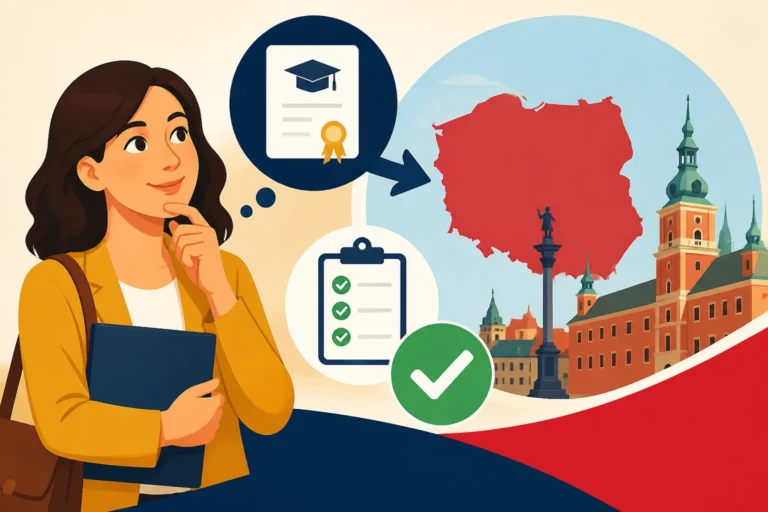
How Long Does Degree Recognition (Nostryfikacja) Take in Poland?
One of the biggest headaches when you first arrive in Poland, especially if you’re planning to work or further your education, is navigating the bureaucratic maze of getting your hard-earned foreign degree recognised. It often feels like you’re trying to catch smoke, with vague guidelines and endless waits. This guide is here to shed some light on the nostryfikacja process, giving you a realistic understanding of how long it might actually take and what you can do to prepare for the inevitable timeline rollercoaster.
Understanding Nostryfikacja in Poland: More Than Just Paperwork
When you hear "nostryfikacja" in Poland, it immediately brings to mind images of piles of documents and endless queues. But it's more than just a formal stamp; it's a critical step for many expats that can significantly impact their career or academic path here. It's essentially the official recognition of your foreign educational qualifications as equivalent to a Polish degree.
What Exactly is Nostryfikacja and Why Do You Need It?
At its core, nostryfikacja is the process by which a Polish university, typically designated by the Ministry of Education, confirms that your foreign diploma and academic transcript are equivalent to a specific Polish degree. This isn't just a "nice to have" for some. For regulated professions – think doctors, nurses, lawyers, teachers, architects, and even psychologists – it's absolutely mandatory. Without it, you simply cannot practice your profession legally in Poland. For other fields, while not strictly required by law, many employers, especially larger Polish companies, might ask for it. Universities will certainly require it if you plan to pursue further studies, like a Master's or PhD, in Poland. You might think your degree from a top university abroad speaks for itself, but Polish institutions need to ensure a standardised level of education across the board. It's their way of maintaining quality control and making sure everyone is playing by the same academic rules. So, if you're looking to integrate professionally, understanding this process is crucial as part of your overall plan for working in Poland as a foreigner.
The process has a specific legal framework, primarily based on the Act on Higher Education and Science. This means it’s not just up to individual university whims but follows a set procedure. It's about comparing curriculum, learning outcomes, and the number of hours spent on various subjects. Sometimes, it feels like they’re trying to fit a square peg into a round hole, especially with non-EU degrees, but that’s the reality of aligning different educational systems.
The Agencies Involved: Urząd, Universities, and Professional Bodies
Navigating the nostryfikacja process means dealing with several different entities, each with its own role and, often, its own pace. It’s not a single-point-of-contact type of deal, which can add to the feeling of being bounced around.
First, the primary players are the Polish universities themselves. Unlike some countries where a central government office handles all recognition, in Poland, you apply directly to a university that has the academic authority to grant a degree in the same field as yours. For example, if you have a medical degree, you'll need to apply to a medical university. If it's an engineering degree, an engineering university (like Politechnika Warszawska or Politechnika Krakowska) will be your port of call. These universities are responsible for evaluating your qualifications, assessing the differences in curriculum, and ultimately making the decision. This decentralised approach means that processing times and specific requirements can vary from one institution to another, even for the same type of degree. Some universities are more familiar with foreign qualifications, especially those from popular expat countries, while others might take more time.
Then there are professional bodies and ministries. For highly regulated professions, even after university nostryfikacja, you might need to register with a specific professional chamber or ministry. For instance, doctors need to register with the District Medical Chamber (Okręgowa Izba Lekarska), and lawyers with their respective bar associations. These bodies often have their own additional requirements and can involve further checks or even internship periods. This extra layer can add significant time to your overall journey to legally practicing your profession in Poland. It’s essential to research these profession-specific requirements early on to avoid nasty surprises down the line. You'll find that having your PESEL Number is often a basic requirement for most official dealings, including these.
Finally, while not directly involved in the nostryfikacja decision, various local government offices (Urząd Wojewódzki) come into play if your degree recognition is linked to a visa or residence permit application. They might require proof of your ongoing nostryfikacja or its completion as part of your documentation for The Complete Guide to Polish Residence Permits for Expats (2027). This interplay means that delays in one process can easily cascade into delays in another, creating a web of bureaucratic entanglement. Always ensure that your documents, including your degree certificates, are impeccably translated into Polish by a sworn translator (tłumacz przysięgły). This seemingly small detail can either smooth your path or throw a massive wrench into the works.
The Timeline Rollercoaster: What Influences Nostryfikacja Duration
If you're looking for a simple, straightforward answer to "How long does degree recognition take in Poland?", I'm afraid I have to be the bearer of less-than-ideal news: it's rarely simple, and often, it feels like a rollercoaster ride. The duration can vary wildly, from a few months to well over a year, depending on a multitude of factors.
Initial Document Gathering and Application Submission
The first major time sink is often right at the beginning: gathering all the necessary documents. This isn't just your diploma. Oh no, it’s much more extensive than that! You'll typically need:
- Original diploma/certificate: Self-explanatory, but sometimes getting the original back for a few days can be tricky if you're already in Poland.
- Transcript of records/academic supplement: This is absolutely critical. It details all the subjects you studied, the hours, ECTS credits (if applicable), grades, and the scope of your degree. The more detailed, the better.
- Proof of curriculum: Sometimes, especially for older degrees or those from less common educational systems, the university might ask for detailed descriptions of the courses, their content, and learning outcomes. This can mean digging through old university archives or contacting former professors.
- Proof of professional practice/internships: For some regulated professions, evidence of practical training is also required.
- Identity document: Your passport or residence card.
- Application form: Specific to the chosen Polish university.
- Proof of payment: There’s usually a fee, which can range from a few hundred to over a thousand PLN.
Every single one of these documents, if not originally in Polish or English (sometimes English is accepted, but Polish is always preferred), will need to be translated by a sworn translator in Poland. And let me tell you, finding a good, certified sworn translator (tłumacz przysięgły) who is familiar with academic terminology and can work quickly isn't always easy or cheap. Delays here are common: waiting for original documents from your home country, finding the right translator, or discovering that a document you thought was sufficient is actually missing crucial details. This initial phase alone can easily take 1-3 months, depending on how organised your home university is and how quickly you can get things translated. Getting your ducks in a row for these initial steps is as important as understanding the nuances of how to get a work permit in Poland, as both are foundational to your professional life here.
The Assessment and Equivalence Phase
Once your application is submitted, the real waiting game begins. The university appoints a committee, often composed of professors in the relevant field, to review your documents. Their job is to compare your foreign education against the Polish equivalent. They look at:
- Curriculum: Are the core subjects similar? Is the depth of study comparable?
- Duration: Did you study for a similar number of years or equivalent academic credits?
- Learning outcomes: Are the skills and knowledge you gained similar to what a Polish graduate in that field would possess?
- Practical training: For professions requiring internships, was your practical experience equivalent?
This assessment phase is highly variable. If your degree comes from a well-known international university or an EU country, and the curriculum is straightforward, it might be quicker. However, if your degree is from a less familiar system, or in a highly specialised field, the committee might need more time to deliberate. They might also request additional information or documentation from you or directly from your home university, which can introduce significant delays as communications go back and forth across different time zones and bureaucratic systems.
It’s also during this phase that they might determine that your degree is not fully equivalent. In such cases, they might require you to:
- Pass specific exams: To test your knowledge in areas they deem insufficient.
- Complete additional courses: To fill gaps in your curriculum.
- Undertake an internship: To gain practical experience.
These supplementary requirements, while necessary for full recognition, will obviously extend the overall timeline significantly, potentially by another semester or even a full academic year. This is where patience truly becomes a virtue.
The Dreaded Waiting Game and Communication
This is perhaps the most frustrating part for many expats. Once your application is in, communication from the university can often be sparse. You might submit everything perfectly and then hear nothing for weeks, or even months. Universities in Poland, like many large institutions, are not always proactive with updates. You might find yourself needing to call, email, and visit in person just to get an update on the status of your application. The language barrier here can be a real issue; while some university staff may speak English, it's not guaranteed, especially in smaller offices. This is where investing in some Polish language skills, even basic ones, can genuinely help you navigate the process more smoothly. Platforms like iTalki can be a lifesaver for quickly picking up phrases needed for bureaucratic interactions.
The official legal timeframe for nostryfikacja is typically 90 days from the date of submission, but this period only begins once the university deems your application complete and correct. Any requests for additional documents or supplementary education pause this 90-day clock. Realistically, it’s often more like 3-6 months from the moment your application is formally accepted, not from when you first handed over your documents. And if they require additional coursework or exams, then you're looking at a much longer haul. Prepare for periods of absolute silence, followed by urgent requests for something you didn't even know you needed.
Realistic Timelines and Potential Pitfalls
Let's get down to the brass tacks: what can you actually expect in terms of duration for degree recognition in Poland? While every case is unique, we can provide some general benchmarks and highlight common issues that can stretch out the process.
Average Processing Times for Different Degrees
The time it takes for nostryfikacja can vary significantly depending on your field of study, the country where you obtained your degree, and even the specific Polish university handling your application.
- EU/EFTA/OECD Degrees (General Fields): If your degree is from a country within the European Union, European Free Trade Association, or Organisation for Economic Co-operation and Development, and it's in a non-regulated field (e.g., business, humanities, general science), the process tends to be smoother. These degrees often have more harmonised standards. You might be looking at 3-6 months from initial complete submission.
- Non-EU/EFTA/OECD Degrees (General Fields): Degrees from outside these regions generally face a more rigorous examination, as the Polish university needs to understand a potentially very different educational system. This can stretch the timeline to 6-12 months, especially if they request additional documentation or require you to bridge curriculum gaps.
- Regulated Professions (e.g., Medicine, Law, Engineering): This is where it gets really complex and lengthy, regardless of where your degree is from. Due to the high stakes and specific national requirements, these fields almost always involve extensive curriculum comparisons, and often mandatory supplementary exams, internships, or even a period of supervised practice. For medical degrees, for example, it's not uncommon for the entire process, including exams and practical training, to take 1-3 years or even longer. Law degrees often require extensive additional study of Polish law. Engineering might be slightly faster but still involves careful review.
Keep in mind these are averages. I've known people with straightforward EU degrees wait longer due to administrative backlogs, and others with more complex cases who got lucky with a faster committee. The table below offers a general overview:
| Degree Origin & Field | Best-Case Scenario | Average Timeline (from complete submission) | Worst-Case Scenario (with extra requirements) |
|---|---|---|---|
| EU/EFTA/OECD (General) | 3 months | 4-6 months | 9-12 months (if minor gaps/delays) |
| Non-EU/EFTA/OECD (General) | 5 months | 6-12 months | 1.5-2 years (if significant gaps/exams) |
| EU/EFTA/OECD (Regulated Prof.) | 9 months | 1-2 years | 3+ years (with substantial re-training/exams) |
| Non-EU/EFTA/OECD (Regulated Prof.) | 1 year | 2-3 years | 4+ years (highly complex/extensive exams) |
This table underscores that this isn’t a quick fix. If your employment in Poland hinges on this recognition, or your ability to effectively deal with your personal finances like your annual tax return (PIT) in Poland, then planning ahead is paramount. Thinking about your future and managing your taxes for expats is critical, so factor this waiting period into your financial planning.
Common Reasons for Delays and How to Mitigate Them
Understanding the typical stumbling blocks can help you navigate the process with a bit more foresight.
- Incomplete or Incorrect Documentation: This is the number one killer of timelines. Submitting an application with missing pages, uncertified copies, or translations that aren't by a sworn translator will cause an immediate halt.
- Mitigation: Double-check, triple-check, and then ask a Polish friend or professional (if you can) to check your entire package before submission. Ensure all translations are by a Polish sworn translator and bear their seal.
- Lack of Detailed Transcripts/Curriculum Information: Universities need specifics. A general transcript might not be enough. If your home university doesn't provide enough detail on course content or learning hours, the Polish institution will struggle to make an equivalence.
- Mitigation: Request the most detailed academic documents possible from your home university, even if it means getting course syllabi or academic handbooks from your graduation year. Pre-emptively contact the Polish university to ask exactly what level of detail they require.
- Communication Gaps: Poor communication between your home university and the Polish institution, or between you and the Polish university, can grind the process to a halt.
- Mitigation: Provide clear contact information for your home university's academic office. Be proactive in following up with the Polish university, always politely, and keep a record of all correspondence. Learning Polish, even basic phrases, for these interactions can be incredibly useful.
- Administrative Backlogs: Universities, especially popular ones or those handling many foreign applications, can have internal backlogs. This is often beyond your control.
- Mitigation: Apply as early as possible. If you know you'll need nostryfikacja for a job or further studies, start the process well in advance. Consider applying to more than one university simultaneously if possible, though this will incur multiple fees.
- Curriculum Discrepancies: Significant differences in the educational programme might require you to complete additional modules or exams.
- Mitigation: There's not much you can do to change your past education. However, researching the Polish curriculum for your field before you apply can give you a realistic expectation of potential requirements. Some people even seek pre-assessment advice if available.
The process for How to Get Your Foreign Degree Recognised in Poland is fraught with potential delays. Being meticulously organised, proactive in your communication, and patient are your best strategies.
Navigating the Process and Speeding Things Up (If Possible)
While you can't magically make the Polish bureaucracy move at warp speed, there are certainly steps you can take to make the nostryfikacja process as efficient as possible and avoid unnecessary delays. Think of it as preparing for a marathon, not a sprint.
Proactive Steps for Expats: Pre-Application Tips
Getting ahead of the game is your best friend when it comes to Polish administration. Don't wait until you're already here and need the recognition urgently.
- Research Thoroughly – Before You Even Arrive: Before you pack your bags, identify which Polish universities offer degrees equivalent to yours. Contact their admissions or nostryfikacja offices directly. Ask for a detailed list of required documents, preferred formats, and any specific nuances for your country of origin or field of study. Some universities, particularly those popular with international students, might have English-speaking staff or dedicated expat support. This early research can save you months of frustration later.
- Prepare Your Documents Meticulously: This cannot be stressed enough. Gather every single academic document you possess – diplomas, transcripts, course descriptions, syllabi, letters from professors. Ensure you have originals and multiple certified copies (apostilled or legalised if required by Polish law for your country). Make sure any foreign language documents are ready for sworn translation. The more complete and clear your initial submission, the less likely you are to face requests for additional paperwork. Remember, you might also need documents for other administrative tasks, like when you register with the NFZ as a foreigner in Poland.
- Get Certified Translations Early: Once you've identified the specific documents needed, get them translated into Polish by a Polish sworn translator (tłumacz przysięgły). Do not use non-certified translations for official submissions, they will almost certainly be rejected. Find a reputable translator early, as their schedules can fill up quickly.
- Understand the Local Degree Structure: Familiarise yourself with the Polish Bologna Process framework (Bachelor's, Master's, PhD). Understanding how your foreign degree maps onto this system can help you present your application more effectively.
- Consider a Pre-Assessment (if offered): Some institutions or consultancies might offer a preliminary assessment of your documents. While this often comes with a fee, it can provide valuable insight into potential gaps or requirements before you embark on the full nostryfikacja process.
Seeking Support: Legal Aid and Language Assistance
Sometimes, even with the best preparation, you might hit a wall. Don't be afraid to seek external help.
- Professional Consultancies or Legal Aid: For complex cases, especially for regulated professions or degrees from highly unfamiliar educational systems, consider hiring a legal firm or consultancy specialising in foreign qualifications in Poland. They can help review your documents, communicate with universities on your behalf, and advise on strategies to address any identified discrepancies. While an investment, it can often save you time, stress, and potential costly errors in the long run. They can also guide you on how to apply for a temporary residence permit (Karta Pobytu) if your status depends on your employment.
- Language Assistance: As mentioned before, communication is key, and the language barrier can be a significant hurdle. Even if the official language of correspondence is English, phone calls, informal enquiries, or navigating university websites often require Polish.
- Online Language Platforms: Consider using platforms like iTalki to get some focused Polish lessons on bureaucratic vocabulary and common phrases. Even learning how to ask "What is the status of my application?" (Jaki jest status mojego wniosku?) or "What documents are missing?" (Jakie dokumenty brakuje?) can be incredibly empowering.
- Polish Friends or Colleagues: If you have trusted Polish-speaking friends or colleagues, they might be willing to help you make calls or review correspondence. Just be mindful of their time and offer to compensate them.
- Professional Translators/Interpreters: For in-person visits or complex phone calls, consider hiring an interpreter to accompany you or to facilitate the conversation. This ensures clarity and reduces misinterpretations.
While the nostryfikacja process in Poland can be long and frustrating, a proactive and well-informed approach, coupled with strategic use of support services, can definitely make it a smoother journey. Don’t underestimate the power of thorough preparation and persistent, polite follow-up.
Disclaimer
The information provided in this guide is intended for general informational purposes only and does not constitute legal, financial, or professional advice. While we strive to keep the information up-to-date and accurate, regulations and procedures in Poland can change rapidly. Expats are strongly advised to consult with relevant Polish authorities, educational institutions, legal professionals, or immigration specialists for advice tailored to their specific situation. We cannot be held responsible for any outcomes resulting from the use of this information.