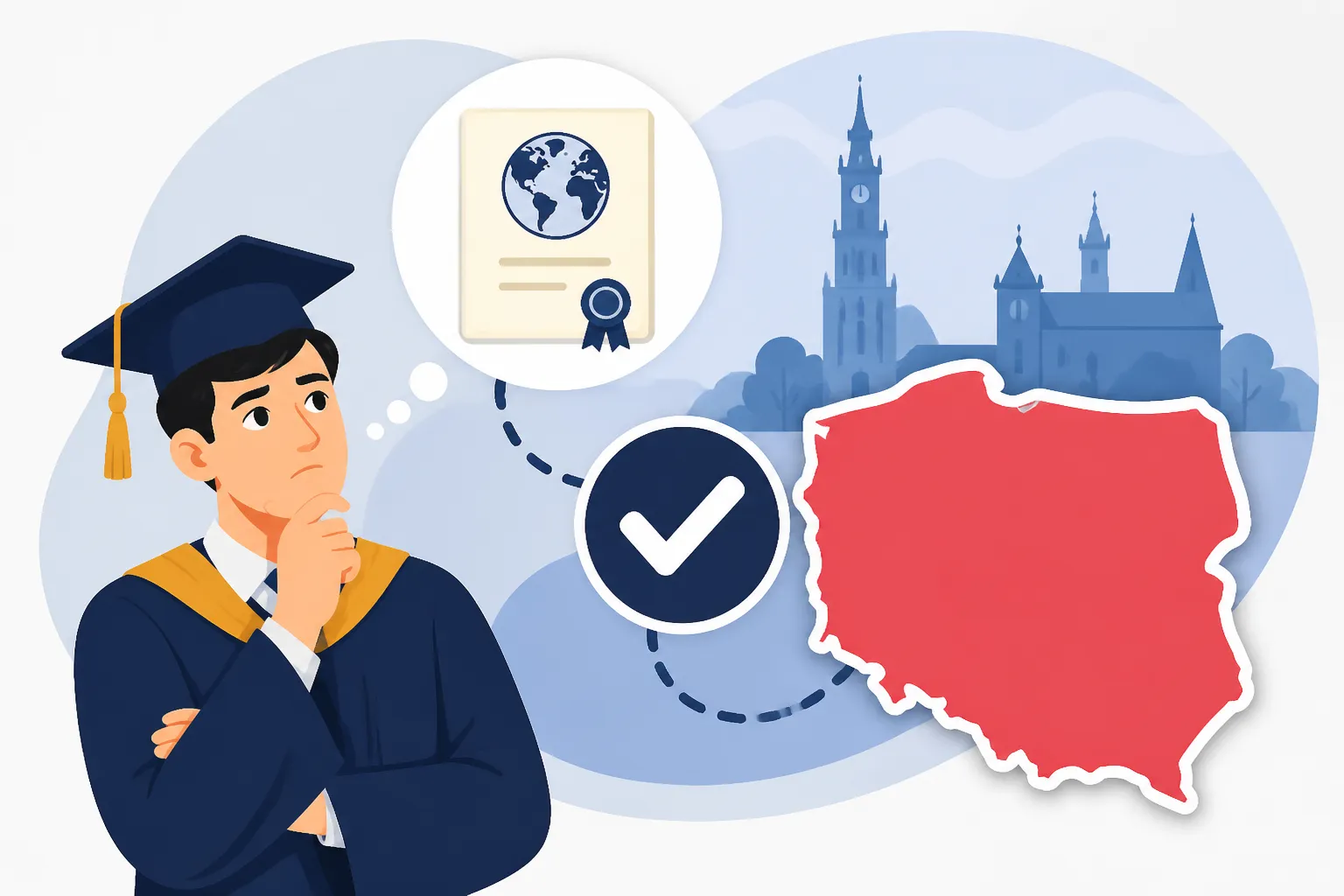
Can I Get My Foreign PhD Recognised in Poland?
Oh, the infamous "nostryfikacja"! If you're an expat in Poland who's earned a PhD abroad and you're now wondering if it holds the same weight here, you've probably already felt a tremor of dread. Navigating the Polish administrative landscape, especially when it comes to academic credentials, can feel like you've stepped into a bureaucratic labyrinth designed by Kafka himself. This guide is here to cut through the confusion and give you a realistic, step-by-step roadmap for getting your foreign PhD officially recognised in Poland.
The Reality of PhD Recognition in Poland: Why It Matters
Let's be honest, you've worked incredibly hard for your PhD. It represents years of dedication, sleepless nights, and intellectual heavy lifting. Coming to a new country and finding that your hard-earned credentials aren't automatically understood or accepted can be deeply frustrating. Many expats experience this, feeling like they're starting from scratch or that their qualifications are somehow diminished. This isn't unique to Poland, but the Polish system does have its own particular quirks that can make the process feel opaque.
Understanding the "Nostryfikacja" Process and Why It's a Pain
The official term for degree recognition in Poland is "nostryfikacja," which literally means "nationalisation" or "bringing into our national system." For PhDs, it’s about confirming that your foreign doctorate is equivalent to a Polish doktor degree, in terms of its level, curriculum, and educational outcomes. This isn't just a formality; it's a legal requirement for specific situations.
You might be asking yourself, "Do I even need nostryfikacja?" And that's a brilliant question, because the answer isn't always a straightforward "yes." For example, if you're aiming for a highly regulated profession like a medical doctor, lawyer, or even certain academic positions within public universities or state-funded research institutions, then full nostryfikacja is almost certainly going to be mandatory. However, if you're applying for a job in the private sector, particularly in international companies, or if you're planning to work as a freelancer or consultant, many employers might simply accept your foreign degree based on its reputation or an internal assessment. They might not require you to jump through all the official hoops. The key is to understand your specific professional goals in Poland and check the requirements carefully.
The Specific Needs for PhD Recognition: Academic vs. Professional
The context of your PhD recognition significantly impacts the process. Are you looking to continue an academic career, pursue a research grant, or teach at a Polish university? Or is your goal to work in industry, where the PhD is more of a general qualification for advanced roles?
For academic positions, particularly those involving habilitation (the post-doctoral degree required for professorship in Poland) or leading research projects, the equivalence needs to be quite precise. The recognising university will scrutinise your doctoral program's structure, the scope of your dissertation, the examination process, and even the standing of your awarding institution. They want to ensure it aligns with the rigorous standards of Polish doctoral studies. On the other hand, if you're entering the professional world outside of academia, the "equivalence" might be less about minute academic details and more about the general level of education. However, even in professional fields, if your job title requires a "doktor" degree by Polish law, then the nostryfikacja is unavoidable. It’s crucial to distinguish these paths early on to avoid unnecessary work and frustration.
The Official Pathway: Step-by-Step Nostryfikacja
Alright, so you’ve determined that, yes, you do need your foreign PhD officially recognised in Poland. Deep breaths. While it can be a marathon, it’s not impossible. The process is overseen by specific Polish universities, not a centralised government office, which adds another layer of complexity. Each university might have slightly different internal procedures, so communication is absolutely key.
Choosing the Right University for Recognition
This is arguably the most critical first step. You don't just pick any university; you need to choose one that has the legal authority to grant a doktor degree in the same or a closely related academic discipline as your foreign PhD. For instance, if your PhD is in Theoretical Physics, you wouldn't apply to a university that only offers doctorates in Fine Arts. You'll need to research Polish universities, such as the Jagiellonian University in Krakow, the University of Warsaw, or Adam Mickiewicz University in Poznań, and identify those with strong doctoral programmes in your field.
Once you’ve identified potential institutions, you must contact their specific doctoral schools or recognition offices (often part of the dean's office for a particular faculty). Explain your situation, ask about their specific requirements for nostryfikacja, and inquire about any application deadlines or fees. Don't be shy about asking for information in English; while not guaranteed, many larger universities, especially those with international student programmes, will have staff who can assist. This initial contact is paramount because it sets the stage for everything that follows.
Compiling Your Dossier: What Documents You Really Need
Prepare for a document feast (or famine, depending on how organised you are!). The list of required documents can be extensive and will generally include:
- Your original PhD diploma and transcripts: These are fundamental. They must be either the original documents or certified copies.
- A detailed diploma supplement or description of your doctoral programme: This needs to outline the curriculum, the duration of your studies, the examination procedures, and how your dissertation was evaluated. The more detailed, the better.
- Your dissertation/thesis: Often, the full text of your dissertation will be required, sometimes translated into Polish or English, depending on the university's policy.
- Proof of your academic achievements post-PhD: This could include publications, conference presentations, research grants, or any other academic activities that demonstrate your expertise.
- Your CV/resumé: A comprehensive overview of your academic and professional career.
- Proof of identity: Usually your passport.
- Translations: Any documents not originally in Polish or English (some universities accept English, some insist on Polish) will need to be translated by a sworn (certified) translator in Poland. This is not a task for Google Translate! The cost of sworn translations can add up quickly, so factor this into your budget.
Each university might have additional specific requirements, such as a formal application form, specific declarations, or a request for letters of recommendation. Always double-check their official website and direct correspondence. This mountain of paperwork, often requiring certified copies and sworn translations, is where many expats hit their first wall, feeling lost in the minutiae. Make sure to keep copies of everything you submit.
The Application and Assessment Phase: Waiting, Waiting, Waiting
Once your meticulously prepared application dossier is submitted, the waiting game begins. The university will form an evaluation committee, usually composed of professors from your field, who will assess your degree. Their job is to compare your foreign PhD against the standards of a Polish doktor degree. This involves a thorough review of your academic record, dissertation, and any other evidence of your scholarly work.
In some cases, the committee might require you to:
- Undergo additional examinations: This is less common for PhDs than for Master's degrees but can happen if there are significant gaps identified in your knowledge or a major difference in the educational system.
- Present your dissertation or research: You might be asked to defend your work orally before the committee, much like a traditional PhD defence. If this is required, and your Polish isn't fluent, you might want to consider some targeted language lessons. Platforms like iTalki could be useful for finding tutors who specialise in academic Polish or even just to practice your presentation skills.
- Complete additional coursework: Again, rarer for PhDs but a possibility if certain core components are deemed missing.
The decision from the university can take anywhere from a few months to over a year, depending on the institution, the complexity of your case, and the committee's schedule. This lengthy period of uncertainty is one of the most frustrating aspects for expats, who often need recognition for immediate career or residency purposes. Stay in regular, polite contact with the university's office to check on the status of your application.
Challenges and Workarounds for Expats
As an expat, you face unique hurdles beyond just the academic evaluation. These can often be more daunting than the paperwork itself. But trust me, you're not alone in these struggles, and there are ways to navigate them.
Language Barriers and Navigating Bureaucracy
Let's face it, official Polish can be incredibly complex, even for native speakers sometimes! Forms, official letters, and legalistic language are often not available in English, or if they are, the translations can be confusing. This creates a significant barrier when you're trying to understand exact requirements, fill out applications correctly, or communicate with university staff. Many expats find themselves caught in a loop of misinterpretations and delays simply due to language.
My advice? Don't try to go it alone if you're not confident in your Polish. While Learning Polish: A Complete Guide to Language Courses and Levels is always a good long-term strategy, for immediate needs, consider hiring a local assistant or a consultant specialising in academic recognition. They can help translate documents, make phone calls, clarify doubts, and even accompany you to appointments. They can be worth their weight in gold for reducing stress and speeding up the process. Even practicing specific phrases for administrative queries with a tutor from a platform like iTalki can give you a significant confidence boost and help you understand what's being asked.
Financial Considerations and Potential Tax Implications
The nostryfikacja process isn't free. Universities charge fees for the assessment, which can vary widely. On top of that, you have the significant costs of sworn translations for all your documents. These can quickly add up to a substantial amount, especially if you have a lot of academic history to translate. It’s crucial to get an estimate of all these costs upfront from the chosen university and the sworn translator.
Beyond the direct costs, consider the financial implications of your employment status during this waiting period. If you're unable to work in a position commensurate with your qualifications until your PhD is recognised, this could mean a significant income gap. It's wise to have a financial buffer. Once your degree is recognised and you secure employment, you’ll be dealing with Polish income taxes. Understanding The Complete Guide to Taxes in Poland for Expats (2027) is paramount. Services like Taxes for Expats are designed specifically to help foreigners navigate these complexities, ensuring you're compliant and maximising any potential deductions. It's a good idea to consider these broader financial aspects even before you start the recognition process.
Alternative Pathways and Practical Considerations
What if nostryfikacja feels like too much, or you discover it’s not strictly necessary for your specific goals?
- Private Sector Focus: As mentioned, many private companies, especially international ones, might not require official nostryfikacja. They're often more interested in your skills, experience, and what your degree means for their business goals. Always inquire directly with potential employers.
- Freelancing/Consulting: If you're pursuing self-employment, clients may rely more on your portfolio and reputation than on a formally recognised degree for all services. If you're interested in this path, check out The Complete Guide to Freelancing in Poland as an Expat.
- "Informal" Recognition: Sometimes, a certified translation of your diploma, perhaps with an apostille if your home country is part of the Hague Convention, is sufficient for general purposes or informal status recognition, even if it's not full nostryfikacja. This is not a legal substitute for nostryfikacja but can be useful for CVs or general credential presentation.
- EU/EEA/Switzerland Degrees: If your PhD was awarded in an EU, EEA, or Swiss institution, the recognition process is significantly simplified, often relying on automatic recognition based on directives. You'll typically just need to present your diploma and a diploma supplement.
Always evaluate your specific needs and the time/cost investment before embarking on the full nostryfikacja journey. Sometimes, a pragmatic approach is best.
Life After Recognition: What Comes Next?
Congratulations! After all that effort and perseverance, your foreign PhD has been successfully recognised in Poland. So, what now? This opens up a new world of possibilities and legitimacy for your academic and professional pursuits in your new home.
Leveraging Your Polish-Recognized PhD in the Job Market
With a recognised PhD, you can now confidently apply for positions that explicitly require a "doktor" degree in Poland. This is particularly crucial for:
- Academic Positions: Teaching, research, and administrative roles within Polish public universities and research institutes. Your recognised degree will make you eligible for higher academic ranks and participation in grant applications.
- Regulated Professions: Certain advanced roles in engineering, science, or healthcare might have specific degree requirements that now you meet.
- Public Sector Jobs: Any government or state-affiliated positions that specify a doctorate as a minimum qualification.
When applying for jobs, clearly state that your foreign PhD has been "nostryfikowany" (recognised) by [Name of Polish University] in your CV and cover letter. This immediately tells potential employers that your qualifications meet Polish standards. Don't forget to regularly check job portals and academic recruitment sites. Resources like The Expat Guide to Finding a Job in Poland (2027) can offer broader advice on job hunting, while The Complete Guide to Working in Poland as a Foreigner (2027) will cover employment specifics. Understanding Polish Employment Contracts and Worker Rights (2027) will also be essential once you land that dream job.
Continuing Your Academic Journey or Research
For many PhD holders, the journey doesn't end with the doctorate; it's a springboard for further research and academic contribution. With your PhD recognised, you are now fully integrated into the Polish academic landscape. This means:
- Applying for Habilitation: If your goal is to become a full professor, pursuing the Habilitacja (post-doctoral degree) is the next step, and your recognised PhD is a prerequisite.
- Leading Research Projects: You can now apply for grants and lead research teams within Polish institutions, contributing directly to the country's scientific output.
- Collaborations: It facilitates easier collaboration with Polish colleagues and institutions, as your credentials are now universally understood within the national system.
Whether you plan to embark on new research, teach, or mentor the next generation of scholars, your recognised PhD is your official entry ticket. Exploring guides like The Complete Guide to Studying at a Polish University (2027) or even How to Apply for a PhD Programme in Poland can give you insights into the broader academic framework, should you choose to engage further.
Here’s a quick overview of what to expect during the nostryfikacja journey for a foreign PhD:
| Aspect | Description | Potential Expat Challenge |
|---|---|---|
| Purpose | To officially certify that a foreign PhD is equivalent to a Polish doktor degree, primarily for regulated professions or academic roles in public institutions. | Not always clearly understood if necessary, leading to wasted effort or missed opportunities. |
| Authority | A Polish university with the right to grant PhDs in your field. Procedures can vary between institutions (e.g., University of Warsaw vs. Jagiellonian University). | Finding the correct university and department, navigating differing requirements, lack of centralised information. |
| Required Documents | Original diploma/transcripts, detailed program description, dissertation, CV, proof of achievements, ID. All non-Polish/English documents need sworn translations. | Gathering extensive paperwork, high cost and time for sworn translations, potential for additional obscure requests. |
| Assessment Process | University committee reviews documents, often comparing curriculum, dissertation scope, and academic standards. May involve interviews, presentations, or supplementary exams. | Long waiting times, lack of communication updates, language barriers during interviews, subjective nature of committee assessment. |
| Cost | Application fees (university), significant sworn translation costs. | Unforeseen expenses, budgeting for potentially high translation costs, no clear total cost estimate upfront. |
| Timeline | Typically several months to over a year, highly dependent on the university and complexity of the case. | Delays impacting career plans or residence permit applications, prolonged uncertainty. |
| Outcome | Official certificate of equivalence to a Polish doktor degree, opening doors to specific employment and academic opportunities. | Not always necessary for private sector roles, requiring a balance of effort vs. benefit. |
Disclaimer
Please remember that while I’ve poured my heart and expat wisdom into this guide, administrative procedures and legal requirements in Poland can change. The information provided here is for general guidance and informational purposes only and does not constitute legal, financial, or professional advice. Always consult with official university departments, legal professionals, or migration specialists for the most current and accurate information pertaining to your individual circumstances.