How Do I Register a Freelance Business in Wroclaw?
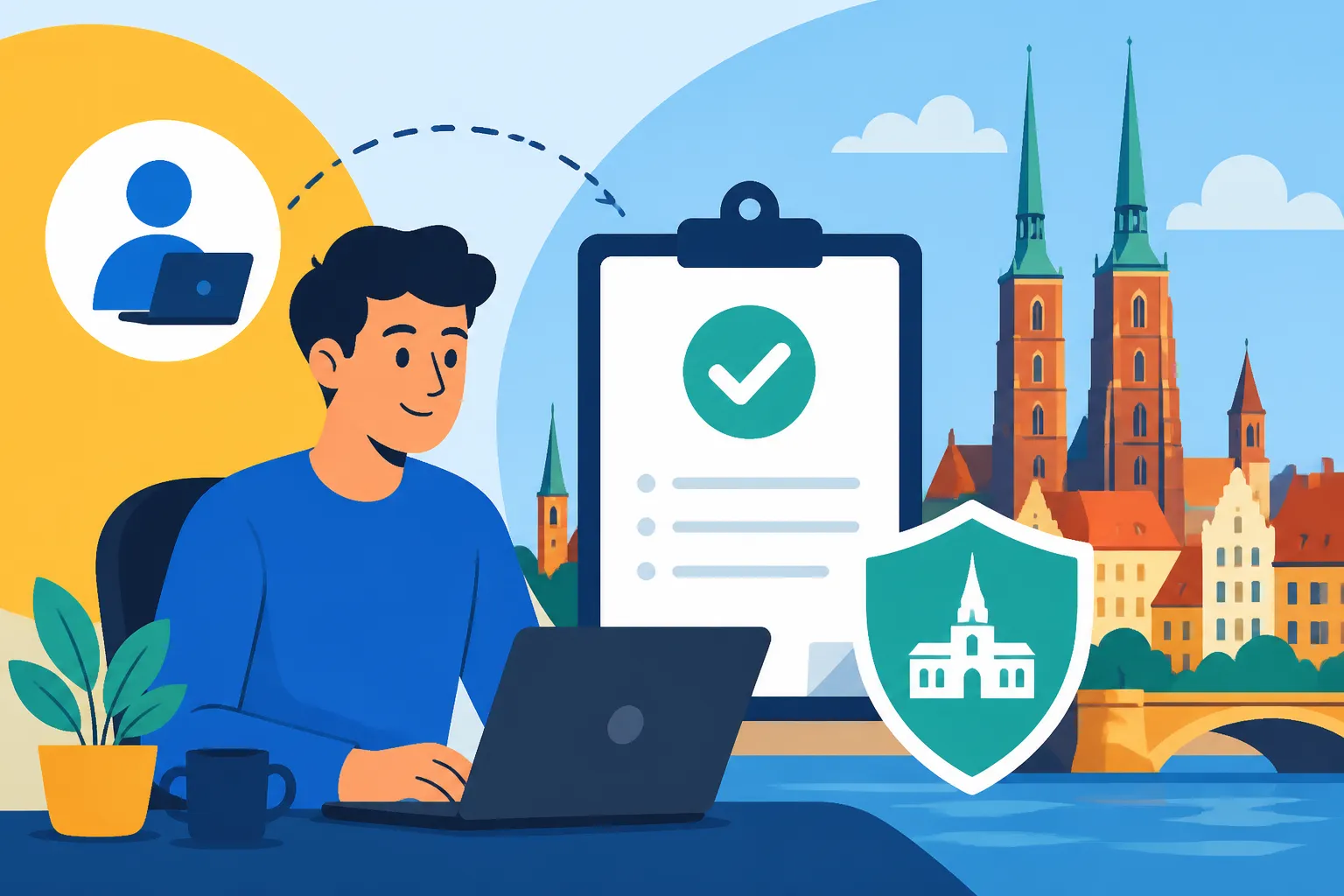
Trying to navigate the bureaucracy of starting your own freelance business in a new country like Poland can feel like trying to solve a Rubik's Cube blindfolded, especially when the instructions are in a language you're still learning. If you've found yourself dreaming of Polish clients and zloty, but waking up to a nightmare of forms and acronyms, you're in the right place. This guide will meticulously walk you through the process of registering a freelance business, specifically as a Jednoosobowa Działalność Gospodarcza (JDG), right here in Wrocław, cutting through the confusion so you can focus on what you do best.
Understanding the Polish Freelance Landscape: The JDG
So, you've landed in Poland, perhaps in the vibrant city of Wrocław, and you're ready to strike out on your own as a freelancer. Good for you! It's an exciting path, but one that comes with its fair share of administrative hoops. In Poland, the most common and often simplest legal form for a sole proprietor or freelancer is the Jednoosobowa Działalność Gospodarcza, affectionately known as a JDG. Think of it as your personal business entity, tied directly to you.
What is a JDG Jednoosobowa Działalność Gospodarcza?
A JDG is essentially a sole proprietorship. It means you, as an individual, are operating a business. There's no legal distinction between you and your business; your personal assets can, in theory, be liable for business debts, though this is often mitigated by various insurance options. It's popular because it's relatively easy and inexpensive to set up and manage compared to other company structures like a Spółka z o.o. (Limited Liability Company). Most freelancers, consultants, IT specialists, designers, translators, and many other service providers choose the JDG route when they start working for themselves in Poland.
The beauty of the JDG, especially for expats, is its relative simplicity. The initial registration is free, and the ongoing accounting can be straightforward, particularly if you opt for certain tax schemes. You'll operate under your own name, and your personal PESEL number often acts as your primary identifier for tax purposes. It's the go-to for anyone who wants to quickly get up and running without diving into the complexities of corporate law.
Why Wrocław for Freelancing?
Wrocław isn't just a pretty city with gnomes; it's a booming hub for technology, outsourcing, and creative industries, making it an incredibly attractive place for freelancers. The city boasts a dynamic startup scene, a large number of international companies, and a thriving expat community, all of which contribute to a diverse and growing demand for freelance services. Whether you're a software developer, a graphic designer, a marketing specialist, or a translator, chances are you'll find a receptive market here.
The local government and various business incubators in Wrocław are also increasingly supportive of new businesses and entrepreneurs, including foreigners. While specific support programs might require some digging, the overall environment is conducive to growth. Plus, the cost of living in Wrocław, while rising, can still be more manageable than in Warsaw, making it an excellent base for independent professionals looking for a vibrant European city without the sky-high expenses. The presence of numerous co-working spaces, expat meetups, and industry events means ample opportunities to network and find potential clients right on your doorstep.
Essential Steps to Register Your JDG in Wrocław
Alright, let's get down to brass tacks. Registering your JDG can seem daunting, but breaking it down into manageable steps makes it much less intimidating. I've been there, staring at Polish forms, wondering if I'm about to accidentally sign up for a lifetime supply of pierogi (which actually sounds pretty good, but still).
Getting Your PESEL and NIP
Before you can even think about registering your business, you need to sort out your personal identification numbers. These are your bread and butter for pretty much everything official in Poland.
First up, the PESEL. This is your universal personal identification number in Poland, similar to a Social Security number in the US or a National Insurance number in the UK. If you're planning on staying long-term, working, or generally living a normal life here, you absolutely need one. You'll use your PESEL for health insurance, bank accounts, and yes, your freelance business. The process usually involves registering your residence (Registering Your Residence Zameldowanie in Poland: The Complete Guide) at your local Urząd Gminy or Urząd Miasta (City Hall). In Wrocław, this would typically be the Urząd Miejski Wrocławia. You'll need your passport, visa/residence permit, and proof of address (like a rental agreement). Sometimes, especially if you don't have a zameldowanie, you can get a PESEL by applying for it directly for tax purposes, but often linking it to your residence registration is the most straightforward path. For a deeper dive into this, check out our guide on How to Get Your PESEL Number and Why It Matters for Healthcare.
Next, the NIP (Numer Identyfikacji Podatkowej) is your Tax Identification Number. For individuals who have a PESEL and are not VAT registered, your PESEL usually acts as your NIP. However, if you don't have a PESEL (rare for long-term freelancers, but possible in specific scenarios) or if you plan to register for VAT, you might need a separate NIP. You apply for this at the Urząd Skarbowy (Tax Office) using a form called NIP-7. However, for most expats, once you have your PESEL, it effectively becomes your tax ID, simplifying things considerably. For more on these essential numbers, take a look at our guide on How to Get a PESEL and NIP Number in Poland.
Choosing Your Business Activity Codes PKD
This is where you define what your business actually does. Poland uses a system of Polska Klasyfikacja Działalności (PKD) codes, which are standard classification codes for economic activities. You'll need to select one primary PKD code that best describes your main freelance activity, and you can also add several secondary codes for any other activities you might engage in.
For example, if you're a freelance web developer, your primary code might be 62.01.Z (Activities related to computer software). If you also do graphic design, you might add 74.10.Z (Specialised design activities). It's crucial to choose these carefully because they can impact your tax obligations and even future grants or subsidies. Don't worry too much about having too many codes, as long as they are relevant. It's easier to add them at the beginning than to amend your registration later. You can find the full list of PKD codes on the Polish Central Statistical Office (GUS) website. If you're unsure, consulting with a Polish accountant who works with expats can be invaluable here.
Registering Through CEIDG
The actual registration of your JDG happens through the Centralna Ewidencja i Informacja o Działalności Gospodarczej (CEIDG) – the Central Register and Information on Economic Activity. This is the big one, and thankfully, it can largely be done online!
Here's a general step-by-step for the online method:
- Access CEIDG: Go to the official CEIDG website (www.ceidg.gov.pl). You'll want to find the section for registering a new business (often labeled "Zarejestruj działalność").
- Verify Your Identity: To submit the application online, you'll need a "Trusted Profile" (Profil Zaufany) or an electronic signature. A Profil Zaufany is a free method of verifying your identity in online interactions with Polish public administration. If you don't have one, you can usually set it up via your Polish online banking (if your bank supports it, like PKO BP, mBank, Santander, ING, etc.) or by confirming your identity at an official point (like a Urząd Skarbowy or Post Office). This is an essential tool for almost all online government services in Poland.
- Fill Out the CEIDG-1 Form: The online form will guide you through entering your personal data (PESEL, name, address), your chosen PKD codes, the address of your business (which can be your home address if you work remotely), and your chosen start date for the business. You'll also select your preferred tax form (which we'll discuss in the next section) and how you'll pay your ZUS contributions.
- ZUS and Tax Office Notifications: The brilliant thing about CEIDG is that it acts as a "one-stop shop." Once you submit your application through CEIDG, it automatically notifies the Tax Office (Urząd Skarbowy) and the Social Insurance Institution (ZUS) about your new business. This means you don't typically need to physically visit these offices to register your JDG. However, you will need to follow up with ZUS for your specific contribution details and potentially with the tax office for certain declarations, especially regarding VAT if applicable.
- Confirmation: After successful submission, you'll receive a confirmation, and your business will be officially registered. You can then download an official certificate from the CEIDG website.
The online process, while convenient, can still be a bit of a linguistic hurdle. Many expats use Google Translate or ask a Polish-speaking friend for help. Alternatively, some accounting firms offer services to help with the initial registration for a fee, which can save a lot of headaches. For more detailed instructions, our guide How to Register a JDG Jednoosobowa Działalność Gospodarcza in Poland offers a comprehensive walkthrough.
ZUS and Urząd Skarbowy Notifications
As mentioned, CEIDG handles the basic notifications to ZUS and the Tax Office. However, your work isn't entirely done.
ZUS (Social Insurance Institution): While ZUS is notified, you still need to ensure your social security and health insurance contributions are correctly set up. For new entrepreneurs, there's a fantastic relief program called "Ulga na Start" (Start-up Relief), which means you don't pay social contributions for the first six full months of your JDG (you still pay health insurance though!). After that, for the next 24 months, you can benefit from "Mały ZUS" (Small ZUS), paying reduced contributions based on your income. These reliefs are a huge help for getting your business off the ground. After these periods, or if you don't qualify, you'll pay "Duży ZUS" (Large ZUS) based on a higher minimum threshold.
You need to submit specific forms to ZUS (e.g., ZUS ZZA for health insurance only, or ZUS ZUA for full social and health insurance) within 7 days of your business start date. This is crucial. If you're employed elsewhere in Poland and starting a JDG as a secondary activity, your ZUS obligations will be different. It’s a complex area, and a good accountant is truly your best friend here. For a full breakdown, see Understanding ZUS Social Contributions in Poland: The Full Guide.
Urząd Skarbowy (Tax Office): Again, while CEIDG informs them, you might need to take additional steps. If you plan to be a VAT taxpayer (which is often beneficial if your clients are other businesses, especially outside Poland), you'll need to register for VAT by submitting a VAT-R form to your local Urząd Skarbowy in Wrocław before your first taxable transaction. You’ll receive confirmation and be assigned a specific NIP for your VAT purposes. If you are not a VAT taxpayer and are operating below the annual VAT exemption threshold (currently around PLN 200,000 for sales), you typically won't need to do anything further with the tax office beyond your annual tax declarations. Our detailed guide on How the Polish Tax Office Urząd Skarbowy Works can help demystify this institution.
Navigating the Financial and Administrative Maze
Once your JDG is officially registered, the real fun begins: managing your finances and staying compliant. This is often the part where expats feel the most overwhelmed, but with the right information, it's totally manageable.
Bank Account for Your JDG
Technically, for a JDG, you can use your personal bank account for business transactions, as there's no legal separation between you and your business. However, I strongly, strongly recommend opening a separate bank account specifically for your JDG. Why?
- Clarity for Tax Purposes: It makes accounting infinitely easier. All your business income and expenses are in one place, simplifying reconciliation and reducing the chances of errors when it comes time to file your taxes.
- Professionalism: It looks more professional to clients, especially if you're receiving international payments.
- Easier Audits: Should the tax office ever come knocking (unlikely for most freelancers, but you never know), having a clear distinction between personal and business finances will make their job – and yours – much easier.
Most major Polish banks, such as PKO BP, Santander, mBank, and ING, offer business accounts tailored for JDGs. Look for accounts with low or no monthly fees, easy online banking, and competitive foreign exchange rates if you deal with international clients. Many banks are now quite expat-friendly and offer services in English. To learn more about opening an account, check out The Expat Guide to Opening a Bank Account in Poland.
Understanding Your Tax Options: Ryczałt vs. Skala
This is arguably the most critical decision for your JDG's financial health. Poland offers a few main tax forms for JDGs, but the two most common for freelancers are the ryczałt od przychodów ewidencjonowanych (lump-sum tax on registered revenues) and the zasady ogólne (general rules), which include the progressive tax scale (skala podatkowa).
-
Ryczałt (Lump-Sum Tax): This is a simplified tax scheme where you pay a percentage of your revenue (not profit) based on your PKD activity. The rates vary widely, from 2% for certain services (like rentals) to 17% for professions like IT. For many IT freelancers, a rate of 12% (or even 8.5% for specific services) can be very attractive. The huge benefit here is that you don't track business expenses for tax purposes. If your business has minimal expenses, this can lead to significant tax savings. However, if you have high business costs (e.g., buying expensive equipment, software licenses), ryczałt might not be optimal as you can't deduct them. This scheme also excludes certain types of business activities.
-
Zasady Ogólne (General Rules) / Skala Podatkowa (Progressive Tax Scale): This is the default tax regime. You pay tax on your profit (revenue minus deductible business expenses). Poland has a progressive tax scale, currently at 12% for income up to PLN 120,000 per year, and 32% for income above that. There's also a tax-free allowance. If you have substantial business expenses that you can deduct, this option might be more favorable. You also have the possibility of joint taxation with your spouse if certain conditions are met.
Choosing between ryczałt and skala depends heavily on your specific income, expenses, and type of activity. It’s not a one-size-fits-all answer. This is where an accountant specializing in JDGs and expat situations becomes invaluable. They can run simulations based on your projected income and expenses to advise you on the most tax-efficient choice. Many expats find resources like Taxes for Expats helpful in understanding these complex rules, especially with double taxation agreements between Poland and their home country. For more insights on this, you can check out our article on How Much Tax Does a JDG Pay in Poland in 2026? and a broader look at How to Pay Taxes as a JDG Owner in Poland.
Here’s a simplified comparison:
| Feature | Ryczałt (Lump-Sum Tax) | Skala Podatkowa (Progressive Tax Scale) |
|---|---|---|
| Tax Base | Revenue (gross income) | Profit (revenue – deductible expenses) |
| Tax Rate | Varies by PKD code (e.g., 2%, 3%, 8.5%, 12%, 17%) | 12% (up to PLN 120,000); 32% (above PLN 120,000) |
| Expenses | Cannot deduct business expenses | Can deduct legitimate business expenses |
| Tax-Free Amount | Not applicable directly | Applicable (reduces tax liability) |
| Complexity | Simpler if you have few expenses, simpler accounting | Requires meticulous expense tracking, more complex |
| Best For | Freelancers with low expenses, high revenue (e.g., IT) | Freelancers with significant, deductible expenses |
Invoicing and Accounting Basics
Once you're registered and have chosen your tax form, you'll need to start issuing invoices and keeping records.
- Invoicing: You'll need to issue invoices (faktura) for your services. These should include your JDG details (name, address, NIP/PESEL), the client's details, a description of the service, the date of issue, date of service, net amount, VAT (if applicable), and gross amount. There are many online invoicing tools available, some even free for basic use, that are compliant with Polish regulations.
- Accounting: Even if you choose ryczałt, you need to keep a record of your revenues (ewidencja przychodów). If you're on the skala podatkowa, you'll need to maintain a Księga Przychodów i Rozchodów (Book of Revenues and Expenses). This is where having a separate bank account really pays off! Most expats quickly realize that navigating Polish accounting rules, especially with VAT and ZUS, is best left to professionals. Hiring a good, English-speaking accountant is a wise investment. They will handle your monthly ZUS and tax declarations, quarterly or monthly VAT filings, and your annual tax return (PIT). They can also advise on legitimate tax deductions and reliefs available to you.
Beyond Registration: Thriving as a Freelancer in Wrocław
Getting registered is just the beginning. To truly succeed as a freelancer in Wrocław, you need to think about networking, continuous learning, and ensuring you're legally sound.
Building Your Network and Language Skills
Wrocław is a fantastic city for networking. There are numerous expat groups on social media, regular meetups, and industry-specific events. Attending these can help you connect with potential clients, collaborators, and other freelancers who understand the unique challenges of working independently in Poland. Look for events at co-working spaces like Business Link or Hubraum in Wrocław, which often host workshops and networking sessions.
While many international companies operate in English, learning Polish will significantly enhance your opportunities, both professionally and personally. Even a basic understanding can open doors to local clients, build rapport, and make daily life much smoother. Resources like iTalki offer flexible online lessons with native Polish speakers, allowing you to learn at your own pace. There are also many language schools in Wrocław offering courses for foreigners. Showing an effort to learn the local language is always appreciated and can help you integrate deeper into the Wrocław community. Consider exploring our guide, Learning Polish: A Complete Guide to Language Courses and Levels.
Legal and Insurance Considerations
Beyond taxes and ZUS, there are other aspects to consider to protect yourself and your business.
- Contracts: Always, always, always have clear contracts with your clients. Ideally, these should be in both Polish and English, especially for larger projects. They should define the scope of work, deliverables, payment terms, intellectual property rights, and termination clauses. If you're dealing with foreign clients, ensure your contracts specify Polish law as the governing law, or understand the implications if a foreign law applies.
- Insurance: While the public health insurance (NFZ) component of ZUS contributions covers your basic medical needs (and it’s essential to understand Health Insurance in Poland: Mandatory, Private and Subscription Options Explained), consider additional private medical insurance options like Medicover or LUX MED for faster access to specialists and English-speaking doctors. Beyond health, professional liability insurance is highly recommended for freelancers, particularly in fields like IT or consulting. It protects you in case a client claims your work caused them financial loss or damage.
Local Resources and Support for Expats
Wrocław has a thriving expat community, and many resources are geared towards helping foreigners settle in and succeed.
- Expat Groups: Join Facebook groups like "Expats in Wrocław" or "Wrocław Foreigners." These are excellent places to ask questions, share experiences, and get recommendations for accountants, lawyers, or local services.
- Business Support: The City of Wrocław often has initiatives to support local entrepreneurship. Check the official city website (www.wroclaw.pl) for sections on business or investor support, which might offer information on local grants, training, or advisory services. Sometimes, even universities in Wrocław have startup incubators open to the broader community.
- Co-working Spaces: Beyond networking, co-working spaces like those mentioned earlier provide a professional environment, often with administrative support, meeting rooms, and a sense of community that can be crucial for solo freelancers.
Starting your freelance journey in Wrocław, Poland, can be incredibly rewarding. Yes, there are forms, acronyms, and a few head-scratching moments, but with a clear plan, a bit of patience, and perhaps a good accountant, you'll be well on your way to building a successful JDG and enjoying all that this wonderful city has to offer.
Disclaimer
The information provided in this guide is intended for general informational purposes only and does not constitute legal, financial, or tax advice. While we strive to provide accurate and up-to-date information based on current regulations and typical expat experiences in Poland, rules and procedures can change. It is essential to consult with qualified legal, tax, and accounting professionals in Poland for advice tailored to your specific situation before making any decisions related to your freelance business, taxation, or residency. We do not accept responsibility for any loss arising from reliance on the information contained in this article.