Understanding Train Travel with PKP Intercity in Poland
One of the first things you'll realize when settling into life in Poland is that getting from point A to point B often feels like deciphering an ancient riddle. While the public transport in cities can be a marvel, venturing further afield can present its own set of challenges, especially when it comes to long-distance train travel. Many expats arrive here, hear "PKP" and immediately picture a single, monolithic entity, but the reality is more nuanced, and navigating Poland's extensive rail network, particularly the intercity services, can feel overwhelming. This guide is here to untangle the complexities of PKP Intercity, making your journeys across this beautiful country smoother and far less stressful.
Demystifying PKP Intercity and Its Place in Polish Rail
When you think of Polish trains, you probably think of "PKP." But "PKP" actually stands for "Polskie Koleje Państwowe," which roughly translates to "Polish State Railways," and it's less of a single company and more of a group of independent companies operating under a common brand. It’s a bit like a family name where each member has their own job. PKP Intercity is one of the most prominent members of this family, specifically dedicated to long-distance and express connections. Understanding their role is your first step to mastering Polish train travel.
What Exactly is PKP Intercity?
PKP Intercity is the national operator for long-distance passenger services in Poland. Think of them as the go-to for connecting major cities like Warsaw, Krakow, Gdansk, Wroclaw, and Poznań, as well as reaching popular tourist destinations across the country. They’re distinct from the regional carriers, like Koleje Mazowieckie or Koleje Śląskie, which typically handle shorter routes and commuter lines around specific voivodeships (provinces). PKP Intercity aims to provide faster, more comfortable, and often direct connections between key hubs. They are the backbone of intercity travel, getting you efficiently from one major metropolitan area to another.
Their focus is really on those longer hauls, the kind of journeys where you want to sit back, perhaps get some work done, or simply enjoy the scenery without the constant stops of local services. They operate a variety of train types, each offering different levels of speed and amenity, which can initially be a bit confusing but soon becomes intuitive. Whether you're commuting for business between cities or exploring Poland for leisure, PKP Intercity will likely be your primary choice for rail travel.
The Different Train Categories You'll Encounter
PKP Intercity operates several categories of trains, each with its own characteristics regarding speed, comfort, and, of course, price. Knowing these differences can save you a headache and ensure you book the right experience for your journey. You'll primarily see TLK, IC, EIC, and EIP.
-
TLK (Twoje Linie Kolejowe – Your Railway Lines): These are generally the slowest and most affordable long-distance trains. TLK trains make more stops and are often older rolling stock, so don't expect plush interiors or cutting-edge amenities. However, they're perfectly functional, get you where you need to go, and are a great budget-friendly option for longer trips, especially if you're not in a rush. They connect a wide range of cities and towns, often serving routes that faster trains might skip.
-
IC (InterCity): A step up from TLK, IC trains offer a better standard of comfort and are usually a bit faster. You'll often find more modern carriages, air conditioning, and sometimes even Wi-Fi on select routes. They still make a fair number of stops, but the overall journey experience is improved. For many expats, IC trains strike a good balance between cost and comfort, making them a popular choice for regular intercity travel.
-
EIC (Express InterCity): As the name suggests, EIC trains are express services, focusing on speed and premium comfort. These trains make very few stops, connecting only the largest cities. You can expect high-quality carriages, comfortable seating, on-board catering (often a WARS dining car), and generally more spacious environments. EIC tickets are pricier, but for those who value speed and comfort, especially on business trips or longer journeys, they are well worth the investment.
-
EIP (Express InterCity Premium – Pendolino): This is the crème de la crème of Polish rail travel. The EIP service is operated by modern Pendolino trains, Poland's high-speed rail offering. These trains are sleek, quiet, and offer the highest level of comfort, speed, and amenities, including dedicated catering service, power sockets, and usually reliable Wi-Fi. EIP trains connect key Polish metropolises like Warsaw, Krakow, Gdansk, Katowice, and Wroclaw, offering the fastest travel times. A seat reservation is always mandatory for EIP trains, and they are the most expensive option, but they represent the pinnacle of rail travel in Poland.
Why Choose PKP Intercity for Long-Distance Journeys?
For anyone navigating Poland, especially new arrivals, the choice of how to travel between cities can be daunting. While flying might seem quicker for very long distances (like Warsaw to Szczecin), and buses often appear cheaper, PKP Intercity offers a compelling blend of advantages that make it a superior choice for many long-distance journeys. It’s about more than just getting there; it’s about the experience.
Firstly, reliability and convenience are huge factors. Polish trains generally run on schedule, and while delays can happen (more on that later), they’re often less disruptive than dealing with airport security lines, baggage claims, or potential road traffic jams. Many major train stations, like Warszawa Centralna, Kraków Główny, or Wrocław Główny, are centrally located, making onward travel to your accommodation much simpler compared to airports, which are often a significant distance from city centers. Plus, the ability to walk around, stretch your legs, and access facilities like dining cars adds a level of comfort simply not possible on a bus. This is especially true if you're carrying a lot of luggage, perhaps after a move. For tips on a smooth relocation, check out advice from services like Sirelo, which can help with the larger logistics, but for getting you and your carry-ons to your next Polish city, PKP Intercity is a solid bet.
Beyond convenience, there’s the environmental aspect and the sheer enjoyment of the journey. Train travel is generally more eco-friendly than flying or driving, which aligns with the values many expats bring with them. And let’s not forget the views! Whizzing through the Polish countryside, watching the landscapes change from bustling urban centers to serene forests and fields, offers a unique perspective that you simply miss when stuck on a motorway or cruising at 30,000 feet. It’s an opportunity to truly see the country you’re calling home.
Navigating the Booking Process: Online, App, and Station
Booking train tickets in Poland, especially with PKP Intercity, has become remarkably easier over the years, largely thanks to digital advancements. Gone are the days when you absolutely needed to wrestle with a Polish-only website or battle a long queue at the ticket counter. However, knowing all your options can give you flexibility and peace of mind.
Booking Tickets Online: The Digital Frontier
For many expats, booking online is the most straightforward approach. The official PKP Intercity website (intercity.pl) is now quite user-friendly and offers an English interface, which is a lifesaver. You can select your departure and arrival stations, choose your date and time, and specify the number of passengers and any applicable discounts. The site allows you to pick your train category (TLK, IC, EIC, EIP) and even select your seat preference (window, aisle, near a table, quiet zone on some trains). Payment is usually by card, and your e-ticket is sent to your email, which you can then print or display on your phone.
Beyond the official website, several excellent third-party apps and platforms streamline the process even further. Koleo and Bilkom are two popular choices among residents and expats alike. These apps often provide more intuitive interfaces, real-time updates on delays, and can sometimes even allow you to book tickets for different regional carriers alongside PKP Intercity, giving you a comprehensive view of connections. They simplify the digital frontier, making it easier to manage your travel details on the go. Many expats find that setting up an account on one of these apps early on, even just to check schedules, is incredibly beneficial, especially when you're still getting used to things in Poland. For example, if you're a new resident figuring out your first steps, understanding how to get around is key, similar to how you'd research How to Register Your Residence (Zameldowanie) at the Urząd in Poland or How to Open a Bank Account at a Polish Bank as a Foreigner.
Conquering the Ticket Office: A Human Approach
While online booking is convenient, sometimes you need to go old school. Perhaps you have a complex itinerary, a specific question about connections, or simply prefer human interaction. Train station ticket offices (kasa biletowa) are still fully operational, especially at larger hubs like those in Warsaw or Krakow. The main challenge here can be the language barrier. Not all agents will speak fluent English, especially in smaller towns.
When approaching the ticket counter, it helps to have your destination, preferred date, and approximate time written down. Politeness and patience go a long way. You can also try simple phrases like "Bilet do [destination], proszę" (A ticket to [destination], please). Don't be afraid to ask for specific train types if you know what you want (e.g., "InterCity," "Pendolino"). Many larger stations also have self-service ticket machines. These machines often have English language options and are fantastic for straightforward bookings, especially if you're comfortable with digital interfaces but prefer to pay with physical cash or a Polish debit card.
Understanding Different Ticket Types and Discounts
PKP Intercity, like many European rail operators, uses a dynamic pricing model. This means that ticket prices often increase closer to the departure date and vary depending on demand. Therefore, booking in advance, especially for popular routes and peak times, can lead to significant savings. Keep an eye out for "Promo" fares, which are essentially early bird discounts. These are usually the cheapest tickets and are released in batches, so snatch them up when you see them!
Beyond promotional fares, there are several standard discounts that expats might be eligible for. Students (with a valid Polish student ID or ISIC card) and seniors (usually over 60, with proof of age) can often get substantial reductions, sometimes up to 30-50%. There’s also the "Bilet Rodzinny" (Family Ticket) for groups of 2-5 people, where one adult and at least one child can get a 30% discount on their base fare. If you’re traveling frequently, or planning extended stays, understanding your potential eligibility for these discounts can significantly impact your The Complete Guide to Cost of Living in Poland for Expats (2026). Always ensure you have the necessary documentation (ID, student card, PESEL number if applicable for local discounts) when traveling, as conductors do check.
Preparing for Your Journey: What Expats Need to Know
Getting your ticket is just the first hurdle. To truly enjoy your Polish train journey, a little preparation goes a long way. From securing your seat to understanding what you can bring onboard, being prepared helps avoid those little travel anxieties that can sneak up on you.
Seat Reservations and Why They Matter
For most PKP Intercity trains (IC, EIC, EIP), a seat reservation is mandatory and included in the ticket price. This means you’ll have a specific carriage (wagon) and seat number (miejsce) assigned. For TLK trains, a seat reservation might be optional depending on the route and how busy it is. However, I strongly, strongly recommend getting one, even if it's optional. There’s nothing worse than finding yourself standing for a long journey, especially if you're traveling during peak hours or on a popular route to a destination like the Baltic coast or the mountains.
When booking online, you'll usually be given the option to select your seat from a carriage map, or at least specify a window/aisle preference. At the ticket office, explicitly ask for a seat reservation if you're booking a TLK and it's not automatically added. If you decide last minute to take a TLK without a reservation and find yourself without a seat, you can sometimes approach the conductor and ask if there are any available spaces, but it's a gamble. Always aim for a reservation to guarantee your spot and make your journey stress-free.
Luggage, Bikes, and Pets: Bringing Your Whole Life Onboard
PKP Intercity trains are generally quite accommodating when it comes to luggage, certainly more so than budget airlines. There isn't a strict weight limit for standard baggage, but you should be able to manage your bags independently. You'll typically find overhead racks, as well as space between seats or at the end of carriages for larger suitcases. Be mindful of fellow passengers and don't block aisles or doorways. If you're planning a full move or have unusually bulky items, remember that services like Sirelo specialize in international relocation, which might be a better fit than trying to cram everything onto a train.
Bringing a bicycle on board is possible but requires a special ticket (bilet na przewóz roweru) and designated space. These spots are limited, especially on faster trains, and must often be reserved in advance. Not all trains have bike spaces, so check when booking. For pets, small animals (like cats or small dogs) can usually travel for free if they are kept in a carrier that fits on your lap or under the seat. Larger dogs, however, require a ticket and must be muzzled and kept on a leash. There might also be specific rules regarding service animals. Always double-check the latest regulations on the PKP Intercity website or at a ticket office, as rules can change.
Food, Wi-Fi, and Onboard Comforts
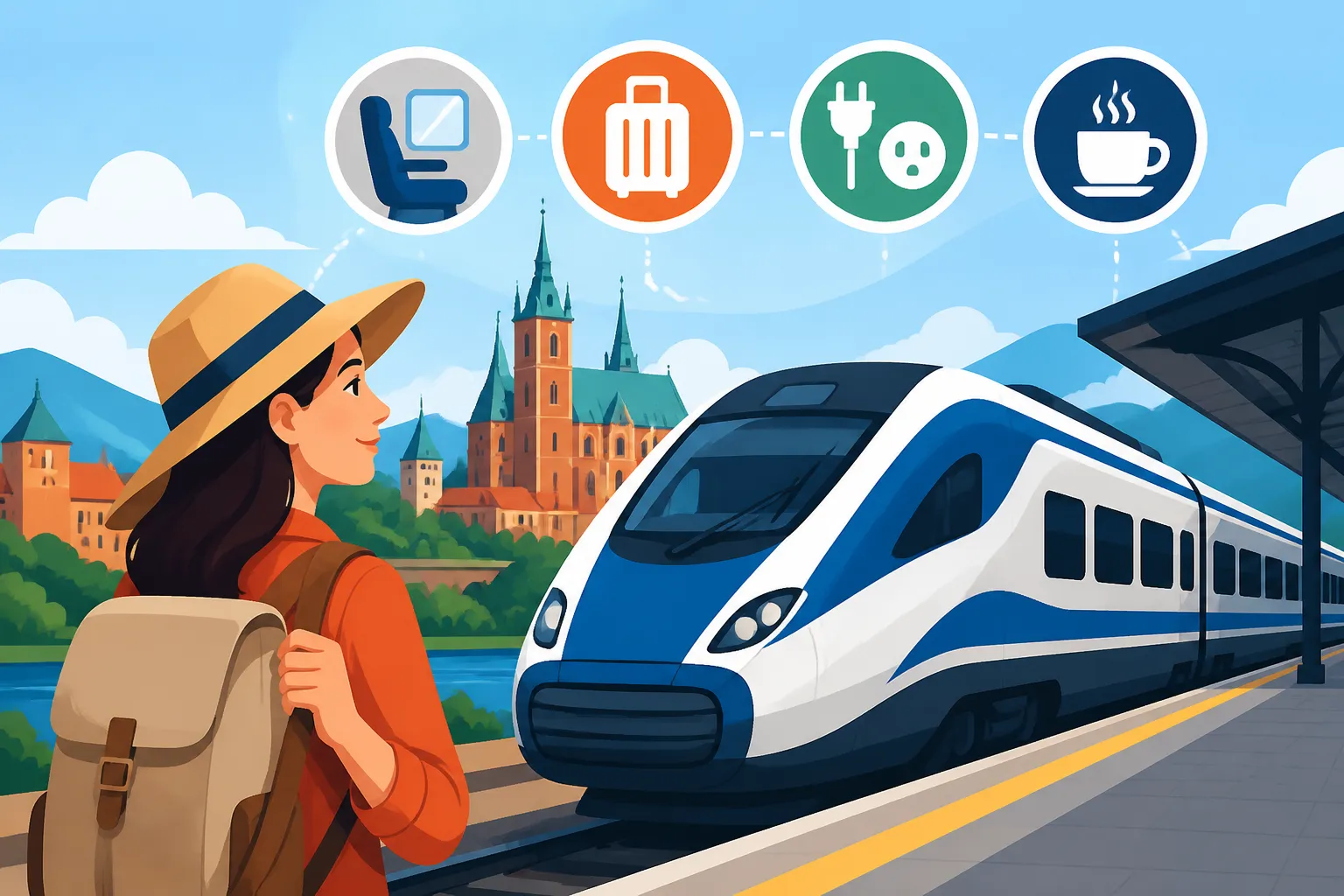
The amenities available will largely depend on the train category you've chosen. On EIP (Pendolino) and EIC trains, you can expect a very high standard. EIP trains, in particular, often include a complimentary snack and drink service in 1st class, and have a dedicated WARS dining car where you can purchase hot meals, snacks, and beverages. WARS is Poland’s historic railway catering service, and grabbing a hot cup of tea or a traditional schabowy (pork cutlet) while watching the scenery fly by is a quintessential Polish train experience. IC trains also often have WARS dining cars or at least a trolley service. TLK trains, being more basic, generally do not have dedicated dining facilities, so it’s wise to bring your own snacks and drinks for those journeys.
Wi-Fi availability varies. EIP trains usually boast good Wi-Fi, as do many newer EIC and IC carriages. However, don't rely on it being perfect or available on every single train, especially TLK services. Power sockets are increasingly common, particularly in 1st class and on newer rolling stock, allowing you to charge your devices. Again, it’s not guaranteed on all older TLK or IC trains, so come prepared with a power bank if staying connected is crucial. For guaranteed internet access, especially if you're working remotely or need constant connectivity, consider a portable Wi-Fi device or an eSIM from a provider like Airalo, which offers convenient data plans across Poland and beyond.
Day of Travel: From Station to Destination
The day of your journey can bring a mix of excitement and a touch of stress, especially if you’re navigating a new city’s train station. But armed with a little knowledge, you'll feel confident finding your way from the dworzec to your destination.
Understanding Polish Train Stations and Platforms
Polish train stations, or dworzec kolejowy, range from grand, historic buildings (like the beautiful main stations in Wrocław or Gdańsk) to more functional, modern structures. At larger stations, you'll typically find a main hall with ticket counters, waiting areas, shops, and sometimes restaurants. The most important thing to look for is the departure board, or rozkład jazdy. These electronic screens display essential information: train number, destination, departure time, and most crucially, the platform (peron) and track (tor) number. Always double-check these boards, even if you think you know your platform, as changes can occur.
Platforms themselves are generally well-signposted. Sometimes, one peron might have two tory (tracks), meaning trains can depart from either side. Pay close attention to which tor your train is leaving from. If you're unsure, don't hesitate to ask someone – many Poles, especially younger generations, are happy to help in English. Just point to your ticket and the departure board with a questioning look, and someone will often guide you. These stations are often central to cities, acting as key transport hubs, much like Understanding the Public Transport Ticket System in Polish Cities connects local transit networks.
Boarding Your Train and Finding Your Seat
Once you've located your platform and track, look for the train itself. On modern trains, especially EIP and EIC, there are electronic displays on the side of the carriages indicating the train number, destination, and often the carriage number. For older trains, you might need to look for a small sign or even ask a fellow passenger. Your ticket will have your carriage number (wagon) and seat number (miejsce). Carriages are usually numbered sequentially, but sometimes there can be a gap (e.g., no carriage 5, it jumps from 4 to 6).
Boarding is typically straightforward. Find your carriage, enter, and then look for your seat. Seats are usually clearly numbered. If you have a specific seat reservation for a TLK or IC train, and someone is in your seat, politely show them your ticket. Most people will move without issue. Don't be shy about it – you paid for that specific spot! Ensure your ticket is easily accessible, either printed or on your phone, as conductors will come through to check it shortly after departure. If you've booked on an app like Koleo, they will often generate a QR code that the conductor can scan directly.
Dealing with Delays and Cancellations
Ah, delays and cancellations – the bane of any traveler's existence. While Polish trains are generally reliable, issues do arise. Weather conditions (heavy snow in winter, thunderstorms in summer), technical faults, or unforeseen circumstances can cause delays. If your train is delayed, the departure boards will usually update with the new estimated departure time (przewidywany odjazd). Announcements are typically made in Polish and sometimes in English at major stations.
If a significant delay occurs (e.g., over 60 minutes), or if your train is cancelled, you usually have rights to compensation or alternative transport. For instance, PKP Intercity has a policy where you might be entitled to a refund or a percentage of your ticket price back, depending on the length of the delay. You'll need to fill out a claim form, often available online or at the ticket office. In case of a cancellation, go to the ticket office immediately; they should be able to rebook you on the next available train or offer a full refund. Always keep your ticket, even if it seems useless, as it's your proof of purchase for any claims. For expats learning the ropes of living in Poland, dealing with such administrative hurdles can feel similar to navigating How to Get Your PESEL Number and Why It Matters for Healthcare or other bureaucratic processes.
Common Challenges and Pro Tips for Expat Travelers
Even with the best intentions, things can sometimes get a little tricky. Being prepared for common expat challenges and having a few insider tips can make your Polish train adventures much smoother.
Language Barriers and Essential Phrases
While many younger Poles and service staff in major cities speak English, don't assume it everywhere. Especially in smaller stations or if you encounter an older conductor, a little Polish can go a long way. Here are a few phrases that might come in handy:
- "Dzień dobry" (Jen DOH-bri) – Good morning/day (always polite to start with this)
- "Bilet do [destination], proszę" ([BEE-let doh …, PRO-she]) – A ticket to [destination], please.
- "Jeden dorosły/dziecko" ([YEH-den do-ROS-wee/JEE-ets-ko]) – One adult/child.
- "O której odjeżdża?" ([O KTOO-rej od-YEZH-ja]) – What time does it depart?
- "Gdzie jest peron [number]?" ([GJEH yest PEH-ron…]) – Where is platform [number]?
- "Czy ten pociąg jedzie do [destination]?" ([Chy ten PO-chyong YED-je doh…]) – Does this train go to [destination]?
- "Przepraszam" ([Psheh-PRA-sham]) – Excuse me / Sorry.
- "Dziękuję" ([Jen-KOO-yeh]) – Thank you.
Even just attempting a few words shows respect and often elicits a more helpful response. Don't be afraid to use gestures and point to your ticket or the departure board. Patience and a friendly smile are universal translators.
Digital Tools and Apps to Make Life Easier
Embrace technology! Beyond the PKP Intercity website, apps like Koleo and Bilkom are invaluable. They not only let you book tickets but also provide real-time updates on train movements, track changes, and potential delays. These apps are often much quicker to update than the static departure boards, and they can be a lifesaver when you're caught in a last-minute platform change.
For navigating public transport to and from the train station, apps like Jakdojade are excellent for local connections, covering buses, trams, and metro in major Polish cities. And, of course, for staying connected throughout your journey, especially if you're traveling through areas with patchy mobile signal, having an eSIM from a provider like Airalo ensures you always have data for your planning and communication needs. Many expats find these tools essential for their daily commute and for long-distance travel, much like understanding How to Set Up Home Internet and TV in Poland is crucial for staying connected at home.
Security and Safety on Polish Trains
Overall, train travel in Poland is very safe. However, like anywhere, it pays to be vigilant. Keep an eye on your belongings, especially when placing luggage in overhead racks or dedicated storage areas. Don't leave valuables unattended, and be particularly careful with your phone or wallet in crowded carriages or stations. While rare, petty theft can occur.
In sleepers or overnight trains, ensure your compartment door is locked. If you're traveling solo at night, consider booking a seat in a busier carriage. If you ever feel unsafe or witness anything suspicious, don't hesitate to inform the conductor (konduktor). They are usually easily identifiable by their uniform and are there to help. Remember, your personal safety is paramount, and a proactive approach ensures a worry-free journey.
Planning Beyond PKP Intercity: Connecting Your Journey
While PKP Intercity handles the long hauls, Poland's diverse rail network means you'll often need to connect with other services to reach your final destination. Understanding how these pieces fit together is key to seamless travel across the country.
Integrating Local and Regional Trains
PKP Intercity is fantastic for getting you between major cities, but once you arrive, you might need a local train to reach a smaller town or a specific district within a larger metropolitan area. This is where regional carriers come in. Each voivodeship often has its own regional train operator – for example, Koleje Mazowieckie around Warsaw, Koleje Dolnośląskie in Lower Silesia (Wrocław area), Koleje Małopolskie around Krakow, or Arriva RP in some northern regions.
These regional trains operate on different ticketing systems than PKP Intercity, although some third-party apps like Koleo can handle tickets for both. You'll typically buy tickets for regional services at separate ticket counters, dedicated machines, or sometimes directly from the conductor onboard (though this might incur a small surcharge, so check first). These trains often run more frequently and make more stops, akin to a suburban commuter service. Integrating these local legs into your journey plan ensures you can reach almost any corner of Poland efficiently. Think of it as linking your cross-country journey with your daily Understanding the Public Transport Ticket System in Polish Cities experience.
International Connections from Poland
PKP Intercity also plays a role in Poland's international rail connections. From major Polish cities, you can catch direct international trains to neighboring countries like Germany (Berlin), Czech Republic (Prague), Slovakia (Bratislava), Austria (Vienna), Hungary (Budapest), and even further afield. These international routes are often operated in cooperation with the national rail operators of the destination country. For instance, the EuroCity (EC) trains linking Poland with Germany and the Czech Republic are high-standard international services.
Booking international tickets can often be done through the PKP Intercity website or through the websites of partner railway companies (e.g., Deutsche Bahn for Germany, České dráhy for Czech Republic). It’s crucial to book international tickets well in advance for the best prices and availability, especially for sleeper services or popular routes. These connections make Poland an excellent base for exploring Central and Eastern Europe by rail, offering a convenient and often scenic alternative to flying. For expats who enjoy exploring, these international links open up a world of weekend getaways and adventures.
| PKP Intercity Train Category | Speed | Comfort Level | Onboard Amenities | Typical Cost | Key Features |
|---|---|---|---|---|---|
| TLK (Twoje Linie Kolejowe) | Moderate | Basic | Limited (some WARS trolley) | Low | Most stops, older carriages, budget-friendly. |
| IC (InterCity) | Moderate-Fast | Standard | WARS dining car/trolley, AC | Medium | Good balance of speed and comfort, modernizing fleet. |
| EIC (Express InterCity) | Fast | High | WARS dining car, AC, power sockets, Wi-Fi (select) | High | Fewer stops, premium service, comfortable seating. |
| EIP (Express InterCity Premium – Pendolino) | Very Fast | Premium | WARS dining car, complimentary snacks/drinks (1st class), power sockets, Wi-Fi | Highest | High-speed, modern design, very few stops, mandatory reservation. |
Disclaimer
Please note that while we strive to provide the most accurate and up-to-date information, rules, regulations, and services related to train travel in Poland, including ticket pricing, discounts, and amenities, can change. Always verify the latest information directly with PKP Intercity or through official booking channels before making your travel plans. This guide is intended for informational purposes only and does not constitute official legal or travel advice.